


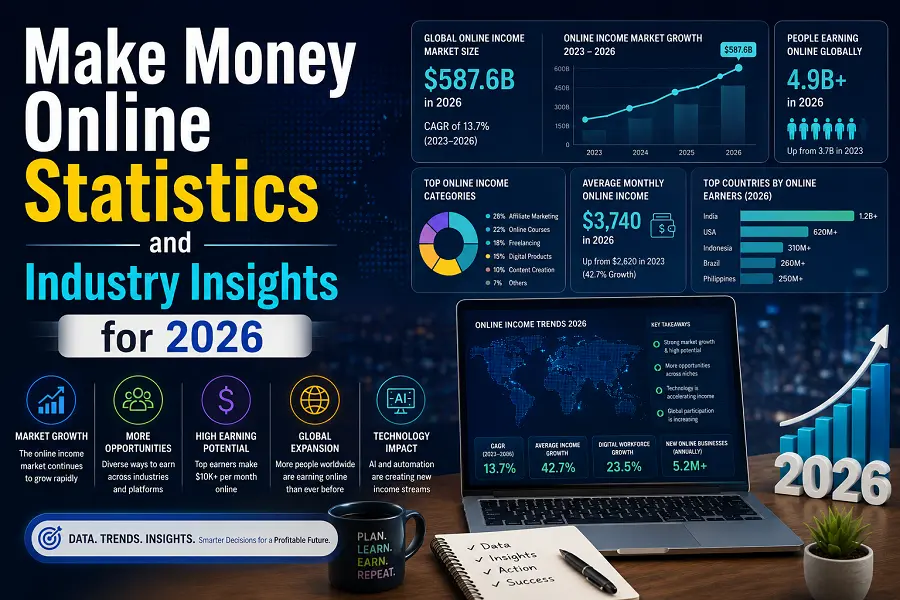
The online income landscape has matured significantly. What began as a fringe concept — earning a living from a laptop, anywhere in the world — is now a mainstream economic reality. Millions of people generate their primary income online, and millions more supplement traditional employment with digital revenue streams that didn’t exist a decade ago.
The numbers behind this shift reveal not just how large the opportunity has become, but where it’s concentrating, which models are sustaining, and what the data says about realistic outcomes across different approaches.
The Digital Economy Has Reached a Scale That Demands Attention
The global digital economy is no longer a subset of the broader economy — it’s increasingly the engine driving it. E-commerce alone accounts for a substantial and still-growing share of total retail sales worldwide, with mobile commerce representing the fastest-growing segment within that category.
The freelance and independent work sector tells a parallel story. The number of people earning income through freelance platforms, direct client relationships, and project-based digital work has grown consistently year over year. A significant percentage of the workforce in developed economies now earns some portion of their income outside traditional employment structures — a figure that has risen every year since remote work normalized at scale.
Key figures defining the current digital economy landscape:
- Global e-commerce revenue continues to expand, with cross-border sales growing at roughly double the rate of domestic online retail
- The creator economy — encompassing content creators, newsletter writers, podcast producers, and educators — is estimated to involve tens of millions of active participants globally
- Remote and location-independent workers now represent a permanent structural feature of the labor market, not a pandemic-era anomaly
- Digital product sales, including software, courses, templates, and downloadable assets, have become one of the highest-margin online income categories due to near-zero marginal cost per unit sold
- Affiliate marketing spending by brands continues to grow as performance-based marketing demonstrates more measurable ROI than impression-based alternatives
These figures aren’t ceiling numbers — they represent current baselines from which continued growth is projected across most categories.
Freelancing Platforms Have Restructured How Skills Are Monetized
The traditional career model exchanged specialized skills for a salary inside a single organization. Freelancing platforms have disaggregated that exchange — allowing skilled individuals to sell specific capabilities to multiple clients simultaneously, often across geographic boundaries that would have been impractical to cross in a pre-digital labor market.
The statistics reveal several important patterns about how this market actually functions:
- Skill premium concentration — top earners in freelance markets earn disproportionately more than median earners; the market rewards specialization and demonstrated track records more than general availability
- Platform diversification — experienced freelancers rarely depend on a single platform; maintaining presence across multiple marketplaces reduces income volatility and increases inbound opportunity
- Direct client relationships outperform platform work long-term — freelancers who convert platform clients to direct relationships consistently report higher rates, lower fees, and more stable income than those who remain platform-dependent
- Writing, design, and development dominate volume — these three skill categories account for the majority of freelance transactions, though specialized technical fields like AI prompt engineering, data analysis, and cybersecurity consulting show the fastest rate growth
- Geographic arbitrage remains significant — freelancers in lower cost-of-living regions offering services to clients in higher cost-of-living markets achieve purchasing power parity advantages that make mid-tier platform earnings genuinely competitive with local professional salaries
The freelance market rewards those who treat it as a business — investing in positioning, client relationships, and skill development — rather than those who treat it as a job board.
E-Commerce Models Are Diverging Between Scale and Specialization
The e-commerce landscape in 2026 is not monolithic. Two distinct and equally viable paths have emerged, each with different capital requirements, margin profiles, and competitive dynamics.
The scale path — pursued by sellers operating on major marketplaces with high-volume, low-margin products — requires sophisticated logistics, advertising optimization, and supply chain management. Margins are thin, competition is intense, and the operational complexity is substantial. Success in this model depends heavily on systems and data.
The specialization path — pursued by sellers operating their own stores or niche marketplaces with curated, differentiated, or handcrafted products — trades volume for margin and marketplace dependency for audience ownership. Direct-to-consumer brands with genuine product differentiation and loyal audiences consistently outperform commodity sellers on profitability metrics even at significantly lower revenue levels.
Statistics that illuminate where e-commerce opportunity is concentrating:
- Customer acquisition costs on major marketplaces have risen substantially as competition for advertising placement has intensified — compressing margins for undifferentiated products
- Email list ownership correlates strongly with e-commerce profitability; sellers with direct customer relationships report higher repeat purchase rates and lower dependence on paid traffic
- Subscription and replenishment models within e-commerce show significantly higher lifetime customer value than one-time purchase models across comparable product categories
- Social commerce — purchasing driven by content on video and social platforms — is growing faster than traditional search-driven e-commerce, shifting where product discovery happens
Content Creation Economics Have Matured Beyond Ad Revenue
The early content creator economy ran almost entirely on advertising revenue — views and page impressions converted to income through platform ad programs. That model hasn’t disappeared, but it has been eclipsed by more sophisticated monetization structures that have dramatically improved creator economics.
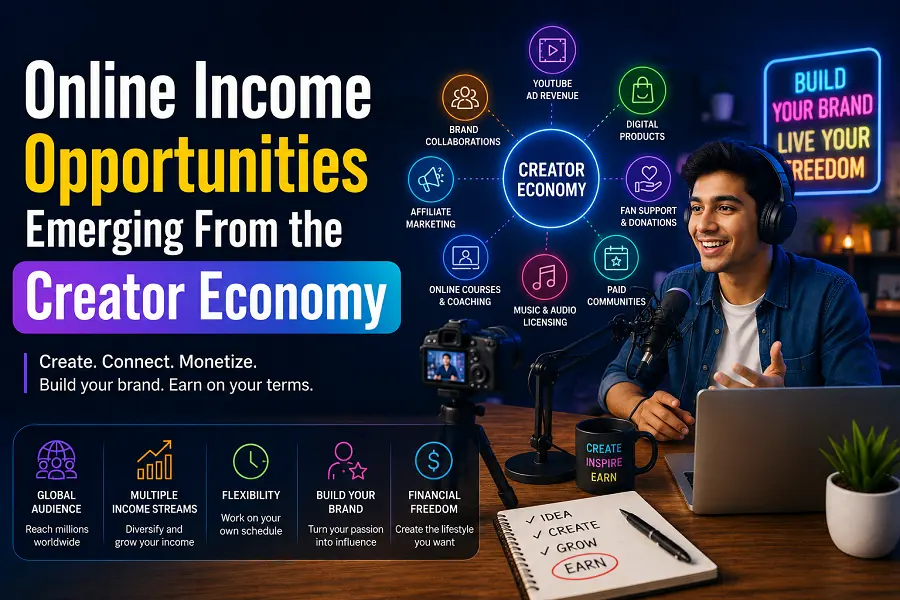
The creators generating sustainable income in 2026 typically operate across multiple revenue streams rather than depending on any single source:
- Direct audience monetization through memberships, subscriptions, and exclusive content platforms has become the most reliable income base for mid-tier creators with engaged audiences
- Digital products — courses, templates, presets, ebooks, and software tools created once and sold repeatedly — represent the highest-margin category available to most creators
- Brand partnerships and sponsorships have shifted toward longer-term relationships with fewer brands rather than one-off sponsored posts, producing more predictable income for creators and more meaningful audience exposure for brands
- Licensing and syndication of original content to media organizations, platforms, and brands provides passive income from work already created
- Consulting and services derived from demonstrated public expertise give creators a high-ticket income layer that requires no additional content production
The statistics consistently show that creators who treat their audience as an asset to own — building email lists and direct relationships rather than depending entirely on platform algorithms — achieve significantly higher income stability than those whose revenue is entirely algorithm-dependent.
Conclusion
The make money online landscape in 2026 is neither a gold rush nor a myth. It is a mature, segmented, and increasingly competitive economic environment where the people generating sustainable income share identifiable characteristics: they specialize rather than generalize, they build direct audience relationships rather than platform dependency, they diversify revenue streams rather than betting on a single model, and they treat their online income activity as a business rather than a side experiment.
The statistics support one conclusion above all others: the online income opportunity is real, substantial, and accessible — but the gap between those who approach it strategically and those who approach it casually is wide, measurable, and growing.
FAQs
1. How large is the make money online industry in 2026?
The digital economy encompasses trillions in annual economic activity across e-commerce, freelancing, content creation, digital products, and affiliate marketing. While precise figures vary by how the category is defined, the consistent trend across all segments is continued growth — with mobile commerce, creator economy monetization, and digital product sales showing the fastest expansion rates.
2. What is the most reliable way to make money online in 2026?
Freelancing with a specialized, in-demand skill set consistently produces the most reliable near-term income for people entering the online economy. It requires no upfront capital, produces income relatively quickly after establishing a track record, and scales with skill development and client relationship building over time.
3. How much do content creators actually earn on average?
Creator earnings follow a steep distribution curve. A small percentage of creators earn substantial incomes while the majority earn modestly or nothing from content alone. The differentiating factor for those in the sustainable earning tier is almost always multiple monetization streams — particularly direct audience monetization and digital products — rather than dependence on platform ad revenue.
4. Is e-commerce still a viable online income model given increased competition?
Yes, but the model matters enormously. High-volume commodity selling on major marketplaces faces intense competition and compressed margins. Differentiated direct-to-consumer brands with genuine product uniqueness, owned audiences, and subscription or replenishment models continue to perform strongly. The opportunity has shifted from volume to differentiation.
5. What separates people who successfully make money online from those who don’t?
Consistency, specialization, and business thinking are the factors that most reliably separate sustainable earners from those who don’t achieve traction. Successful online earners treat their activity as a business — investing in skill development, audience building, and multiple revenue streams — rather than pursuing quick income methods that rarely produce durable results.






Leave a Reply