


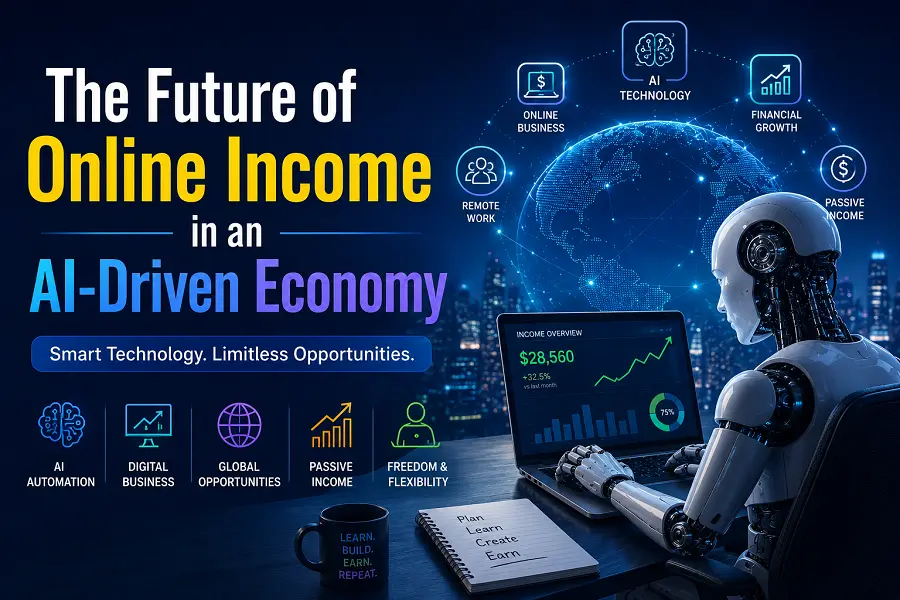
Every major technological shift reorganizes who earns what and how. The printing press redistributed knowledge creation. Industrialization restructured labor. The internet disaggregated distribution. Artificial intelligence is doing something more fundamental than any of these predecessors — it’s restructuring the economics of cognitive work itself.
For the millions of people who earn income online, this isn’t an abstract observation. It’s a pressing practical question: which income models survive AI disruption, which ones get stronger because of it, and what does building sustainable digital income look like when the baseline capability of any individual has been permanently elevated?
The Income Models AI Is Disrupting Most Severely
Honest assessment of AI’s impact on online income requires identifying where disruption is already severe rather than speculating about distant futures. Several income categories that supported large numbers of online earners are under genuine structural pressure right now.
Generic content production is the most obvious casualty. Article writing, basic copywriting, and templated content creation — work that once provided reliable freelance income for writers without deep specialization — has been largely automated. Platforms that once paid reasonable rates for competent general writing have either reduced rates dramatically or shifted to AI-assisted production entirely.
Entry-level data work faces similar pressure. Basic data entry, simple research tasks, and routine data formatting — once accessible income for people building online careers — are being automated at the task level faster than new equivalent opportunities are appearing.
Basic customer service and response work has been substantially absorbed by AI systems capable of handling the majority of routine inquiries without human involvement.
The pattern across disrupted categories is consistent: work that was defined primarily by volume, consistency, and rule-following rather than judgment, creativity, or relationship is the most vulnerable. This isn’t a prediction — it’s a description of what has already happened.
The Income Models AI Is Making Significantly Stronger
Disruption rarely destroys value uniformly. The same AI capabilities that are compressing some income categories are simultaneously amplifying others in ways that create substantial new earning potential for people positioned to take advantage.
Deep expertise has become more valuable, not less. When AI handles baseline competence in most knowledge domains, the premium for genuine depth — the kind of understanding that comes from years of focused practice and real-world application — increases rather than decreases. A generalist writer competing with AI output faces existential pressure. A subject-matter expert using AI to produce at scale in their domain of genuine authority occupies an entirely different competitive position.
Human judgment in high-stakes contexts carries a premium that AI cannot currently erode. Legal strategy, medical decision-making, financial planning for complex situations, architectural design, and organizational leadership all involve consequence and accountability that clients and institutions are not ready to delegate to autonomous systems. The income ceiling in these domains is rising because AI handles the volume work, freeing human experts for the highest-value engagements.
Relationship-based income — coaching, consulting, mentorship, advisory work — is structurally resistant to AI displacement because the value often isn’t primarily informational. Clients pay for access to a specific person’s perspective, accountability, challenge, and connection. AI can inform; it cannot yet replace the human relational dynamic that makes coaching and advisory work transformative for clients.
Creative direction and taste-making occupy a similar position. The ability to determine what should be made, what aesthetic choices serve a specific audience, and what creative vision is worth executing remains a distinctly human contribution — even as AI handles increasing portions of production execution.
New Income Categories That Didn’t Exist Before AI
Beyond the reshuffling of existing income models, AI is creating genuinely new earning categories that have no meaningful pre-AI equivalent.
AI system design and prompt engineering for specific business contexts has become a billable professional skill. Organizations need people who understand how to architect AI workflows, write effective system prompts, evaluate model outputs, and build reliable AI-assisted processes. This work requires domain expertise combined with AI fluency — a combination that remains scarce enough to command strong rates.
AI output evaluation and quality assurance is emerging as a distinct professional function. As organizations deploy AI at scale, they need humans who can evaluate whether outputs meet quality standards, identify systematic errors, and provide the feedback that improves system performance over time. This is specialized judgment work that cannot itself be fully automated.
AI training data creation — producing high-quality examples, annotations, and specialized content that improves model performance in specific domains — represents a category where domain expertise translates directly into earning potential that scales with AI development investment.
Human authentication and verification is an emerging category driven by the inverse of AI capability. As AI-generated content, synthetic media, and automated interactions become ubiquitous, the verified human perspective, human-created work, and human relationships carry a scarcity premium that is only beginning to be monetized.
What Building Sustainable Online Income Looks Like Going Forward
The strategic principles that produce durable online income in an AI-driven economy look different from those that worked in the previous era. Several shifts are worth internalizing explicitly.
Depth over breadth has become the dominant strategic principle. The generalist who knows a little about many things faces direct competition from AI systems that know a great deal about everything at baseline competence. The specialist with irreplaceable depth in a specific domain faces no such competition — AI makes them more productive without threatening their position.
Audience ownership matters more than ever. When AI can generate unlimited content on any topic, distribution and trust become the scarce resources. An owned audience that trusts a specific human voice has something AI cannot replicate — a relationship built through demonstrated expertise and consistent delivery over time. That relationship is the defensible asset around which sustainable income is built.
Multi-stream income structures reduce exposure to disruption in any single category. Online earners who depend on one income source — one platform, one client type, one revenue model — face concentrated risk in an environment where individual categories can shift rapidly. Combining consulting income with digital product revenue with community membership fees creates resilience that single-stream models cannot provide.
Continuous skill investment is no longer optional maintenance — it’s the active cost of remaining competitive. The half-life of specific online income tactics has shortened significantly in an AI-accelerated environment. Practitioners who treat learning as ongoing operational investment rather than periodic upkeep maintain positioning that those who coast on existing skills gradually lose.
Conclusion
The future of online income in an AI-driven economy is neither uniformly bright nor uniformly threatening — it’s deeply dependent on positioning. The people who will thrive are those who use AI as infrastructure rather than compete with it as a service provider, who build depth rather than breadth, who own their audiences rather than rent algorithmic distribution, and who combine human judgment with AI capability in ways that produce outcomes neither could achieve alone.
The online income opportunity hasn’t shrunk — in many respects it has expanded. But the map of where that opportunity lives has been redrawn, and navigating by the old map leads somewhere different than intended.
FAQs
1. Which online income models are most at risk from AI disruption?
Generic content production, basic data work, entry-level research tasks, and routine customer service have experienced the most severe disruption already. These categories share a common characteristic — they were defined primarily by volume and consistency rather than judgment, creativity, or human relationship — making them most susceptible to automation.
2. What types of online income are becoming more valuable in an AI economy?
Deep domain expertise, high-stakes human judgment, relationship-based services like coaching and consulting, and creative direction are all strengthening. These categories involve consequence, accountability, and human connection that clients and institutions are not delegating to AI systems — and the premium for genuine human expertise in these areas is rising as AI handles baseline competence.
3. What new online income categories has AI created?
AI workflow design, prompt engineering for specific business contexts, AI output evaluation and quality assurance, training data creation for specialized domains, and human authentication services are all genuinely new earning categories with no meaningful pre-AI equivalent. Each rewards domain expertise combined with AI fluency.
4. How should someone future-proof their online income strategy?
Build depth in a specific domain rather than breadth across many. Own your audience through email lists or communities rather than depending on platform algorithms. Develop multiple revenue streams to reduce exposure to disruption in any single category. Treat skill investment as ongoing operational cost rather than periodic maintenance.
5. Will AI eventually replace most online income opportunities?
The evidence suggests AI will continue restructuring online income categories rather than eliminating the opportunity entirely. The categories that survive and grow are those where human judgment, relationship, creativity, and accountability add value that clients genuinely require from a human — not just from a capable system. The opportunity shifts rather than disappears, but the shift is significant enough to require active repositioning rather than passive adaptation.








Leave a Reply