


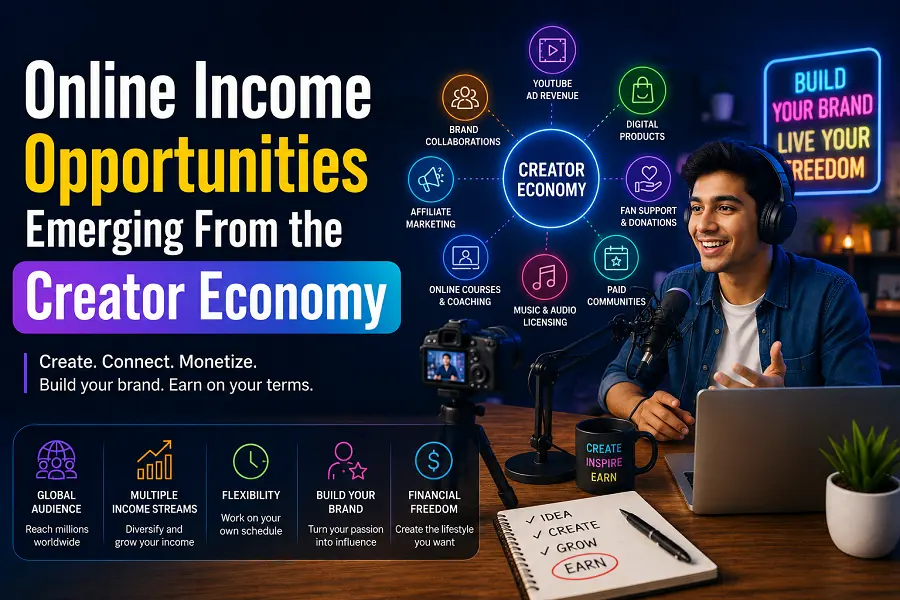
The creator economy has quietly become one of the most significant labor market developments of the past decade. What started as a handful of YouTubers and bloggers earning advertising revenue has evolved into a complex, multi-billion dollar ecosystem supporting millions of people who build income around knowledge, creativity, and audience relationships.
The opportunities available to creators in 2026 look fundamentally different from those that defined the first generation of the creator economy. The advertising-dependent model that once dominated has been largely supplanted by diversified income structures that are more sustainable, more profitable, and less dependent on platform goodwill.
Niche Authority Has Become the Creator Economy’s Most Valuable Currency
The early creator economy rewarded scale — the more views, subscribers, and followers, the more advertising revenue flowed. That model created incentives for broad appeal over genuine depth, producing enormous amounts of content optimized for reach rather than value.
The economics have inverted. Niche authority — deep credibility within a specific, well-defined subject area or professional community — now generates higher income per audience member than broad general content ever achieved. A creator serving ten thousand highly engaged professionals in a specialized field consistently outperforms a general creator with one hundred thousand passive followers across virtually every meaningful monetization metric.
The mechanisms driving this inversion are straightforward. Niche audiences convert to paid products at higher rates because the creator’s work directly addresses problems they actively need solved. Brand partnerships with niche creators command higher rates per engaged audience member because advertisers value targeted reach over raw impression volume. Community memberships in niche spaces retain subscribers longer because members feel the specificity of their professional or personal identity reflected in the content.
The practical implication for aspiring creators is counterintuitive: going narrower increases earning potential rather than limiting it. The creator who serves “marketers at B2B software companies” is better positioned than the creator who serves “anyone interested in marketing.”
Direct Monetization Models Have Displaced Advertising as the Primary Revenue Engine
Platform advertising revenue was always a fragile income foundation — dependent on view counts that algorithm changes could eliminate overnight and rates that platform economics dictated unilaterally. The creator economy’s maturation has produced a far more robust set of direct monetization models that put income control back in the creator’s hands.
The direct monetization landscape in 2026 spans several distinct approaches, each with different audience requirements and income profiles:
- Paid newsletters and subscription content — recurring fees for exclusive written content delivered directly to subscribers, bypassing platform algorithms entirely and creating income that correlates with audience trust rather than view counts
- Course and educational product sales — structured learning experiences that package creator expertise into a format buyers can engage with at their own pace, generating revenue that isn’t tied to ongoing content production after the initial creation
- Membership communities — recurring access fees for curated communities where the creator’s presence, curation, and facilitation are the primary value drivers alongside member-to-member connection
- Cohort-based programs — live, time-bound learning experiences that command premium pricing by combining educational content with direct creator access and peer accountability structures
- Consulting and advisory services — high-ticket engagements where demonstrated public expertise converts directly into client relationships, often requiring fewer clients than any other monetization model to generate substantial income
The creators building the most stable income structures combine two or three of these approaches rather than optimizing any single one — creating income layers that reinforce each other without competing for the same audience attention.
The Syndication and Licensing Opportunity Most Creators Overlook
Content created for one audience in one format has commercial value beyond its original context. Licensing and syndication — selling the rights to use existing content in new contexts — represents a significant income opportunity that most creators never activate.
Original research, frameworks, and methodologies developed by creators with genuine expertise are regularly sought by media organizations, corporate training programs, conference organizers, and educational institutions. The creator who has developed a distinctive approach to a professional problem has an asset with commercial value beyond the audience that discovered it organically.
The syndication opportunity takes several practical forms. Written content can be licensed to industry publications seeking expert perspectives. Video content can be licensed for corporate training libraries. Frameworks and methodologies can be packaged as licensed curriculum for professional education programs. Podcast content can be licensed for private networks serving corporate or professional audiences.
What makes licensing attractive is its economic structure — it generates revenue from work already completed without requiring additional production. The marginal cost of licensing existing content is essentially the time required to identify, negotiate, and deliver to licensing partners. For creators with established bodies of work in specific domains, this represents a revenue activation of an existing asset rather than creation of a new one.
AI Tools Are Creating New Creator Income Categories
The intersection of creator expertise and AI capability is producing income opportunities that didn’t exist in meaningful form two years ago. Creators with deep knowledge in specific domains are finding that their expertise translates into AI-related products and services that command strong market interest.
Prompt libraries built around specific professional workflows — curated, tested collections of AI instructions optimized for particular use cases — have become legitimate commercial products for creators with relevant domain expertise. A creator who deeply understands a specific professional field can build and sell prompt systems that allow practitioners in that field to use AI tools far more effectively than they could independently.
AI-assisted content products represent another emerging category. Creators who understand how to combine AI production capability with genuine editorial judgment and domain expertise are producing research reports, market analyses, and specialized content products that deliver more value than either pure AI output or traditional manual production could achieve at equivalent cost.
Teaching AI application within specific professional contexts has become a high-demand educational category. Professionals in every industry are trying to understand how AI tools apply to their specific workflow context — and creators with both domain expertise and AI fluency are uniquely positioned to serve this demand through courses, workshops, and consulting engagements.
Brand Partnership Economics Have Shifted Toward Long-Term Relationships
The sponsored post model — a brand pays a creator for a single piece of content mentioning their product — still exists but increasingly represents the low end of creator-brand commercial relationships. The partnership structures generating the strongest income for established creators in 2026 look substantially different.
Long-term brand ambassadorships provide creators with predictable recurring income in exchange for sustained, authentic integration of a brand into their content over months rather than individual posts. These relationships work better for brands because consistent exposure builds genuine audience familiarity rather than one-time awareness. They work better for creators because predictable income enables better content planning and the relationship allows for more authentic integration than transactional one-off sponsorships typically produce.
Co-created products represent the most sophisticated end of the creator-brand relationship spectrum. Rather than a creator promoting an existing brand product, both parties develop something new together — typically a product or limited collection that carries both the brand’s production capability and the creator’s audience credibility. Revenue sharing arrangements in these structures can significantly exceed what advertising or ambassadorship deals produce for creators with substantial audience trust.
Performance-based partnership structures are also gaining ground — arrangements where creator compensation scales with actual conversions rather than fixed fees. For creators confident in their audience’s responsiveness, these arrangements can generate substantially higher total income than flat-fee alternatives when products genuinely serve their audience’s needs.
Conclusion
The creator economy income opportunities available in 2026 reward a different set of qualities than those that drove success in the first generation of the space. Niche authority outperforms mass appeal. Direct monetization outperforms advertising dependency. Licensing activates value from existing assets. AI fluency opens new product categories. Long-term brand relationships outperform transactional sponsorships.
The common thread across every category gaining ground is the primacy of genuine expertise and trusted audience relationships. Creators who have built real knowledge and real connection with a specific audience possess assets that compound in value over time — and the income opportunities available to them in 2026 reflect that compounding more clearly than at any previous point in the creator economy’s development.
FAQs
1. What is the most important factor for success in the creator economy in 2026?
Niche authority consistently outperforms broad reach across every meaningful income metric. Creators with deep credibility in a specific domain convert audiences to paid products at higher rates, command stronger brand partnership rates, and retain community members longer than generalist creators with larger but less engaged followings.
2. How have direct monetization models changed creator income?
Direct monetization — paid newsletters, courses, memberships, cohort programs, and consulting — has largely displaced advertising as the primary income engine for serious creators. These models produce income that correlates with audience trust rather than platform algorithm performance, giving creators substantially more control over their revenue than advertising dependency ever allowed.
3. What is content licensing and how can creators activate it?
Content licensing involves selling rights to use existing creator content — frameworks, research, methodologies, written work, or video — in new commercial contexts like corporate training, media publication, or professional education. It generates revenue from completed work without additional production, representing an income activation of an existing asset rather than creation of something new.
4. How are AI tools creating new income opportunities for creators?
Creators with domain expertise are building commercial products around AI application in their specific fields — prompt libraries for professional workflows, AI-assisted research and analysis products, and educational content teaching AI application in specific professional contexts. These categories reward the combination of genuine domain knowledge and AI fluency that pure AI systems and pure domain experts each lack independently.
5. What makes long-term brand partnerships more valuable than single sponsored posts?
Long-term brand ambassadorships provide creators with predictable recurring income while enabling more authentic content integration than transactional sponsorships produce. Co-created product arrangements at the premium end of creator-brand relationships can generate income that significantly exceeds what advertising deals offer, while performance-based structures reward creators whose audiences demonstrate strong responsiveness to relevant product recommendations.





Leave a Reply