


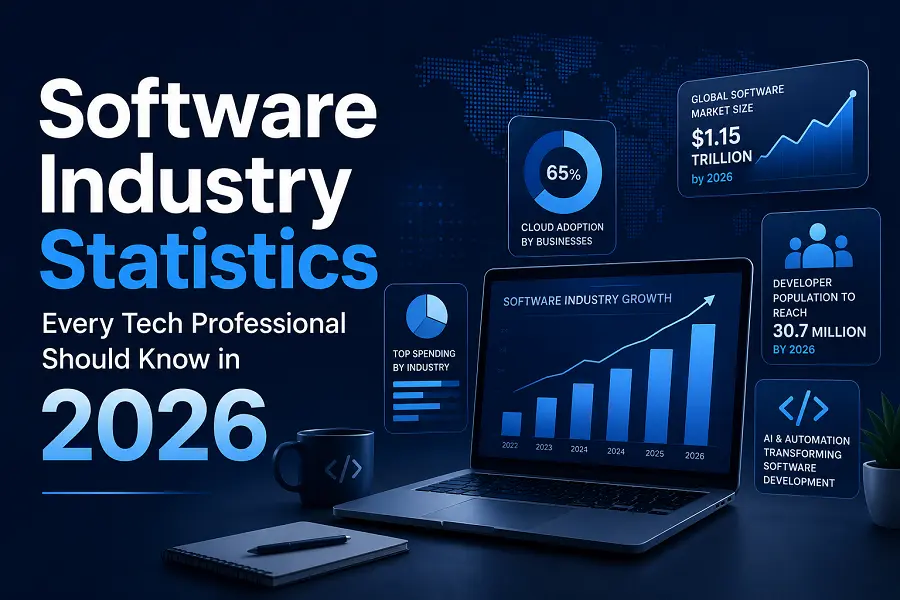
The software landscape is shifting rapidly under the weight of massive economic, infrastructural, and intelligent technological changes. For technology professionals, keeping up with these shifts is no longer about learning the next hot framework—it is about understanding structural baseline metrics that dictate project funding, architecture choices, and engineering productivity. Navigating this ecosystem with clarity requires an inspection of concrete numbers shaping reality today.
Global Market Expansion and Resource Allocation
The total global software market spending is projected to reach $1.43 trillion this year. This aggressive fiscal expansion underlines a fundamental truth: software has moved from a supportive business tool to the primary driver of corporate operations. Large enterprises represent 55% of this ecosystem, relying heavily on deeply integrated enterprise resource planning and customer relationship management infrastructures.
The remaining 45% of the market is actively sustained by small and medium-sized enterprises. These smaller operations are rapidly increasing their cloud budgets to match the agility of larger competitors, pulling down historical barriers to entry.
-
Regional Dominance: North America maintains the largest single market share at 38%, closely tracked by the Asia-Pacific region, which remains the fastest-growing geographical market with an estimated compound annual growth rate of over 12%.
-
Segment Breakdown: Productivity software commands the single largest portion of market share at 32%, followed by enterprise software at 28%, and application development tools at 22%.
-
Infrastructure Shifting: Systems infrastructure software, including virtualization layers and middleware, holds an 18% share, driven heavily by hybrid architectural upgrades.
The Pragmatic Evolution of Automation and Engineering Tools
The technical environment has evolved past early experimental cycles into a period of deep operational integration. Developer toolkits are seeing a massive overhaul, primarily focused on mitigating operational overhead and cutting down long delivery cycles.
-
AI Coding Assistance: Roughly 51% of professional developers now use intelligent code completion and generation tools every single day, with 65% interacting with them at least weekly to automate boilerplate logic and initial unit tests.
-
Autonomous Operations: A sharp rise in multi-agent systems means 40% of enterprise applications are on track to integrate task-specific autonomous agents by the end of December.
-
Low-Code Proliferation: Low-code and no-code platforms are moving from minor business workflows to core architectures, with projections indicating these platforms will power 75% of new application developments before next year.
-
The Rise of Alternative Languages: Memory safety and raw performance needs have propelled alternative system languages like Rust into critical pipeline frameworks, establishing a baseline shift away from historically standard codebases.
Security Architecture and Cloud Sovereignty
As software footprints expand, systemic protection models are adapting out of pure necessity. Ransomware and sophisticated double-extortion tactics now constitute 59% of system breaches, changing how engineering departments budget their deployments.
Security is moving entirely to the left of the pipeline, transitioning from a pre-production deployment checklist item to a fully automated continuous integration rule. Over 90% of enterprises use multi-cloud strategy architectures to maintain strict compliance, prevent vendor lock-in, and preserve systemic resilience.
Furthermore, data privacy during execution has catalyzed a shift toward confidential computing. Projections indicate 75% of data processing workloads in untrusted cloud environments will adopt this specialized silicon-level protection layout to protect operational metrics from outside extraction.
Conclusion
Succeeding in the modern software sector demands an objective view of where resources are migrating. Development velocity is accelerating via automated tooling, while simultaneously balancing against high security architectures and structured data constraints. Tech professionals who balance their technical roadmaps against these specific distribution scales will position their infrastructure to build resilient, cost-effective, and highly competitive tools.
FAQs
What programming language is seeing the fastest adoption for infrastructure software?
Rust is experiencing massive adoption rates for underlying infrastructure due to its built-in memory safety guarantees and performance comparable to older languages like C++. It is increasingly used to design secure operating systems, web engines, and analytical engines.
How are AI agents altering traditional enterprise application workflows?
AI agents are transitioning applications from passive data silos to proactive operational workflows. Instead of humans executing manual data transfers, automated agents are coordinating multi-tier tasks, handling real-time data syncs, and solving simple systemic anomalies autonomously.
Why is confidential computing becoming a baseline standard for cloud engineering?
Confidential computing addresses a historic vulnerability by sealing data inside hardware-based enclaves while it is being actively computed. This standard prevents cloud providers, adjacent host users, or intruders from viewing active memory pools during processing cycles.
What is driving the large market share of productivity and enterprise software?
Organizations are centralizing their operations into unified digital ecosystems. Modern workflow automation, custom supply chain management integrations, and real-time document sync tools require substantial subscription and maintenance investments, swelling their market capitalization.
Are low-code tools replacing traditional software engineers?
No, low-code platforms are expanding the creation pool by letting non-technical staff automate basic operational tasks. This democratization relieves engineering teams from building internal tooling, allowing professional developers to focus on high-complexity backends and secure architectures.





Leave a Reply