


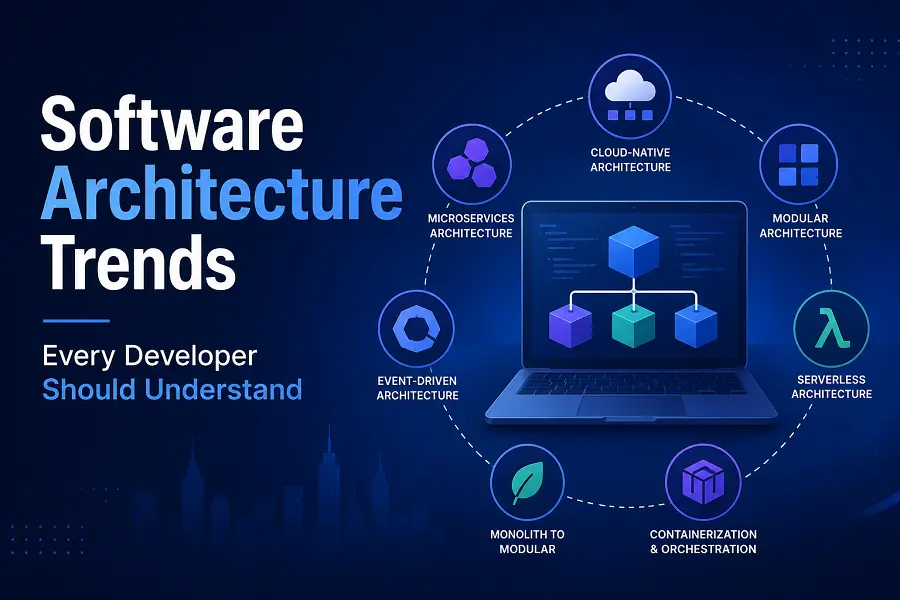
The way we build software is shifting. Driven by cloud-native scaling, data complexity, and the demand for instant system responses, modern software architecture has evolved far beyond traditional monolithic frameworks. For developers, keeping pace is no longer just about learning new programming languages; it requires a foundational shift in how we structure, decouple, and deploy applications.
To build resilient, future-proof systems, engineering teams must master a new set of design patterns. Here are the defining software architecture trends that are shaping production environments today.
1. Event-Driven Architecture (EDA) and Real-Time Data
Modern users expect instantaneous updates. Traditional request-response cycles (like standard REST APIs) often create performance bottlenecks because they require systems to wait for a response before moving to the next task. Event-driven architecture solves this by allowing decoupled services to publish and consume state changes asynchronously.
-
Loose Coupling: Services operate independently, meaning a failure in a payment processing service will not crash the user authentication system.
-
High Scalability: Systems handle massive traffic spikes gracefully by queuing messages rather than overloading servers.
-
Real-Time Processing: Enables immediate data streaming for live dashboards, fraud detection, and collaborative workspaces.
2. Micro-Frontends for Scalable User Interfaces
While backend microservices have become industry standard, frontends have historically remained large, tangled monoliths. The micro-frontend pattern splits a website or web app into features owned by independent teams. Each team manages their own slice of the user interface from development to deployment.
-
Independent Deployments: A team can push an update to the checkout button without needing to rebuild or test the entire homepage.
-
Technology Agnostic: Different parts of the same application can run on React, Vue, or Angular, depending on the specific team’s preference and project requirements.
-
Code Isolation: If a bug occurs within the profile management component, it remains contained, preventing the entire application UI from breaking.
3. Serverless Architecture and Edge Computing
The focus of infrastructure has shifted from managing virtual machines to writing pure code. Serverless computing abstracts server management entirely, executing code only when triggered by specific events. Combining this with edge computing moves processing power closer to the physical location of the user, drastically reducing latency.
This combination alters how developers approach system boundaries. Instead of routing global traffic to a centralized data center, edge functions execute logic at CDN endpoints. This minimizes data travel distance, optimizes resource consumption, and ensures that application scale matches real-time user demand perfectly without manual intervention.
Conclusion
Software architecture is moving rapidly toward decoupling, automation, and localization. Transitioning to event-driven communication, modularizing frontend structures, and utilizing edge infrastructure allows engineering teams to build applications that are highly maintainable and inherently scalable. Staying ahead requires embracing these paradigms early to deliver fast, reliable digital experiences.
FAQs
What is the difference between monolithic and microservices architecture?
A monolithic architecture builds an entire application as a single, unified codebase where all components are tightly coupled. Microservices break the application down into small, independent services that communicate via APIs, allowing teams to develop, deploy, and scale each service separately.
When should a team choose event-driven architecture?
Event-driven architecture is ideal when building systems that require real-time data processing, high scalability, and loose coupling between services. Common use cases include e-commerce order processing, live chat applications, IoT data streaming, and financial transaction monitoring.
How do micro-frontends improve development workflows?
Micro-frontends allow large engineering organizations to divide frontend responsibilities among autonomous teams. This eliminates deployment bottlenecks, reduces code conflicts, and allows individual feature teams to ship updates faster without waiting for cross-company release cycles.
Does serverless architecture completely eliminate servers?
No, servers still exist in a serverless architecture. However, the cloud provider completely handles provisioning, scaling, maintaining, and patching the infrastructure, allowing developers to focus solely on writing application logic without managing the underlying hardware.
How does edge computing reduce application latency?
Edge computing runs code on servers that are geographically closer to the end-user, often at the network perimeter. By processing requests locally rather than sending data back and forth to a centralized cloud region, round-trip data travel time drops significantly.





Leave a Reply