

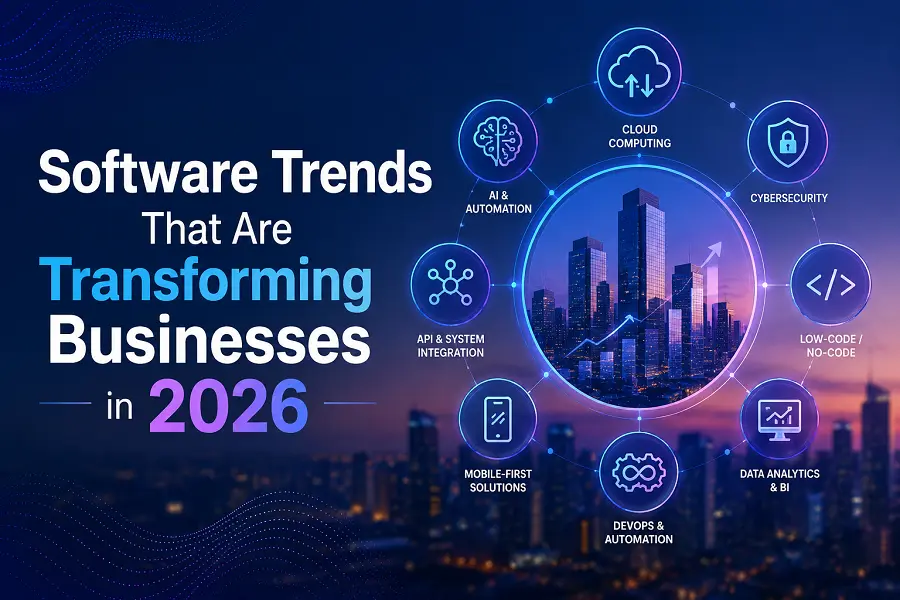
Business software has never evolved faster. Companies that once updated their tech stack every few years are now making strategic decisions quarterly. The shift isn’t just about efficiency — it’s about survival in a market where software defines competitive advantage.
Here’s what’s genuinely reshaping how businesses operate right now.
AI Agents Are Moving From Experiment to Infrastructure
Generative AI grabbed headlines in previous years, but 2026 belongs to AI agents — autonomous software systems that complete multi-step tasks without human hand-holding.
Unlike basic chatbots, AI agents can:
- Browse the web, analyze data, and write reports independently
- Manage workflows across multiple platforms like CRM, ERP, and communication tools
- Learn from feedback loops, improving accuracy over time
- Trigger actions based on real-time business events
Companies are deploying agents across finance, HR, customer support, and supply chain. The result is a measurable reduction in manual overhead — and faster decision-making at every level.
What makes this trend sticky is cost. Training and deploying AI agents has dropped dramatically in price. Even mid-sized businesses can now afford what was once enterprise-only technology.
Vertical SaaS Is Replacing Generic Platforms
The era of one-size-fits-all software is quietly ending. Vertical SaaS — industry-specific cloud software built for sectors like healthcare, construction, or legal services — is outpacing generic platforms in adoption rates.
Here’s why the shift makes sense:
- Faster onboarding — pre-built workflows match how a specific industry actually operates
- Better compliance — built-in regulatory frameworks reduce risk for regulated sectors
- Higher ROI — less customization needed means shorter time-to-value
- Stronger integrations — vertical tools connect natively with industry-standard systems
- Tailored support — vendors understand niche problems that generic providers never prioritize
Healthcare SaaS companies are building around EHR interoperability. Legal-tech firms are embedding AI contract review. Construction platforms are embedding project finance tools directly into scheduling software.
Businesses are choosing depth over breadth — and vendors who understand a single industry deeply are winning.
Edge Computing Is Redefining Real-Time Processing
Cloud computing isn’t going away, but it’s being complemented by edge computing — processing data closer to where it’s generated rather than sending everything to a centralized server.
For businesses running IoT devices, point-of-sale systems, or manufacturing sensors, the latency difference matters enormously. A retail store processing inventory data at the edge can react to stock movements in milliseconds. A factory running predictive maintenance at the edge can catch equipment failures before a production line stops.
The software implications are significant. Businesses now need applications that can:
- Operate with intermittent or no cloud connectivity
- Sync intelligently when bandwidth becomes available
- Prioritize which data gets processed locally versus centrally
Edge-native software architecture is becoming a requirement for operations that can’t afford delays. Vendors who haven’t built for edge environments are already losing contracts to those who have.
Platform Consolidation Is Cutting the App Sprawl
The average business runs dozens of disconnected software tools. In 2026, the backlash against app sprawl is driving a consolidation wave. Companies are actively reducing their vendor count and choosing platforms that cover more ground with tighter integrations.
This trend is reshaping procurement decisions. Rather than best-of-breed tools for every function, buyers want connected ecosystems — fewer logins, unified data, and one support relationship.
For software vendors, this means platform thinking wins. Feature-rich standalone tools without strong integration stories are losing ground to broader suites that may be slightly less specialized but dramatically easier to manage.
Conclusion
Software in 2026 isn’t just a support function — it’s the operating layer of modern business. AI agents are eliminating routine work. Vertical SaaS is replacing generic solutions with purpose-built precision. Edge computing is pushing intelligence to where the action happens. And platform consolidation is demanding that tools work together, not in isolation.
Businesses that treat software strategy as a core business strategy — not an IT decision — will find themselves ahead. Those that don’t will be playing catch-up with competitors who already have.
FAQs
1. What is the biggest software trend for businesses in 2026?
AI agents are the most transformative trend. Unlike simple automation tools, they complete multi-step tasks autonomously across different platforms, reducing manual workloads and accelerating business processes significantly.
2. What is vertical SaaS and why is it growing?
Vertical SaaS refers to software built specifically for one industry rather than general business use. It’s growing because it reduces setup time, ensures regulatory compliance, and delivers faster ROI compared to generic platforms that need heavy customization.
3. How does edge computing benefit businesses?
Edge computing processes data near its source rather than in a remote cloud server. This reduces latency, supports offline operations, and is especially valuable in manufacturing, retail, and logistics where real-time responsiveness is critical.
4. What does platform consolidation mean for software buyers?
It means choosing fewer, broader software platforms over many specialized tools. Businesses gain unified data, simpler vendor management, and lower overall costs — though they may trade away some depth in specialized features.
5. How should a business prioritize software investments in 2026?
Start by identifying which manual processes consume the most time or introduce the most errors — those are prime targets for AI agent deployment. Then evaluate whether your current tools talk to each other well. Disconnected systems are a hidden cost that compounds every year.





Leave a Reply