


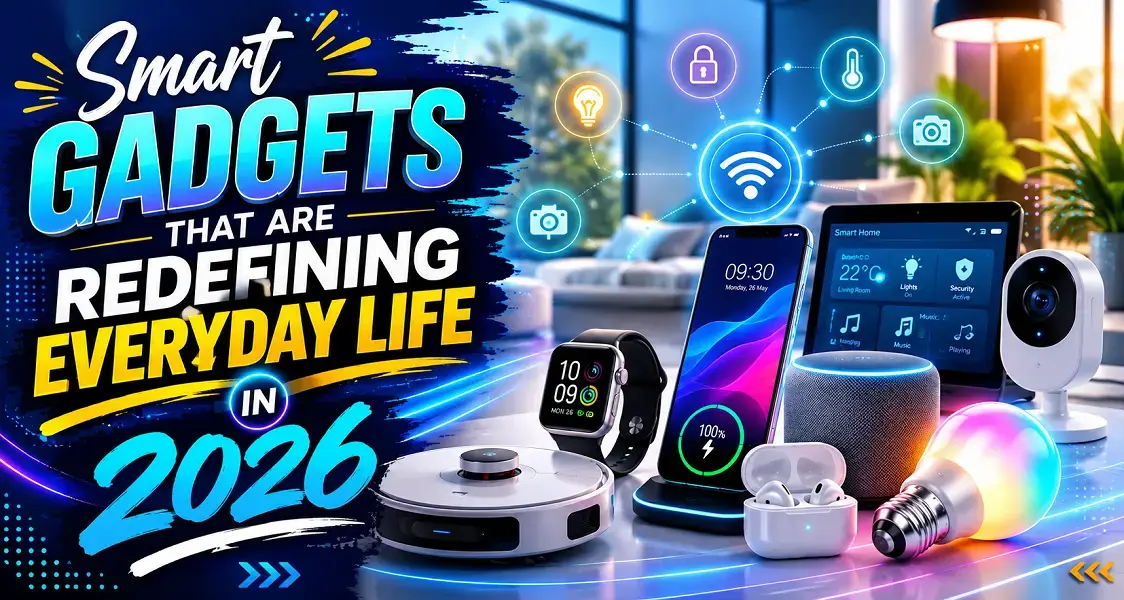
The definition of a connected lifestyle has evolved dramatically. Modern innovation is no longer focused on adding intrusive screens to every household item. Instead, the focus has shifted toward ambient, helpful technology that runs quietly in the background to eliminate friction from daily routines. These advancements are practical, highly efficient, and designed to save time while seamlessly blending into our environments.
Intelligent Home Maintenance and Automations
The burden of repetitive household cleaning and property maintenance is rapidly shifting toward autonomous devices that process complex physical environments in real time.
-
Legged Vacuum Cleaners: Standard robot vacuums often get trapped by architectural barriers, but newer variations feature mechanical legs capable of climbing up and down staircases, clearing high thresholds, and performing multi-level floor washing without human intervention.
-
Wire-Free Navigation Mowers: Outdoor lawn maintenance has abandoned perimeter boundary wires. Instead, modern robotic mowers use satellite positioning and visual mapping to navigate complex garden layouts, avoid small animals, and trim edges perfectly.
-
Self-Emptying Pool Cleaners: Maintaining a swimming pool is now entirely automated, with robotic water skimmers that drive themselves to a docking station, empty collected debris, and recharge without manual handling.
-
Presence-Based Ambient Lighting: Traditional motion sensors that turn off when you sit still are obsolete. Modern systems utilize millimeter-wave (mmWave) radar technology to detect microscopic movements like breathing, ensuring lights stay active only when a room is truly occupied.
Next-Generation Security and Access Control
Home security systems have evolved from passive monitors into proactive, localized systems that maximize privacy and convenience simultaneously.
-
Ultra-Wideband Smart Locks: Instead of forcing you to tap a phone or scan a fingerprint while holding groceries, modern entry systems utilize Ultra-Wideband (UWB) technology. These smart locks identify your precise spatial approach and unlock the deadbolt hands-free exactly as you reach the door.
-
Optical Wireless Power Charging: Battery management for security door hardware is becoming a thing of the past. Continuous optical charging systems transmit safe, targeted infrared light paths from a ceiling fixture directly to the lock panel, keeping the device powered indefinitely.
-
Local Edge AI Camera Hubs: Home security data privacy has taken a massive leap forward. Instead of streaming sensitive video feeds to distant cloud servers, decentralized security boxes process all facial recognition, package tracking, and perimeter alerts locally on physical hardware inside the home.
-
Ultrasonic Pipe Monitors: Water damage prevention is simpler than ever with non-invasive sensors that simply clip onto the main water pipe line. These devices use rapid ultrasonic sampling to detect pinhole leaks and abnormal flow patterns before structural damage occurs.
Intentional and Screen-Free Kitchen Technology
Modern culinary gadgets are prioritizing tactile utility and mental clarity over flashing notification displays, transforming how we prepare food and manage waste.
Ultrasonic kitchen tools have introduced professional-grade precision to the home counter, featuring chef knives that vibrate tens of thousands of times per second to slide through dense ingredients with zero physical strain. In the appliance sector, visual scanning technology inside refrigeration units tracks inventory and monitors food freshness automatically, sending personalized recipe concepts to your phone based on ingredients that need to be used first.
Meanwhile, daily coffee rituals have dropped the traditional overnight wait times; compact countertop extraction units now pull high-quality cold brew in under five minutes by applying localized pressure adjustments. For health-conscious households, pocket-sized allergen sensors can instantly test food samples for specific proteins like gluten or dairy at the dining table, providing peace of mind within seconds.
Conclusion
The current wave of smart technology is redefining convenience by proving that the best gadgets are the ones you rarely have to think about. By prioritizing local processing, screen-free designs, and actual physical autonomy, these tools are successfully shifting our relationship with technology from active management to effortless utility.
Frequently Asked Questions
What makes 2026 smart home gadgets different from older models?
Older smart devices required constant manual app control, suffered from fragmented ecosystems, and relied heavily on cloud servers. Current devices prioritize physical autonomy, universal compatibility standards, and local processing to run seamlessly in the background without constant user intervention.
How do UWB smart locks differ from Bluetooth locks?
Bluetooth smart locks often trigger prematurely when you are simply walking past the door inside your house. Ultra-Wideband (UWB) locks utilize precise spatial awareness to measure exact distance and directional intent, meaning they will only unlock when you are standing directly outside the threshold.
Why is millimeter-wave (mmWave) technology better than standard motion sensors?
Traditional passive infrared motion sensors only detect explicit, large-scale movements, causing lights to turn off if you are quietly reading or working. Millimeter-wave radar detects subtle biological presence, such as the rise and fall of a chest while breathing, keeping systems active as long as you remain in the room.
Do local edge AI security hubs require a monthly subscription?
Generally, no. Because local edge AI hubs process all video analysis, facial recognition, and event logging directly on the physical hardware inside your home instead of relying on external cloud storage servers, they eliminate the recurring fees associated with traditional security systems.
How do modern clip-on water monitors detect leaks without touching the water?
These non-invasive devices use high-frequency ultrasonic sensors to send sound waves directly through the exterior wall of the pipe. By taking dozens of precise flow velocity measurements every second, the system detects micro-turbulences and tiny pressure drops caused by hidden leaks anywhere in the plumbing system.








Leave a Reply