

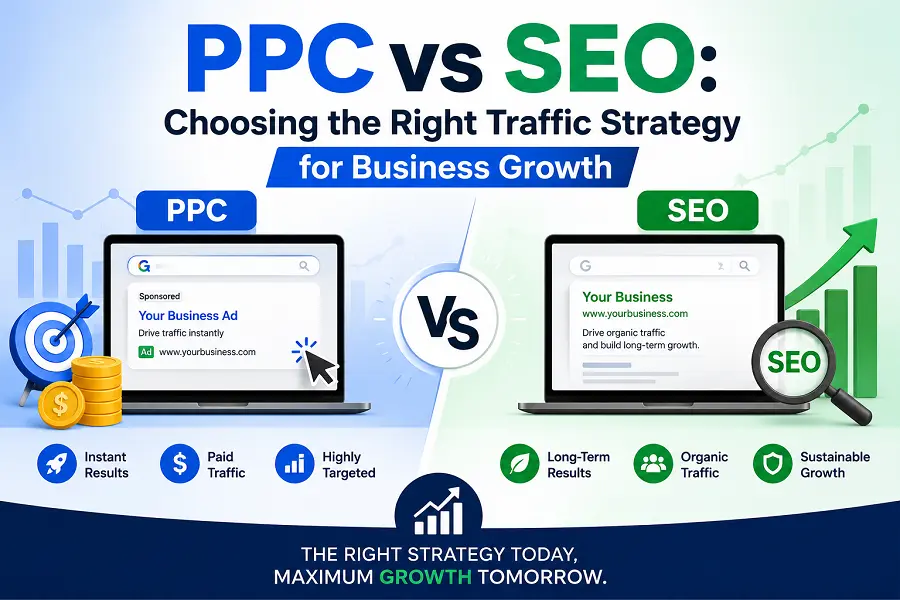
Selecting the optimal methodology to attract digital visibility directly determines a company’s customer acquisition costs and long-term valuation. Businesses face a fundamental choice between purchasing immediate consumer attention or cultivating an enduring digital asset that captures demand organically. Balancing paid search mechanics against search engine optimization represents a foundational growth decision.
The decision is not merely about finding a financial preference; it requires aligning a company’s cash flow velocity, market maturity, and competitive positioning with the technical realities of modern search results pages.
The Immediate Impact of Paid Visibility
Pay-per-click advertising operates as a highly responsive system where capital converts directly into immediate marketplace visibility. This mechanism places marketing assets directly above organic results within moments of campaign activation. It bypasses the traditional authority-building phase required by algorithms, offering absolute control over commercial placement.
-
Granular Budget Calibration: Spending thresholds adapt in real-time to match daily corporate cash flows, scaling upward during high-yield historical sales periods.
-
Controlled Funnel Destination: Traffic routes exclusively to conversion-optimized landing pages engineered for specific offers rather than broad informational content.
-
Immediate Insight Generation: Rapid data collection reveals exact transactional search phrases, establishing a verified baseline for conversion performance.
-
Agile Competitor Countermeasures: Bidding thresholds adjust dynamically to disrupt rival promotions or secure dominant visibility for fresh product announcements.
Building Asset Equity Through Organic Discovery
Search engine optimization shifts the focus toward establishing deep, structural authority that commands organic search engine layouts. Rather than renting traffic through recurring monetary injections, this strategy treats optimization as a long-term property investment. Over time, the content library and technical framework generate continuous value without compounding media costs.
-
Compounding Traffic Equity: High-ranking editorial resources continue to attract prospective buyers months after deployment, dropping marginal acquisition costs toward zero.
-
Elevated Consumer trust: Search users naturally favor organic listings over sponsored links, viewing top organic positioning as an implicit validation of industry leadership.
-
Broad Informational Capture: Optimization targets early-stage researchers seeking answers to foundational industry challenges, nurturing leads long before a purchase decision occurs.
-
Permanent Digital Footprint: Once a digital asset claims authority for highly competitive commercial search terms, that ranking remains resilient against sudden budget reductions.
Aligning Growth Velocity with Capital Constraints
The choice between these channels ultimately depends on the current operational lifecycle of the business. Early-stage enterprises or companies launching entirely new products often lack the historical data and domain authority required to compete organically. For these operations, paid acquisition serves as a necessary customer exploration tool to validate market fit and fund early infrastructure.
Conversely, established operations with robust product lines can utilize their existing customer insights to fuel content networks that dominate long-tail search volume. The most resilient organizations eventually transition from choosing one channel over the other to creating a symbiotic data loop. Paid data uncovers profitable keywords, which organic content then targets permanently, freeing up advertising capital to test riskier, higher-margin acquisition experiments.
Conclusion
PPC delivers immediate, predictable sales velocity at a linear cost, while SEO generates compounding, long-term brand equity with diminishing relative expenses. A business must evaluate its immediate revenue needs against its patience for structural growth to deploy capital effectively.
FAQs
Which strategy offers a faster return on marketing investment?
PPC delivers near-instantaneous returns by directing targeted traffic to commercial offers the same day a campaign launches, whereas SEO initiatives typically require several months of consistent optimization before generating meaningful revenue.
How do AI Overviews alter the balance between paid and organic channels?
AI Overviews synthesize informational search queries directly at the top of results pages, reducing standard organic clicks on basic informational articles while increasing the value of transactional paid ads and highly specific, deep-authority organic content.
Can a business completely stop PPC once its SEO rankings are high?
While possible, dropping paid ads entirely can surrender valuable top-of-page real estate to competitors. Maintaining an active ad presence alongside top organic rankings maximizes total click share and blocks rival brands.
Is SEO more cost-effective than PPC in the long run?
Yes. Organic traffic does not carry a direct cost-per-click fee, meaning the cost per lead steadily decreases as content authority matures, unlike paid channels where every single website visit requires continuous financial output.
How does website user experience affect both traffic strategies?
Poor user experience damages both channels. It lowers an ad campaign’s quality score—raising the cost-per-click—while simultaneously driving up bounce rates, which signals search engines to lower the site’s organic rankings.





Leave a Reply