


Product reviews built the trust infrastructure of e-commerce. Before a consumer would hand payment details to a website they’d never visited before, to buy a product they couldn’t physically examine, they needed something — some signal that other humans had made this exchange and found it worthwhile. Reviews provided that signal, and for two decades they were the closest thing the online shopping world had to word-of-mouth.
Artificial intelligence is now pulling at every thread of that infrastructure simultaneously. It’s changing how reviews are written, how they’re read, how they’re verified, how they’re surfaced, and what role they play in the purchase decision at all. The result isn’t the death of reviews — it’s their most significant transformation since they first appeared on product pages.
AI-Generated Reviews Are Forcing a Credibility Crisis
The volume problem in online reviews has existed for years — too many reviews to read, too little signal in most of them. AI has made this problem structurally worse while simultaneously creating pressure for solutions that might ultimately make the entire ecosystem more reliable.
Generating plausible-sounding product reviews at scale requires almost no effort with current AI tools. A competitor, a disgruntled former employee, a business with a budget and a goal — any of them can now produce hundreds of syntactically natural, contextually appropriate reviews in the time it previously took to write one. The detection challenge this creates for platforms is significant because AI-generated reviews no longer carry the linguistic fingerprints that previously made fake content identifiable.
The downstream effects on consumer behavior are already measurable:
- Trust in unverified review platforms has declined among consumers who are aware of AI generation capabilities
- Verified purchase badges and platform-level authentication signals carry significantly more weight than they did two years ago
- Consumers are increasingly treating aggregate star ratings as less reliable and investing more time in reading review content for signals of genuine human experience
- Third-party review aggregators that apply additional verification layers are gaining traffic from consumers seeking more reliable signals than individual platform reviews provide
The credibility crisis created by AI-generated fake reviews is creating market demand for the opposite: verified, authenticated, provably human review content. That demand is reshaping how platforms think about review infrastructure.
Verified Human Reviews Are Becoming a Competitive Differentiator
The platform response to AI-generated review proliferation is moving in a consistent direction: verification systems that confirm reviews come from humans who actually made the purchase or used the service. What was once a basic trust feature is becoming a sophisticated authentication infrastructure.
Several verification approaches are gaining adoption across review platforms and e-commerce environments:
- Purchase verification with timestamped receipts — reviews linked to specific transaction records that confirm the reviewer bought the product at a verifiable point in time
- Behavioral authentication — analysis of how a review was written, including timing patterns, revision behavior, and device fingerprinting that distinguishes human writing sessions from automated generation
- Video and photo requirement tiers — higher-trust review categories requiring visual evidence of product use, which creates an authentication barrier that AI-only generation cannot currently clear
- Blockchain-based review provenance — immutable records of review origin and purchase verification that cannot be retroactively manipulated
- Identity-linked review profiles — reviewer accounts connected to verified identities that accumulate credibility over time through consistent, authentic review histories
The businesses that implement robust verification first will hold a trust advantage that is difficult to replicate quickly. Consumer willingness to pay a premium for products with demonstrably authentic review profiles is creating direct commercial incentive for verification investment.
AI Is Also Transforming How Consumers Discover and Use Reviews
The same AI capabilities creating problems for review authenticity are solving a different, longstanding problem in how consumers actually use review information. Reading dozens of reviews to extract relevant signal is cognitively expensive — most consumers don’t do it thoroughly, which means much of the information in review ecosystems goes unused.
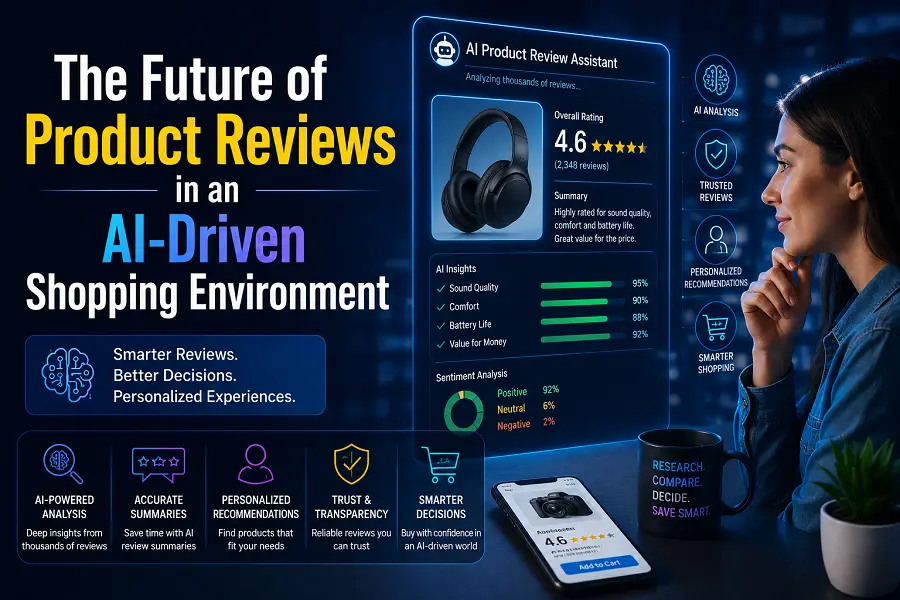
AI-powered review synthesis is changing this dynamic by processing large review sets and extracting structured insights that surface what matters without requiring the consumer to read every entry:
- Sentiment-segmented summaries that separately characterize what reviewers praise and what they criticize, rather than blending sentiment into a single paragraph
- Use-case specific insights that extract what reviewers in specific situations — business travelers, families, professional users — experienced, surfacing relevant information for consumers with matching contexts
- Longitudinal quality analysis that identifies whether product quality or service consistency has changed over time based on review content patterns, not just rating trends
- Comparative synthesis that simultaneously analyzes reviews across competing products and identifies where each holds genuine advantage
- Concern extraction that identifies the most frequently cited negatives in plain language, giving consumers direct access to the most common criticisms without requiring them to find and read every negative review independently
For consumers, this transforms reviews from a raw material that requires significant investment to process into structured intelligence that’s immediately actionable. The irony is that AI is simultaneously threatening the authenticity of review content and dramatically improving the usability of authentic review content that exists.
The Role of Influencer and Expert Reviews Is Being Redefined
Traditional influencer reviews — a creator with a large following receives a product, produces content about it, and their audience uses that content as a purchase signal — operated on an implicit authenticity assumption that audiences largely accepted. The combination of AI-generated influencer content, disclosed and undisclosed sponsorship arrangements, and increasingly sophisticated audience skepticism is disrupting that assumption.
The direction of travel in expert and creator reviews points toward structures that provide verification the audience can evaluate rather than authenticity they must simply trust:
- Long-term use documentation — creators who document product experience over weeks or months rather than immediate first impressions, providing evidence of sustained engagement that brief sponsored reviews cannot simulate
- Comparative testing with transparent methodology — structured side-by-side comparisons with disclosed testing criteria that audiences can evaluate rather than subjective impressions they must accept
- Conflict of interest disclosure depth — going beyond regulatory minimums to fully disclose commercial relationships, compensation structures, and product acquisition methods in ways that allow audiences to apply appropriate weighting
- Audience outcome tracking — creators who follow up with audiences who purchased based on recommendations, reporting aggregate satisfaction data that closes the loop between recommendation and outcome
The creators who build the most durable review credibility in an AI-saturated environment are those whose audiences can verify, not just trust, that the content reflects genuine experience.
Shopping AI Assistants Are Changing What Reviews Need to Communicate
A structural shift in how product research happens is quietly changing what reviews need to contain to remain useful. When consumers searched for products themselves and read reviews directly, review content was optimized for human reading — conversational, experiential, subjective.
As AI shopping assistants become the intermediary between review content and purchase decisions, the same review content is increasingly being read by AI systems that extract structured information to answer consumer queries. A review that helps a human make a decision and a review that helps an AI assistant answer a question about a product are not the same document.
The practical implications for what makes reviews useful are evolving:
- Specific, factual claims about product performance carry more weight in AI-mediated environments than subjective impressions
- Structured descriptions of use cases and outcomes are more extractable by AI summarization than narrative reviews
- Quantified assessments — battery lasted exactly eleven hours, delivery arrived two days early, customer service responded within four hours — provide the kind of concrete data points AI assistants can retrieve and cite
- Comparative references to alternative products give AI systems the relational context needed to answer “is this better than X” queries
This shift creates a gradual pressure on review content toward more structured, factual, specific communication — which, as a byproduct, also makes reviews more resistant to AI generation because genuine specific detail is harder to fabricate convincingly than plausible-sounding general praise.
Conclusion
The future of product reviews in an AI-driven shopping environment is neither their elimination nor their continuation unchanged. Reviews are being stress-tested at every point — their authenticity, their production, their discovery, their utility, and their role in the purchase journey — simultaneously.
What emerges will be shaped by the tension between two forces: AI’s capacity to generate review-shaped content without genuine experience behind it, and the market’s growing demand for verified, specific, provably authentic human testimony about products. The platforms, businesses, and creators who invest in the verification and specificity infrastructure that satisfies that demand will define what reviews mean in the decade ahead.
FAQs
1. How is AI changing the authenticity of online product reviews?
AI has made generating plausible fake reviews at scale trivially easy, removing the linguistic fingerprints that previously made inauthentic content identifiable. This has driven platform investment in verification systems — purchase confirmation, behavioral authentication, and identity-linked review profiles — that provide authentication signals consumers can rely on beyond the review text itself.
2. What verification methods are platforms using to ensure review authenticity?
Leading approaches include purchase-verified review systems linked to transaction records, behavioral analysis that distinguishes human writing sessions from automated generation, photo and video requirements that create barriers AI-only generation cannot clear, and blockchain-based provenance records that make review origin immutable and auditable.
3. How is AI improving the usefulness of legitimate reviews?
AI review synthesis extracts structured insights from large review sets — separating praise from criticism, identifying use-case specific experiences, tracking quality changes over time, enabling comparative analysis across competing products, and surfacing the most common concerns in plain language. This makes the information in review ecosystems significantly more accessible without requiring consumers to read every entry manually.
4. How are influencer and expert reviews adapting to maintain credibility?
The most credible review creators are shifting toward long-term use documentation, comparative testing with transparent methodology, deeper conflict of interest disclosure, and audience outcome tracking. These approaches provide verification audiences can evaluate rather than authenticity they must simply accept — a crucial distinction in an environment where AI-generated influencer content is increasingly possible.
5. How are AI shopping assistants changing what makes a review useful?
As AI assistants increasingly mediate between review content and purchase decisions, reviews containing specific factual claims, quantified performance data, structured use-case descriptions, and comparative product references become more valuable than subjective narrative reviews. Content that AI systems can extract and cite to answer specific consumer queries serves both human readers and AI intermediaries more effectively than impressionistic general praise.








Leave a Reply