


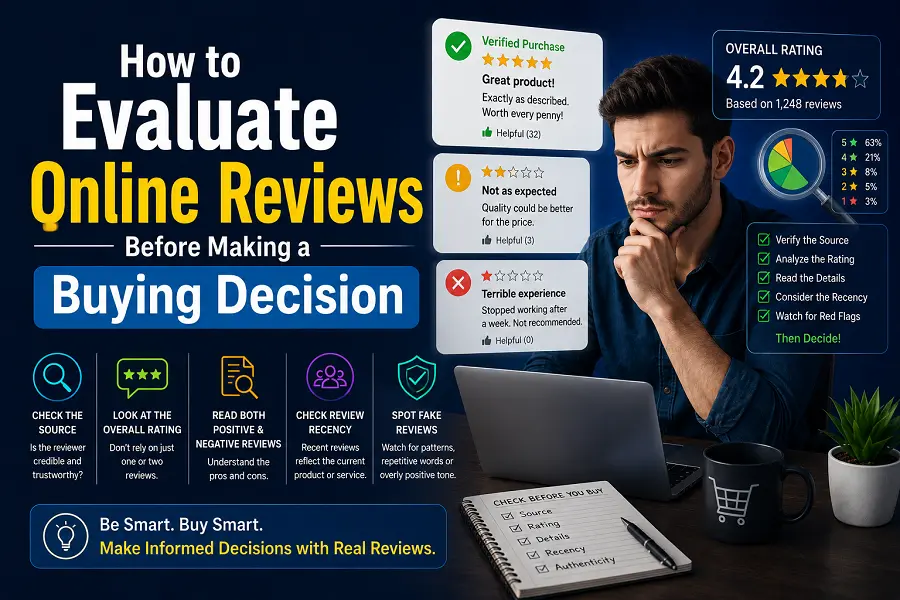
Online reviews have become the default research method for most purchase decisions. Before booking a hotel, hiring a contractor, buying a gadget, or choosing a restaurant, the instinct to check what other people experienced is now automatic for most consumers.
The problem isn’t access to reviews — it’s knowing which ones to trust. Review ecosystems have grown complex enough that a five-star average no longer means what it once did, and a single scathing review doesn’t necessarily mean what it appears to either. Reading reviews effectively is a skill, and like most skills, it improves significantly with the right framework.
Start With the Overall Pattern, Not the Individual Score
The first mistake most consumers make when evaluating reviews is focusing on the aggregate star rating before understanding what produced it. A 4.2-star average tells you almost nothing useful on its own — what matters is the distribution behind it, the trend over time, and whether the rating reflects a genuine consensus or a polarized split.
A business with four hundred reviews averaging 4.2 stars where ninety percent of reviews fall between four and five stars represents a fundamentally different situation than one with the same average produced by a roughly equal split between five-star and one-star reviews. The first indicates consistent quality with occasional disappointment. The second indicates a highly variable experience where customers either love or hate what they received — and which outcome a new customer gets may be unpredictable.
Before reading a single review, examine the rating distribution:
- Look for the shape of the histogram if the platform displays one
- Notice whether the one-star and two-star counts are disproportionately high relative to the overall average
- Check whether the average has been stable, improving, or declining over the past six to twelve months
- Note the total review count — patterns become meaningful with volume; sparse reviews produce unreliable averages
A declining rating trend over recent months is often more informative than the current average, which includes historical reviews that may reflect a business that has meaningfully changed.
Read the Critical Reviews With Specific Attention to Pattern and Detail
Positive reviews confirm what a business does well. Critical reviews reveal what it does consistently wrong — and consistency is the key word. A single negative review describing an unusual experience tells you less than three separate reviews independently describing the same problem.
When reading critical reviews, apply these evaluation filters:
- Specificity signals authenticity — a negative review describing a specific interaction, product failure, or service gap carries more weight than a vague statement of dissatisfaction without supporting detail
- Pattern recognition over individual incidents — a complaint appearing in multiple independent reviews describes a systemic issue; a complaint appearing once may describe an isolated incident
- Recency weighting — a pattern of complaints from two years ago may reflect a business problem that has since been resolved; the same pattern appearing in recent reviews indicates an ongoing issue
- Proportionality assessment — evaluate whether the complaint reflects a fundamental product or service failure versus a mismatch between customer expectation and what the business actually offers
- Response quality as signal — how a business responds to criticism reveals organizational character; a defensive, dismissive response to a legitimate complaint tells you something important about how the business handles problems
The reviewer who describes exactly what went wrong, when, and how the business responded gives you genuinely useful information. The reviewer who posts a one-star rating with “terrible” as the entire review gives you almost nothing to evaluate.
Develop a Working Eye for Inauthentic Reviews
Fake reviews exist on every major platform — some purchased by businesses seeking artificial boosts, others generated by competitors seeking to damage rivals. Platforms invest significantly in detection, but manipulation still slips through in quantities sufficient to distort ratings in some categories and markets.
Recognizing the signals of inauthentic content protects you from making decisions based on manufactured consensus:
- Generic enthusiasm without specifics — reviews that praise a business effusively without mentioning any particular detail of what was purchased, experienced, or received often indicate non-genuine content
- Linguistic uniformity across multiple reviews — when several reviews from different accounts use strikingly similar phrasing, sentence structure, or even identical phrases, they likely originate from a common source
- Reviewer account thinness — check the reviewer’s profile when possible; an account created recently with only one or two reviews, or reviews spread across unrelated business categories in a suspiciously short time frame, warrants skepticism
- Temporal clustering — a sudden surge of positive reviews within a short period, particularly following a period of negative reviews, often indicates a review generation campaign rather than an organic increase in satisfied customers
- Implausibly consistent perfection — a business with hundreds of five-star reviews and virtually no variation across them defies the natural distribution of customer experience; real customer satisfaction produces a spread, not a monoculture
No single signal definitively identifies a fake review, but multiple signals appearing together on the same profile should significantly discount the reliability of what you’re reading.
Use Platform and Category Context to Calibrate Expectations
The same star rating means different things on different platforms and in different product or service categories. A 4.0-star restaurant on a highly competitive urban dining platform represents a meaningfully different quality signal than a 4.0-star restaurant in a market with lower review volume and less competitive density.
Similarly, categories where reviews tend toward extremes — emotional purchases, experience-based services, products with strong subjective preferences — naturally produce more polarized distributions than categories where quality is more objectively assessable.
Calibrate your reading accordingly:
- Compare the business’s rating to direct competitors in the same geography and category rather than applying a universal standard
- Understand that categories like contractors, medical services, and legal professionals tend toward lower average ratings than hospitality and consumer products — four stars in a service category often represents stronger performance than four stars in a product category
- Weight platforms where reviews require verified purchases or verified visits more heavily than platforms with open, unverified review submission
- Recognize that some categories attract disproportionate negative reviews because dissatisfied customers are far more motivated to write reviews than satisfied ones — adjusting your reading of averages accordingly
Look for the Reviews That Match Your Specific Situation
The most useful review for your decision isn’t the most popular or the most dramatic — it’s the one written by someone whose use case most closely matches yours.
A hotel that receives consistent praise for business amenities and consistent criticism for noise levels tells a different story to a traveling professional than to a family with young children. A restaurant praised for romantic atmosphere and criticized for noise levels at peak hours is relevant differently depending on whether you’re planning a date or a group celebration.
Most platforms allow filtering or sorting reviews in ways that surface the most relevant content:
- Search within reviews for keywords specific to your use case when the platform allows it
- Filter by reviewer type or trip type on travel platforms that offer this segmentation
- Prioritize reviews from customers who describe a situation similar to yours in the first sentence
- Weight reviews from customers who appear to share your price sensitivity and quality expectations
The review ecosystem works best when used as a matching tool rather than a voting system. You’re not looking for what most people thought — you’re looking for what people like you, buying for reasons like yours, experienced.
Conclusion
Evaluating online reviews effectively requires moving past the instinct to glance at a star rating and read the most recent entry. The consumers who make the best decisions from review data read patterns rather than individual posts, apply authenticity filters to discount manufactured content, calibrate expectations to platform and category norms, and prioritize reviews from buyers whose situation resembles their own.
Reviews remain the most democratized and accessible form of purchase intelligence available — but the returns from reading them go to those who know what they’re actually looking for.
FAQs
1. Is a higher star rating always better when evaluating a business?
Not necessarily. A very high rating with low review volume is often less reliable than a slightly lower rating with substantial volume. Rating distribution, recency, and trend matter as much as the aggregate score. A business with a stable 4.3-star rating across four hundred recent reviews typically represents a more trustworthy signal than a perfect 5.0 from eight reviews.
2. How can you tell if a review is fake?
Look for combinations of signals rather than any single indicator: generic enthusiasm without specific detail, linguistic similarity across multiple reviews, thin reviewer account history, temporal clustering of positive reviews, and implausibly uniform perfection across a large review set. Multiple signals appearing together substantially increase the probability that reviews are inauthentic.
3. Should negative reviews deter you from a purchase?
It depends on what the negative reviews say and how frequently the same complaint appears. A single negative review describing an unusual situation is less informative than three separate reviews independently identifying the same issue. If the problem described is one that would specifically affect your use case, weight it heavily. If it describes a mismatch between expectation and offering that wouldn’t apply to you, treat it accordingly.
4. Which review platforms are most reliable?
Platforms that verify purchases or visits before allowing reviews produce more reliable content than open platforms. Beyond verification, reliability varies by category — specialist platforms serving specific industries often produce more informed reviews than general platforms because reviewers have relevant domain knowledge. Using multiple platforms and comparing the pattern across them is more reliable than depending on any single source.
5. How many reviews should a business have before you trust its rating?
There’s no universal threshold, but meaningful pattern recognition typically requires at least twenty to thirty reviews for basic reliability and several hundred for high confidence. More important than a specific number is whether the review activity is current — a business with fifty reviews from the past six months provides more useful signal than one with five hundred reviews spread across five years with minimal recent activity.






Leave a Reply