


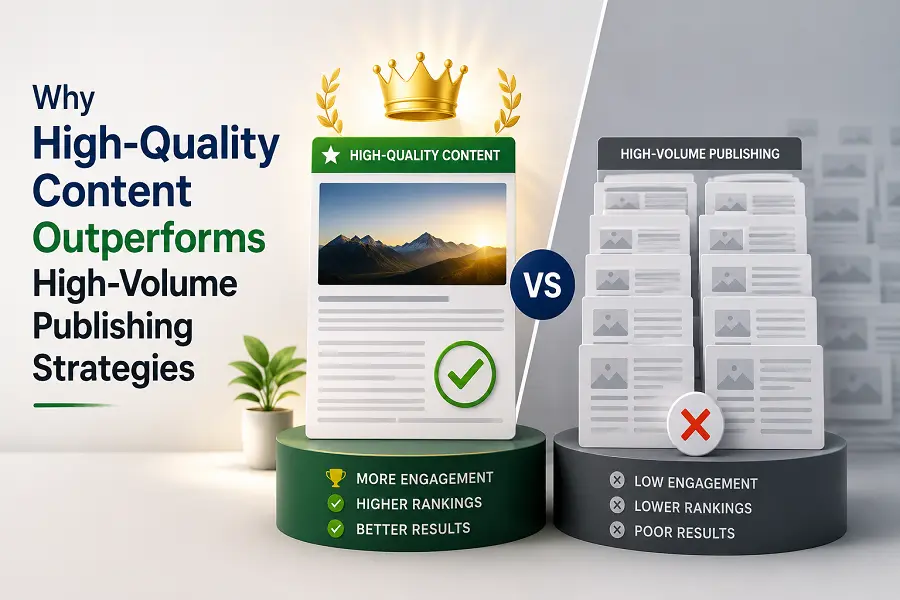
The operational blueprint for achieving organic visibility has undergone a critical structural recalibration. For years, digital marketing relied on a production-line methodology: publishing massive quantities of keyword-targeted pages to capture broad search traffic. Today, advanced evaluation systems utilize site-wide quality classifiers that assess the genuine utility of an entire domain. Flooding a website with repetitive, thin, or paraphrased text no longer expands a digital footprint—it systematically devalues it.
The Algorithmic Devaluation of Scaled Content Abuse
Modern indexing protocols feature automated filters specifically designed to detect and suppress high-volume, low-effort publishing pipelines. When a platform uploads dozens of articles daily that merely rewrite existing web results, classification systems categorize the activity as scaled content abuse. This mechanism does not evaluate pages in total isolation; a high percentage of unhelpful text creates a negative site-wide signal that suppresses the ranking capability of your entire domain.
To successfully clear these advanced algorithmic validation gates, editorial architectures must prioritize depth over raw output frequency:
-
Enforce Strict Quality-Control Gates: Audit every draft to ensure it answers a user query completely before authorizing publication.
-
Eliminate Automated Filler Strings: Eradicate generic introductions and transition padding meant only to inflate word counts.
-
Consolidate Redundant Asset Nodes: Merge thin, overlapping blog posts into singular, authoritative resources that own a topic comprehensively.
-
Devalue Arbitrary Publishing Quotas: Shift internal performance tracking from the number of articles published per week to user retention and engagement metrics.
Harnessing Information Gain to Secure Generative Authority
A core ranking differentiator is the concept of information gain. This algorithmic mechanism mathematically scores how much net-new knowledge a webpage introduces compared to assets already cataloged in the top search results. If a newly published article mirrors the exact structural outline and vocabulary of its competitors, it offers zero information gain, making it highly unlikely to secure standard positioning or automated AI overview citations.
Securing a competitive edge requires embedding unique experiential markers directly into your copy:
-
Publish First-Party Analytical Data: Feature proprietary market surveys, internal process trial metrics, or localized performance statistics that cannot be found elsewhere.
-
Embed Direct Specialist Commentary: Incorporate raw, uncopied insights from internal subject-matter experts who manage hands-on resolutions daily.
-
Provide Practical Edge-Case Solutions: Detail the specific operational exceptions, common mistakes, and technical trade-offs that standard automated guides ignore.
-
Incorporate Unique Visual Walkthroughs: Build customized workflows, original data charts, or screen-captured process records to give immediate visual context to your written explanations.
Aligning Brand Strategy With the Trust-First E-E-A-T Hierarchy
The quality evaluation systems used to train modern search architectures place an unmatched premium on the final letter of the E-E-A-T framework: Trust. Experience, expertise, and authority are foundational, but they function primarily to support the overall trustworthiness of a digital entity. High-volume strategies naturally dilute trust by prioritizing speed over factual verification, leading to systematic demotions during core algorithmic updates.
Building an enduring brand presence requires establishing a transparent, accountable authorship model. Anonymous bylines or generic editorial tags signal a lack of ownership to background parsing crawlers. Attributing your assets to verified human professionals with independent digital footprints instantly elevates your trust scoring.
Furthermore, maintaining deep topical coherence across your domain reinforces your authoritative positioning. A topically focused site that covers a specific industry niche exhaustively is recognized as a trusted subject-matter hub. Prioritizing clear, highly reliable answers over broad lateral expansion ensures your platform remains resilient against ongoing system updates.
Conclusion
Succeeding in the modern search landscape requires a decisive transition from standard database optimization to genuine human utility. High-volume publishing strategies create technical overhead and asset redundancy that modern quality classifiers actively filter out. By investing in comprehensive depth, unique information gain, and verifiable trust signals, your platform delivers true people-first value that guarantees sustainable organic growth.
FAQs
What qualifies as “scaled content abuse” under current search policies?
Scaled content abuse refers to the practice of using automated software or low-effort manual rewriting to produce a high volume of web pages primarily to manipulate search rankings, without offering original value or unique insights to human visitors.
How does a site-wide quality signal affect individual high-quality pages?
If a website contains an abundance of thin, repetitive, or unhelpful content, the automated site-wide classifier applies a negative score to the entire domain. This negative weight can depress the visibility of your high-quality pages.
Does Google completely penalize the use of AI tools for content drafting?
No, the system evaluates the final helpfulness and originality of the content, not the tool used to draft it. AI-assisted content that is thoroughly edited by a human expert and enriched with unique data performs exceptionally well.
How can a business recover from a drop caused by a helpful content core update?
Recovery requires a comprehensive content audit to delete thin or redundant pages. Underperforming assets must either be removed completely or heavily revamped to include original data, expert insights, and clear practical utility.
Why is information gain crucial for ranking in generative search experiences?
Generative engines synthesize information from multiple sources to give users immediate answers. Pages with high information gain are selected for these overviews because they offer unique data or fresh viewpoints that other top-ranking sites lack.







Leave a Reply