


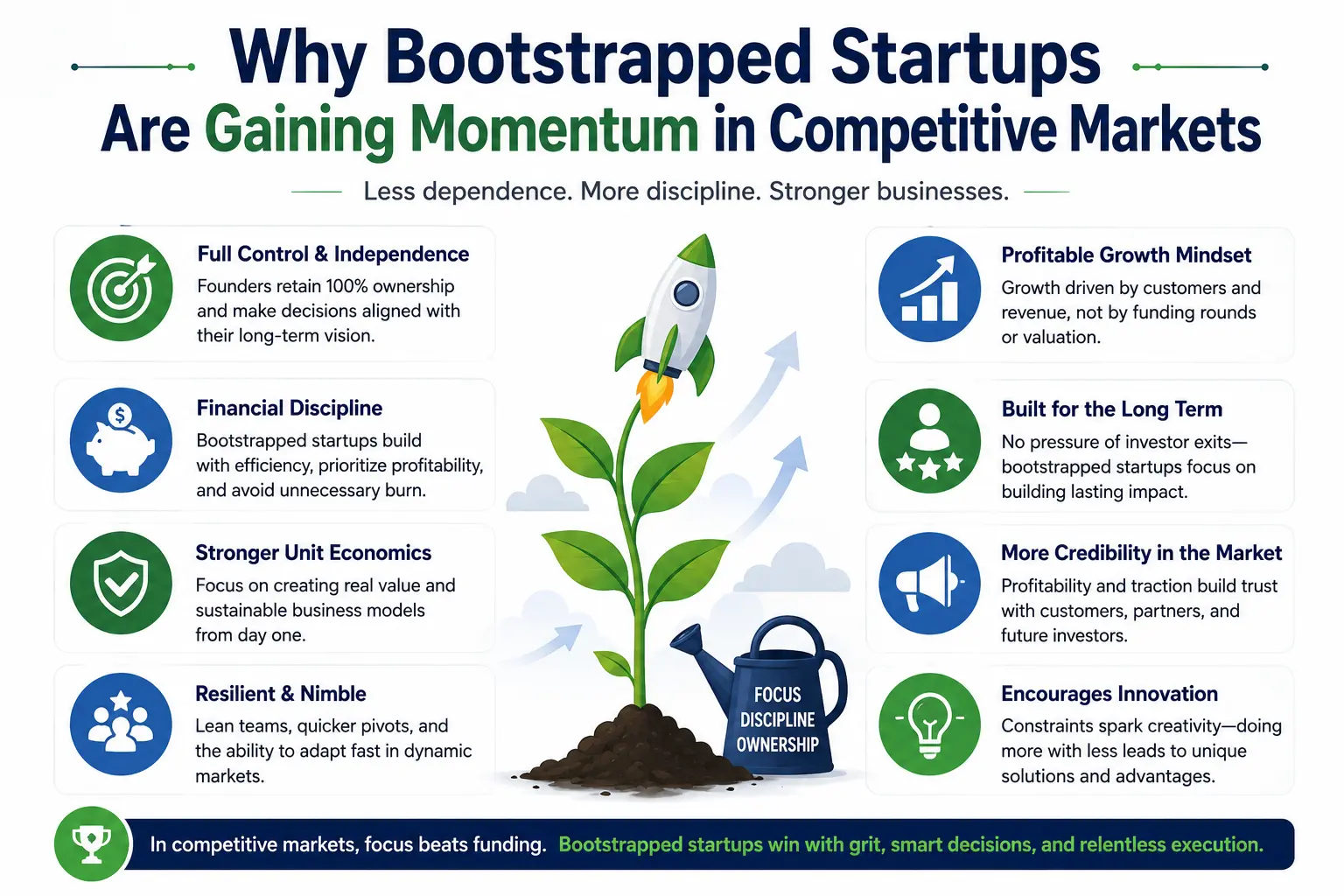
The startup landscape is undergoing a profound structural shift. For years, massive venture capital injections were considered the primary validation of an emerging company’s potential. However, shifting macroeconomic realities and soaring borrowing costs have altered this trajectory. Today, self-funded, bootstrapped startups are outmaneuvering heavily funded competitors by focusing on sustainable unit economics from day one.
By operating within strict financial constraints, these independent founders are forced to prioritize immediate value creation. This lean approach is proving to be a formidable competitive advantage in hyper-saturated marketplaces.
Retaining Absolute Strategic Autonomy and Mission Focus
Venture capital often comes with aggressive growth mandates that pressure companies to scale before establishing a true product-market fit. Self-funded entrepreneurs evade this systemic trap, allowing them to make long-term decisions that prioritize product excellence over arbitrary quarterly benchmarks.
-
Customer-Centric Roadmap: Product updates are driven entirely by paying user feedback rather than the financial exit expectations of external board members.
-
Preserved Equity Control: Founders retain full ownership, ensuring that future profitability directly rewards the internal team and early stakeholders.
-
Agile Strategy Shifts: The absence of bureaucratic investor approval allows bootstrapped teams to pivot their business model within hours in response to shifting market conditions.
-
Selective Talent Acquisition: Hiring focuses strictly on immediate operational utility and cultural alignment, avoiding the bloated corporate structures common in funded firms.
Optimizing Unit Economics for Immediate Profitability
When capital is finite, a business cannot afford to burn cash on unproven customer acquisition channels. Bootstrapped enterprises treat financial discipline as a core operating philosophy, which naturally builds a highly resilient business model.
-
Organic Acquisition Loops: Instead of relying on expensive paid advertising, independent companies leverage content marketing, community building, and word-of-mouth networks to secure users.
-
Lean Tech Stack Management: Every software subscription and infrastructure tool is scrutinized regularly, keeping operational overhead exceptionally low.
-
Value-Based Pricing Structures: Self-funded businesses price their offerings based on the concrete return on investment delivered to the buyer, ensuring healthy gross margins immediately.
-
Iterative Capital Reinvestment: Inward revenue, rather than external funding rounds, fuels expansion, ensuring that growth scales in direct proportion to real market demand.
Building Deeper Customer Trust Through Vulnerability
Consumers and enterprise clients are increasingly wary of venture-backed firms that artificially subsidize prices only to hike fees or abruptly shut down when funding dries up. Bootstrapped entities offer a predictable partnership. Because their survival depends entirely on customer satisfaction, their dedication to service quality is inherently authentic.
This transparency fosters intense brand loyalty. Users are frequently willing to overlook minor feature gaps when they know their subscription fees directly fund continuous, personalized software improvements and responsive, human customer support.
The New Era of Sustainable Business Architecture
The rising momentum of bootstrapped startups marks a healthy return to foundational business mechanics. Success is no longer measured by the size of a fundraising announcement, but by cash flow health, customer retention, and operational freedom. By building slowly, spending intentionally, and listening exclusively to the market, self-funded ventures are proving that financial independence is the ultimate competitive moat.
Frequently Asked Questions
What defines a bootstrapped startup?
A bootstrapped startup is a business launched and scaled using only the founder’s personal savings, initial revenue, and rolling profits, without relying on external venture capital or angel investors.
How do self-funded companies compete with massive corporate marketing budgets?
They focus on highly targeted, low-cost marketing strategies like search engine optimization, niche community engagement, and organic referral systems that build long-term value.
Can a bootstrapped business scale to an enterprise level?
Yes. Many global software and consumer brands scaled to millions in recurring revenue entirely through self-funding before ever considering external partnerships or public offerings.
What is the biggest risk of bootstrapping a venture?
The primary limitation is speed. Without a massive upfront cash injection, product development and market expansion must occur incrementally as revenue allows.
When should a self-funded founder consider external capital?
External funding makes sense only after achieving a stable, highly profitable business model where additional capital serves as an accelerator for a proven growth formula.





Leave a Reply