


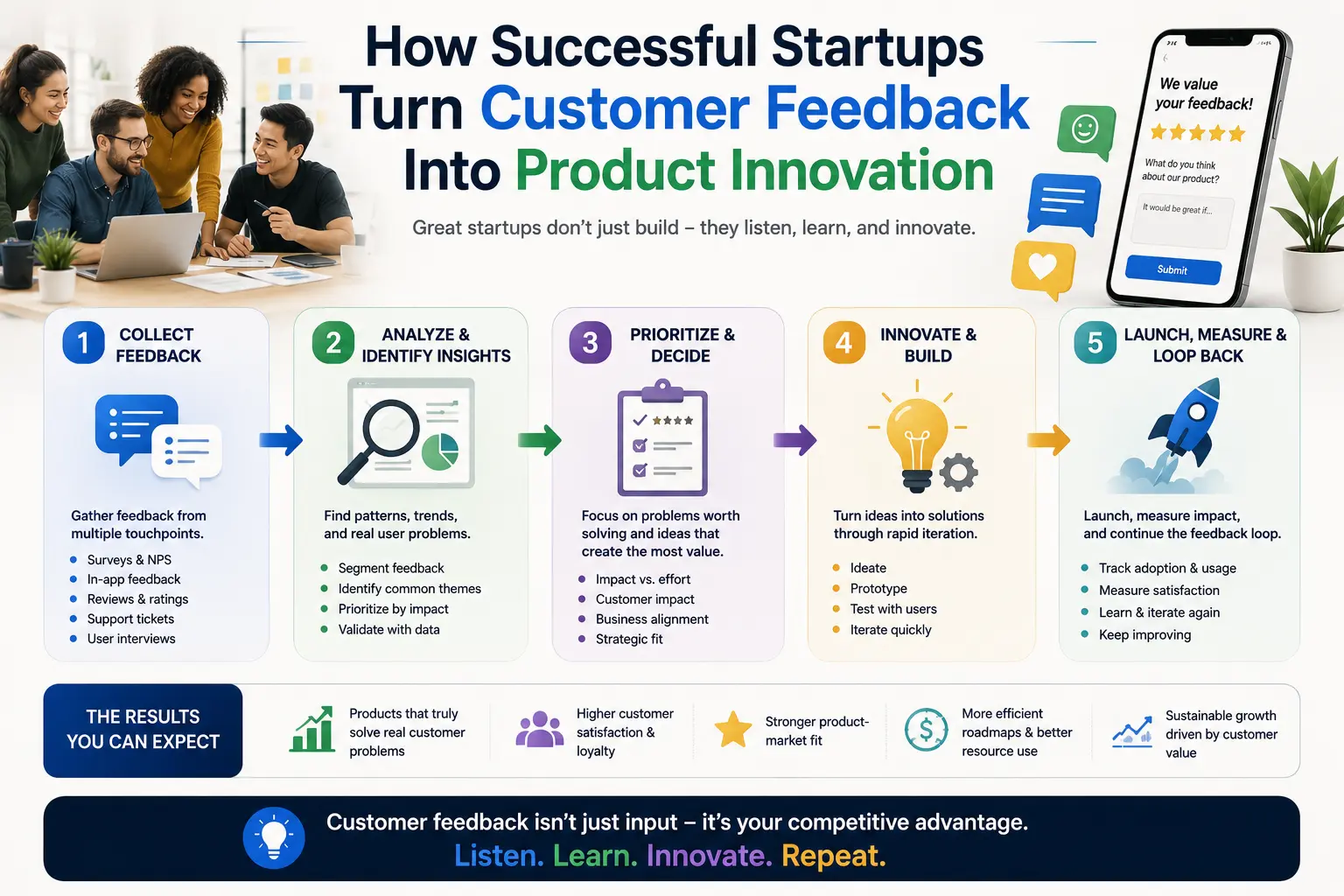
Launching a product is only the first step in a startup’s journey toward commercial sustainability. The true dividing line between transient market entrants and enduring industry leaders lies in how they handle post-launch user data. While legacy corporations rely on retrospective bi-annual surveys, scaling startups establish continuous feedback loops to fuel their development pipelines.
Translating raw customer commentary into meaningful engineering milestones requires an organized methodology. By separating transactional feature requests from deeper operational friction points, agile companies build highly targeted product roadmaps that solve real-world problems.
Establishing Continuous Feedback Harvesting Infrastructure
To fuel consistent engineering breakthroughs, businesses must build proactive channels that capture customer sentiments during live workflows. Relying solely on passive support tickets results in skewed, incomplete data sets that fail to reflect the experiences of the broader user base.
-
Embedded Micro-Surveys: Deploying localized, single-question prompts within the digital workspace immediately after a user interacts with a newly released feature.
-
Automated Telemetry Triggers: Tracking backend behavioral indicators, such as sudden task drop-off rates, to flag hidden UI friction before a client officially complains.
-
Dedicated User Advisory Panels: Assembling a rotation of highly active, communicative accounts to test raw prototypes and offer direct structural feedback.
-
Centralized Knowledge Repositories: Merging unstructured data points from social media, email threads, and sales calls into a single, cross-departmental categorization dashboard.
Deconstructing Customer Sentiments to Isolate Root Needs
Raw feedback is often prescriptive, with users requesting highly specific solutions rather than explaining their fundamental challenges. Successful product engineering requires teams to look past the surface request to uncover the underlying operational bottleneck.
-
Map Feedback to the Core Job-to-Be-Done: Analyze why the user is requesting a specific button or plugin. Frequently, the request stems from a limitation in how the software currently handles core user data or exports files.
-
Quantify Financial Impact and Frequency: Group recurring feedback into a prioritization matrix, indexing requests based on how many users experience the issue and whether it directly impacts retention.
-
Validate Hypotheses via Generative Interviews: Conduct open-ended conversations with selected users, asking them to walk through their current workarounds rather than simply validating your proposed software fix.
-
Deploy Rapid Low-Fidelity Prototypes: Ship basic wireframes or interactive mockups to the requesting user segment to ensure the engineered solution aligns perfectly with their workflow reality.
Aligning Internal Engineering Cycles with User Insights
The final stage of the feedback transformation loop occurs within the internal product release cycle. Once an operational insight is verified, product managers must integrate these user-driven updates directly into active developmental sprints without derailing long-term technological infrastructure projects.
This requires dividing engineering focus into clear, tactical allocations. While a portion of the team works on foundational database scalability, a dedicated rapid-response engineering pod handles immediate workflow enhancements suggested by the community. Transparency closes this loop; publishing dynamic product changelogs showcases to your user base that their observations directly dictate development updates, boosting customer loyalty and feature adoption rates.
Transforming User Sentiment into Competitive Value
Building an innovative product is a collaborative exercise conducted alongside your market. By treating customer feedback as raw data, dissecting it to discover fundamental human needs, and embedding those lessons into an agile engineering workflow, startups can out-innovate larger competitors. Listen explicitly, build transparently, and use the collective intelligence of your audience to secure a resilient market position.
Frequently Asked Questions
How do you prevent a product roadmap from becoming chaotic due to too much feedback?
Startups must filter all incoming suggestions through their core company mission and North Star Metric. If a user request does not align with the product’s ultimate value proposition, it should be politely declined.
What is the danger of relying exclusively on power-user feedback?
Power users develop highly advanced workflows that do not represent the average client. Designing features solely for them can make your platform overly complex and intimidating for new users.
How can early-stage businesses incentivize users to complete feedback surveys?
The best incentive is rapid execution. When customers see their suggestions implemented quickly into the live application, they feel a sense of co-ownership and willingly participate in future research.
What is the difference between explicit and implicit feedback?
Explicit feedback is directly communicated by the user via text, reviews, or support calls. Implicit feedback is gathered by observing behavioral analytics, session recordings, and click maps.
Should startups publicly share their upcoming product feature roadmap?
Sharing a high-level theme or interactive feedback board builds intense community trust, but publishing precise release dates can create unnecessary public pressure and limit internal development pivots.





Leave a Reply