


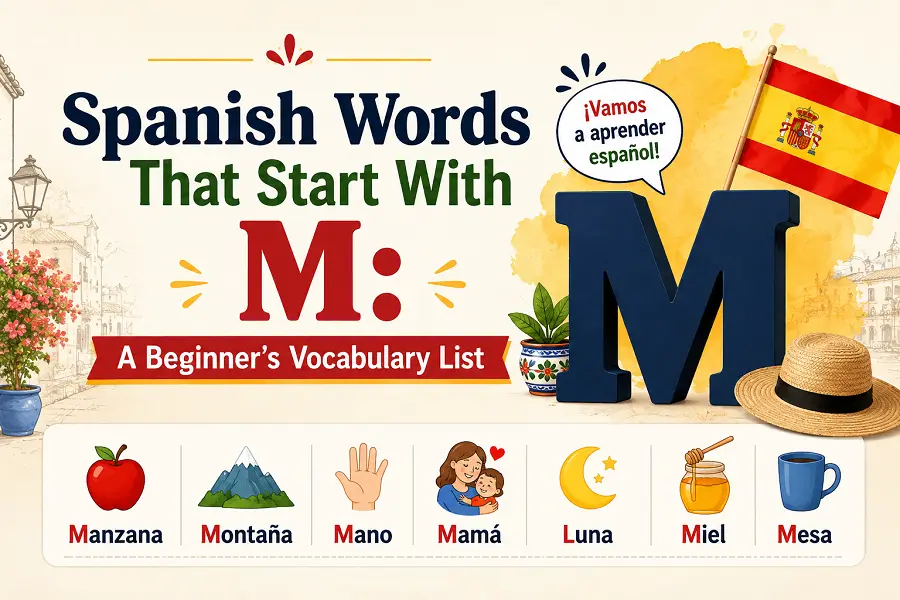
I still remember the first Spanish word I ever learned on purpose, not by accident from a menu or a song. It was “mesa.” Table. My tutor tapped the wooden table between us and said it three times until I stopped saying “messa” like it rhymed with “dresser.” That’s the thing about M — it’s one of the friendliest letters in Spanish. It sounds almost the same as it does in English, so you’re not fighting your mouth to make a new sound. You’re just building vocabulary.
If you searched for spanish words that start with m, you’re probably looking for one of two things: a study list to memorize, or quick answers about specific categories like adjectives or place names. This guide covers both. No fluff, no filler — just words you’ll actually use, organized so you can find what you need fast.
Common Spanish Words That Start With M
Let’s get straight to the list. These are everyday words — the kind you’ll hear in a grocery store, a classroom, or a phone call with a Spanish-speaking friend.
| Spanish | English | Notes |
|---|---|---|
| mesa | table | Feminine noun (la mesa) |
| mano | hand | Tricky one — it’s feminine even though it ends in -o |
| madre | mother | |
| mundo | world | |
| mañana | tomorrow / morning | Context tells you which |
| mujer | woman | Also means “wife” in some contexts |
| mercado | market | |
| miedo | fear | “Tener miedo” = to be afraid |
| momento | moment | |
| mochila | backpack | |
| música | music | |
| mentira | lie (noun) | |
| mapa | map | Masculine, despite ending in -a |
| mes | month | |
| medicina | medicine |
Notice “mano” and “mapa”? Those are the exceptions Spanish teachers love to quiz you on. Most nouns ending in -a are feminine and most ending in -o are masculine, but this pair breaks the pattern. I got “el mapa” wrong on a test once and never forgot it again — sometimes the mistake is the lesson.
M Spanish Words for Everyday Conversation
Beyond nouns, you’ll want verbs and connector words that come up constantly in real conversations.
- mirar – to look at
- mover – to move
- mostrar – to show
- mejorar – to improve
- mentir – to lie
- merecer – to deserve
- mezclar – to mix
- molestar – to bother
- más – more
- muy – very
- mientras – while
- mucho / mucha – a lot, much
A quick tip from experience: “más” and “muy” trip up a lot of beginners because English speakers want to use “more” and “very” interchangeably. In Spanish they’re not. “Muy bien” (very good) works, but “más bien” means something closer to “rather” or “actually.” Small word, different job.
Adjectives in Spanish That Start With M
This is one of the most searched categories, and for good reason — adjectives are what make your sentences sound less like a phrasebook and more like a person talking.
| Spanish | English |
|---|---|
| malo / mala | bad |
| mejor | better |
| mayor | older / bigger |
| moderno / moderna | modern |
| mojado / mojada | wet |
| maravilloso / maravillosa | wonderful |
| molesto / molesta | annoying / bothered |
| mismo / misma | same |
| macho | male (animals, sometimes people) |
| medio / media | half, medium |
Here’s something worth knowing: most Spanish adjectives change their ending depending on whether they’re describing something masculine or feminine (“malo” for “un día malo,” but “mala” for “una idea mala”). It’s not optional, and it’s one of the first habits that separates someone who’s memorized words from someone who’s actually learning the language.
Places in Spain Starting With M
If you’re planning a trip, studying geography, or just curious, Spain has several notable cities and regions that start with M.
- Madrid – the capital city, obviously the big one
- Málaga – coastal city in Andalusia, known for beaches and Picasso’s birthplace
- Murcia – a region and city in the southeast
- Marbella – upscale resort town on the Costa del Sol
- Mallorca – the largest of the Balearic Islands
- Menorca – another Balearic island, quieter than Mallorca
- Melilla – a Spanish autonomous city on the north coast of Africa
- Mérida – historic city in Extremadura with Roman ruins
I’ll be honest — when people ask about “places in Spain starting with M,” they usually mean Madrid or Mallorca. But Mérida deserves more attention than it gets. It has one of the best-preserved Roman amphitheaters outside of Italy, and it barely makes anyone’s first-time-visitor list.
A Simple Way to Actually Remember These Words
Lists are useful for reference, but they’re not how vocabulary sticks. What worked for me — and what most language tutors will tell you too — is using new words in a sentence within the same day you learn them, even a clumsy one. “Mi mochila es mala” (my backpack is bad) isn’t a sentence you’ll find in a textbook, but it uses three M words and it’s mine. That ownership is what makes it memorable.
Flashcard apps help with repetition, but they can’t replace actually speaking or writing the word in context. If you only recognize “miedo” on a flashcard but freeze when you need it in conversation, the flashcard hasn’t done its full job yet.
A Word of Caution
Not every M word behaves the way you’d expect, and Spanish has regional variation too. “Mochila” is standard for backpack almost everywhere, but some words shift meaning depending on the country — Spain, Mexico, and Argentina don’t always use vocabulary the same way. If you’re learning for a specific purpose, like traveling to one country or talking to a specific person, it’s worth double-checking regional usage rather than assuming every Spanish-speaking country uses a word identically.
Final Thoughts
M is one of the easier letters to build vocabulary around because so many words are either intuitive or genuinely common in daily conversation. Start with the nouns and adjectives you’ll use most, get comfortable with the gender exceptions like “el mapa” and “la mano,” and don’t be afraid to make a weird sentence just to lock a word into memory. That’s really how it sticks.
Frequently Asked Questions
1. What are some common Spanish words that start with M?
Common ones include mesa (table), mano (hand), madre (mother), mundo (world), and mercado (market) — all words you’ll hear often in daily conversation.
2. What are words that start with M in Spanish for beginners?
Beginners should focus on high-frequency words like más (more), muy (very), mucho (a lot), mirar (to look), and mañana (tomorrow), since these appear constantly in basic conversation.
3. Are there Spanish words that start with an M that are false friends with English?
Yes — “mole” isn’t the same as the English word, and “molestar” means “to bother,” not the more serious meaning it carries in English. Context matters a lot here.
4. What are some M Spanish words used in greetings or daily phrases?
“Muy bien” (very good), “mucho gusto” (nice to meet you), and “mi nombre es” (my name is) are common phrases beginners learn early.
5. What adjectives in Spanish start with M?
Some common ones are malo (bad), mejor (better), mayor (older/bigger), moderno (modern), and mismo (same).
6. Do Spanish adjectives that start with M change based on gender?
Many do. For example, “malo” becomes “mala” when describing a feminine noun. Not all adjectives change (like “mismo” in some fixed phrases), so it’s worth learning each one individually.
7. What are some places in Spain that start with M?
Madrid, Málaga, Murcia, Marbella, Mallorca, Menorca, Melilla, and Mérida are all well-known places in Spain starting with M.
8. Is Mallorca part of Spain? Yes, Mallorca is the largest island in the Balearic Islands, an autonomous community of Spain.
9. What does “mano” mean in Spanish, and why is it tricky?
“Mano” means “hand.” It’s tricky because it ends in -o but is actually a feminine noun (“la mano”), which breaks the usual gender pattern.
10. What is the Spanish word for “market”?
“Mercado” is the Spanish word for market.
11. How do I remember Spanish M words more effectively?
Using the word in your own sentence the same day you learn it works better than passive repetition alone. Speaking or writing it in context helps it stick.
12. What is the Spanish word for “fear”?
“Miedo” means fear. It’s commonly used in the phrase “tener miedo” (to be afraid).
13. Are there M words in Spanish that differ by country or region?
Yes. Spanish vocabulary can vary between Spain, Mexico, Argentina, and other Spanish-speaking countries, so some M words may carry slightly different meanings or usage depending on the region.
14. What’s the difference between “más” and “muy” in Spanish?
“Más” means “more” and is used for comparisons, while “muy” means “very” and intensifies an adjective. They’re not interchangeable.
15. What is a good first M word to learn in Spanish?
“Mesa” (table) is a great starting point — it’s simple, common, and easy to pronounce for English speakers.










Leave a Reply