


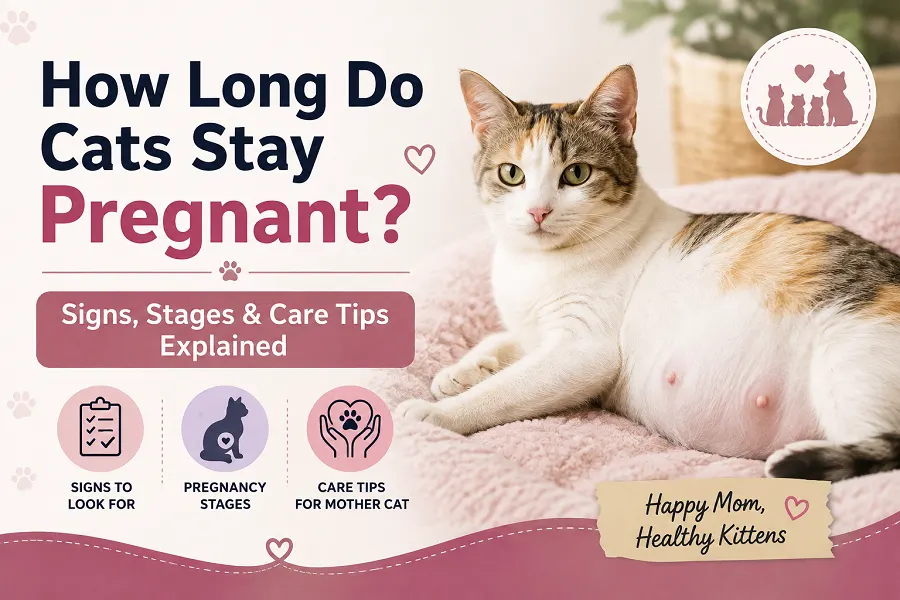
Nine weeks. That’s roughly what you’re looking at if your cat just got pregnant — give or take a few days. But if you’re here because you found your cat looking a little rounder than usual, or you caught her mating a few weeks back and now you’re doing the math, you probably want more than just a number. So let’s get into it.
How Long Are Cats Pregnant For, Exactly?
A cat’s pregnancy — vets call it “gestation” — typically lasts 63 to 65 days, which works out to about nine weeks. Some cats deliver a bit early, around day 61, and others carry a few days past day 65. Anything from 58 to 70 days is still considered within the normal range, so don’t panic if your cat’s timeline doesn’t line up perfectly with the textbook number.
I’ll admit, the first time I helped a friend track her cat’s pregnancy, we were convinced something was wrong when kittens hadn’t arrived by day 63. Turned out the queen (that’s the technical term for a mother cat, by the way) just needed four more days. She delivered five healthy kittens on day 67. Cats don’t read the manual.
One thing worth knowing: unlike dogs, cats can experience something called superfetation — where a cat gets pregnant again while already pregnant, resulting in two litters conceived at different times but born around the same period. It’s rare, but it happens, and it’s part of why gestation length can seem to vary so widely between cats.
Signs Your Cat Might Be Pregnant
Cats aren’t exactly forthcoming about these things, so you’ll need to watch for physical and behavioral clues.
Early signs (weeks 2-3):
- “Pinking up” — her nipples become noticeably darker pink and slightly enlarged. This is usually the first visible sign, appearing around day 15-18.
- Mild nausea or a brief loss of appetite (yes, cats get something like morning sickness too)
- Increased affection or, in some cats, the opposite — more withdrawal
Mid-pregnancy signs (weeks 4-6):
- A visibly swelling belly, though this can be subtle in cats with longer fur
- Weight gain, typically 2-4 pounds total by the end of pregnancy
- Noticeably increased appetite — she’s eating for a litter now
Late signs (weeks 7-9):
- Nesting behavior — she’ll start scouting out quiet, enclosed spaces (closets, under beds, laundry baskets)
- Restlessness and pacing as she gets closer to delivery
- Visible kitten movement in the belly, sometimes seen as ripples across her side
If you’re not sure, a vet can confirm pregnancy through abdominal palpation as early as day 17-25, or with an ultrasound around day 21, which also lets you check on kitten viability. X-rays work too, but not until around day 42-45, once the kittens’ skeletons have calcified enough to show up.
The Stages of Cat Pregnancy, Week by Week
Breaking it down by week helps make sense of what’s actually happening inside.
Weeks 1-2: Fertilization happens within a day or two of mating, and the embryos implant in the uterus by around day 12-13. Nothing visible yet, but hormonal shifts are already underway.
Weeks 3-4: This is when nipples start “pinking up.” Some cats go off their food briefly. A vet visit around this window can confirm pregnancy via palpation, though I’d suggest waiting for an ultrasound if you want a clearer picture — palpation too early can actually be risky, since pressing on the abdomen might harm developing embryos if done by an inexperienced hand.
Weeks 5-6: The belly starts rounding out. Kittens are developing rapidly — by day 40, they have distinguishable features. Your cat’s appetite will climb noticeably; expect her to eat 25-50% more than her pre-pregnancy amount by the end.
Weeks 7-8: Nesting instinct kicks in hard. She’ll paw at blankets, disappear into closets, and generally act like she’s preparing for something big — because she is. This is the time to set up a quiet whelping box if you haven’t already.
Week 9 (days 63-65): Labor typically begins. Signs include restlessness, vocalizing, a drop in body temperature (below 100°F), and sometimes refusing food for the last 24 hours. Delivery of the full litter usually takes 2-6 hours, though it can stretch longer, especially for a first-time mother.
How Many Kittens Should You Expect?
The average litter is 4 kittens, but anywhere from 1 to 8 is normal. Younger cats and first-time mothers tend to have smaller litters, while cats in their prime (2-5 years old) often have larger ones. Breed plays a role too — Siamese and Oriental cats, for instance, are known for bigger litters compared to some other breeds.
Caring for a Pregnant Cat: What Actually Helps
Here’s where a lot of well-meaning advice online gets it wrong. You don’t need to do much — cats have been handling this for thousands of years without human intervention. But a few things genuinely help:
Nutrition matters more than people realize. Switch her to a high-quality kitten food (yes, kitten food, not adult food) around week 4-5. It’s calorie-dense and packed with the extra protein and fat she needs to support herself and a growing litter. Don’t just increase her regular food — the nutrient ratios matter.
Skip unnecessary vet visits, but don’t skip the important ones. A confirmation exam and maybe one follow-up ultrasound is usually enough for a healthy, low-risk pregnancy. Constant handling and vet trips can actually stress her out. That said, if she stops eating for more than a day, seems lethargic, or has any discharge that isn’t clear, get her checked immediately — those aren’t normal.
Set up the nesting box early, not at the last minute. A cardboard box lined with towels, placed somewhere dark and quiet, away from foot traffic. Introduce it around week 6 so she has time to get comfortable with it before she actually needs it. If you wait too long, she might choose her own spot instead — and it’s not always somewhere convenient, like inside your closet or under a mattress.
Keep her indoors. This one’s non-negotiable in my opinion. An outdoor pregnant cat is at risk from other animals, traffic, and the possibility of getting picked up by another tom cat before her current litter is even born (remember that superfetation thing?).
I’ll be honest about a limitation here: even with the best care, not every pregnancy goes smoothly. Complications like dystocia (difficult labor) do happen, particularly in flat-faced breeds like Persians. If your cat has been in active labor for more than an hour without producing a kitten, or she’s crying in obvious distress, that’s an emergency vet situation, not a wait-and-see one.
When to Call the Vet During Pregnancy or Labor
Don’t wait it out if you notice:
- No kittens after more than an hour of strong contractions
- Green or dark discharge before any kittens are born
- More than 2-3 hours between kittens with the mother still straining
- Signs of extreme pain or distress
- A fever, or body temperature that doesn’t rise back to normal after dropping for labor
Trust your instincts here. If something feels off, a phone call to your vet costs nothing, and it’s always better than guessing.
The Bottom Line
So, how long are cats pregnant for? About 63 to 65 days, or roughly nine weeks, though a few days on either side is completely normal. Watch for the early signs — pinking nipples, appetite changes, that telltale belly — and you’ll have a pretty good read on where she is in the process. Most cats handle pregnancy and birth just fine on their own instincts. Your job is mostly to feed her well, give her a quiet space, and know when something’s genuinely wrong versus when it’s just cats being cats.
FAQs
1. How long are cats pregnant for?
Cats are typically pregnant for 63 to 65 days, or about nine weeks, from the day of mating to delivery.
2. How long is a cat pregnant compared to a dog?
Cats have a slightly shorter pregnancy than dogs. Dogs are pregnant for about 63 days on average too, but cat litters tend to be born a touch more consistently within the 63-65 day window.
3. Can a cat’s pregnancy last longer than 65 days?
Yes, some pregnancies extend to 66-70 days and are still considered normal. If it goes beyond 70 days without labor starting, contact your vet.
4. How can I tell if my cat is pregnant without a vet visit?
Look for pinking nipples around week 3, a swelling belly by week 5, increased appetite, and nesting behavior in the final weeks. These signs are a strong indicator, though a vet visit gives you a confirmed answer.
5. How many weeks is a cat pregnant?
About nine weeks total, which breaks down to roughly 63-65 days.
6. What should I feed my pregnant cat?
Switch her to a high-quality kitten food starting around week 4-5. It provides the extra calories, protein, and fat she needs during pregnancy and nursing.
7. How many kittens do cats usually have?
The average litter size is 4 kittens, though litters of 1 to 8 are all within normal range.
8. Do cats show signs of pregnancy early?
Yes, the earliest reliable sign is “pinking up” of the nipples, usually visible around 15-18 days after mating.
9. Is it safe to feel a cat’s belly to check for pregnancy?
It’s best left to a vet. Careless palpation, especially in early pregnancy, can potentially harm the developing embryos.
10. What is a whelping box and when should I set one up?
A whelping box is a quiet, enclosed space where your cat can give birth and nurse safely. Set it up around week 6 so she has time to get familiar with it.
11. Can a cat get pregnant again while already pregnant?
Yes, through a rare phenomenon called superfetation, where a cat conceives a second litter while still carrying an earlier one.
12. How long does labor take once it starts?
Delivering a full litter usually takes 2 to 6 hours, though first-time mothers or larger litters can take longer.
13. What are signs of labor complications in cats?
Watch for more than an hour of straining without a kitten, green or dark discharge before delivery, or visible extreme distress. These need immediate vet attention.
14. Should I keep my pregnant cat indoors?
Yes. Indoor cats are safer from traffic, predators, and the risk of mating again before her current litter is born.
15. At what age can cats get pregnant?
Cats can technically become pregnant as early as 4-6 months old, though it’s healthier to wait until they’re fully grown, ideally after their first year, before breeding.











Leave a Reply