


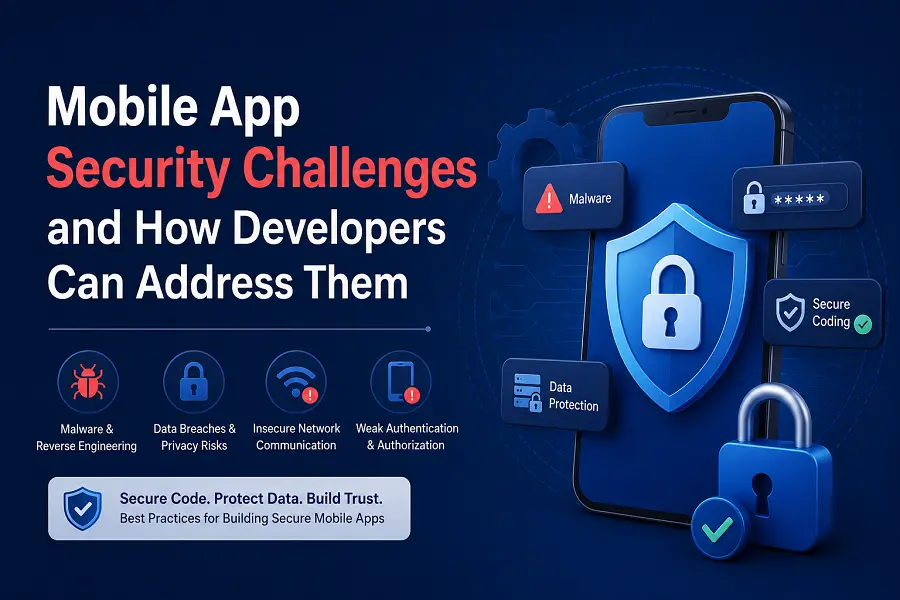
Every mobile app that handles user data carries a security responsibility. Yet breaches keep happening — not because developers are careless, but because attack surfaces are expanding faster than many teams can track. Threat actors have become more systematic, targeting mobile specifically because it sits at the intersection of personal data, financial access, and always-on connectivity.
Understanding where vulnerabilities live — and how to close them — is now a baseline requirement, not an advanced skill.
Insecure Data Storage Remains the Most Exploited Weakness
More sensitive data gets stored incorrectly on mobile devices than any other category of vulnerability. Developers under deadline pressure reach for convenient storage options — shared preferences, local SQLite databases, or plain-text log files — without considering what happens when those locations are accessed by a malicious app or a physical attacker with device access.
The most common mistakes include:
- Storing authentication tokens or API keys in unencrypted local files
- Writing sensitive user inputs to application logs that persist after sessions end
- Caching financial or health data in temporary directories without expiration controls
- Keeping personally identifiable information in shared storage accessible to other apps
The fix isn’t complicated, but it requires deliberate choices at the architecture stage. Sensitive data should be encrypted at rest using platform-native secure storage — Android Keystore and iOS Secure Enclave exist precisely for this purpose. Data that doesn’t need to persist should be cleared aggressively. Logging pipelines should never capture fields that contain personal or financial information, regardless of environment.
API Security Is Where Most Modern Breaches Actually Begin
Mobile apps are largely thin clients — their real logic lives in backend APIs. This means the attack surface isn’t just the app itself; it’s every endpoint the app communicates with. Poorly secured APIs account for a growing share of successful breaches targeting mobile platforms.
Developers can close the most critical API vulnerabilities by addressing these five areas:
- Authentication enforcement — every API endpoint must verify identity; unauthenticated endpoints are open doors regardless of how secure the app feels on the surface
- Token expiration and rotation — long-lived tokens that never expire give attackers unlimited time after a single credential compromise
- Rate limiting — without request throttling, credential stuffing and brute-force attacks can run indefinitely against login and password reset endpoints
- Input validation server-side — client-side validation is a UX convenience, never a security control; servers must validate and sanitize every input independently
- Verbose error messages — stack traces and detailed error responses returned to clients hand attackers a map of internal architecture; production APIs should return minimal, generic error information
Certificate pinning adds an additional layer by ensuring the app only communicates with known, legitimate servers — blocking man-in-the-middle attacks even when a user’s network is compromised.
Weak Authentication Puts Users at Risk Long After Installation
Authentication failures are consistently ranked among the highest-severity mobile vulnerabilities, and the patterns are frustratingly predictable. Weak password policies, absent multi-factor authentication, and improperly implemented biometric flows all create entry points that sophisticated attackers exploit routinely.
Biometric authentication deserves specific attention. Implementing Face ID or fingerprint login incorrectly — particularly by storing biometric data outside the secure enclave or failing to validate the authentication result server-side — creates a false sense of security. The biometric check must be tied to a cryptographic challenge verified by the backend, not just a local boolean the app trusts.
Practical authentication hardening steps every team should implement:
- Enforce minimum credential complexity without making requirements so strict that users write passwords down
- Implement adaptive authentication that escalates verification requirements for high-risk actions like fund transfers or account changes
- Build session invalidation that works reliably across devices when a user logs out or a breach is suspected
- Test authentication flows specifically for bypass attempts, not just successful login paths
Third-Party SDKs Introduce Risks Developers Don’t Control
Most mobile apps ship with multiple third-party SDKs — analytics, advertising, crash reporting, payment processing. Each one is a dependency the development team didn’t write and may not deeply understand. When a widely used SDK contains a vulnerability, every app that includes it inherits that exposure.
This isn’t a reason to avoid SDKs, but it is a reason to treat them with the same scrutiny applied to first-party code. Unreviewed SDK permissions, automatic updates pulling unvetted versions, and SDKs requesting broader device access than their function requires are all common problems with straightforward mitigations.
Teams should maintain an active inventory of every SDK in their codebase, review permission requests before each update, and monitor security advisories for dependencies the same way they monitor their own code for vulnerabilities.
Conclusion
Mobile app security isn’t a feature added before launch — it’s a discipline embedded in every stage of development. Insecure storage, exposed APIs, weak authentication, and unvetted dependencies each represent a different attack vector, but they share a common thread: they’re all preventable with intentional design choices made early.
Users trust apps with their most sensitive data. That trust is the hardest thing to rebuild once it’s broken — and the easiest thing to protect when security is treated as a first principle rather than an afterthought.
FAQs
1. What is the most common mobile app security vulnerability in 2026?
Insecure data storage remains the most frequently exploited vulnerability. Sensitive information stored in unencrypted local files, logs, or accessible databases gives attackers easy access when a device is compromised or a malicious app is present.
2. How should developers secure API communication in mobile apps?
Developers should enforce authentication on every endpoint, implement token expiration and rotation, apply server-side input validation, enable rate limiting, and use certificate pinning to prevent man-in-the-middle attacks. No single measure is sufficient — layered controls are essential.
3. Is biometric authentication safe for mobile apps?
Biometric authentication is secure when implemented correctly. The critical requirement is that the biometric result must be verified server-side using a cryptographic challenge — not simply trusted as a local confirmation. Biometric data itself must never leave the device’s secure enclave.
4. How do third-party SDKs create security risks?
SDKs introduce code the development team didn’t write and may not fully audit. A vulnerability in a widely used SDK affects every app that includes it. Risks also arise from excessive permissions, automatic version updates pulling unvetted changes, and inadequate monitoring of security advisories for dependencies.
5. When should security testing happen in the mobile app development cycle?
Security testing should be continuous, not a final-stage checkpoint. Threat modeling belongs at the design phase, secure code reviews during development, penetration testing before release, and ongoing monitoring post-launch. Vulnerabilities found late cost significantly more to fix than those caught early.






Leave a Reply