


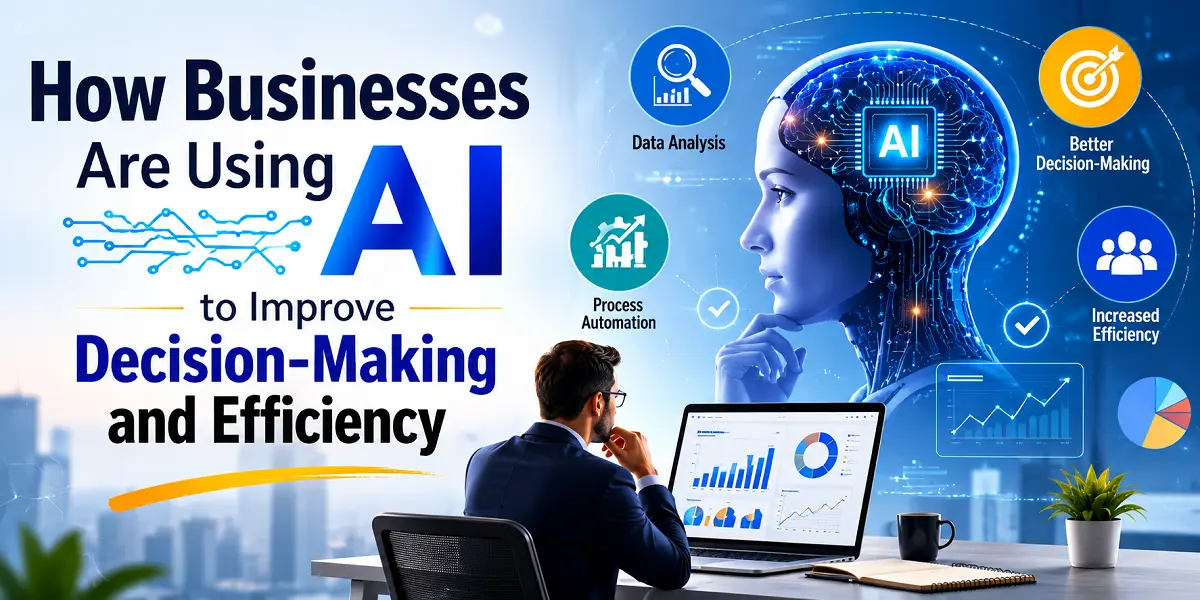
Every business makes hundreds of decisions daily. Most are small — resource allocation, customer prioritization, inventory adjustments. Some are consequential — market entry, hiring, pricing strategy. What separates high-performing organizations in 2026 from the rest isn’t just the quality of those decisions. It’s the speed, consistency, and data foundation behind them.
Artificial intelligence has moved from boardroom conversation to operational backbone. The businesses seeing real results aren’t the ones experimenting with AI — they’re the ones embedding it into how work actually gets done.
Predictive Analytics Is Replacing Reactive Decision-Making
Traditional business intelligence told leaders what happened. Predictive analytics tells them what’s likely to happen next — and that shift in temporal perspective changes everything about how organizations plan and respond.
Supply chain managers are using predictive models to anticipate demand fluctuations weeks before they appear in sales data, adjusting procurement and logistics before shortages or surpluses materialize. HR teams are identifying flight-risk employees based on behavioral signals — reduced collaboration, changed work patterns, longer response times — and intervening with retention conversations before resignations arrive.
The business functions where predictive analytics is delivering measurable impact include:
- Sales forecasting — models trained on historical cycles, seasonal patterns, and market signals produce pipeline predictions significantly more accurate than manual estimates
- Maintenance scheduling — industrial equipment monitored continuously triggers service alerts based on performance degradation, replacing fixed maintenance windows with condition-based intervention
- Credit and fraud risk — financial institutions assess transaction risk in milliseconds using models that detect anomalies invisible to human reviewers
- Customer churn prediction — subscription businesses identify disengaging users early enough to intervene with targeted retention offers before cancellation decisions are made
The common thread is time. Predictive AI compresses the gap between signal and response — giving decision-makers the advantage of acting before problems become crises.
Intelligent Automation Is Eliminating the Work That Slows Teams Down
There’s a category of work that exists in every organization: necessary, rule-based, time-consuming, and almost entirely joyless. Invoice processing, compliance documentation, data entry, report generation, meeting scheduling, contract review. AI automation is systematically eliminating this category — not by replacing the people who do it, but by freeing them from it.
The distinction between basic automation and intelligent automation matters here. Basic automation follows fixed rules and breaks when inputs deviate. Intelligent automation reads context, handles variation, and escalates genuinely ambiguous cases to human judgment while processing everything routine without intervention.
Organizations implementing intelligent automation effectively follow a consistent deployment pattern:
- Map processes before automating them — automation applied to a broken process produces broken results faster; workflow analysis precedes tool deployment
- Start with high-volume, low-complexity tasks — quick wins build organizational confidence and demonstrate ROI before tackling complex workflows
- Design human escalation paths deliberately — every automated workflow needs a clear handoff point for edge cases that require judgment
- Measure time recaptured, not headcount reduced — sustainable automation expands organizational capacity; the value appears in what teams accomplish with recovered time, not in staff reductions
- Iterate based on exception patterns — cases the system escalates reveal where rules need refinement; exception logs are a continuous improvement resource
Teams operating with intelligent automation handling routine tasks consistently report higher output on strategic work — not because they’re working harder, but because fewer cognitive interruptions are fragmenting their attention.
AI-Assisted Decision Support Is Strengthening Human Judgment
The most sophisticated application of AI in business decision-making isn’t replacement — it’s augmentation. Decision support systems that surface relevant data, flag contradictory evidence, and model scenario outcomes give human decision-makers a significantly stronger foundation without removing accountability from the equation.
Executive teams are using AI scenario modeling to stress-test strategic plans against variable market conditions before committing resources. Legal teams are using contract analysis tools that surface risk clauses and precedent conflicts across thousands of documents in the time a human reviewer would need for ten. Medical directors are using diagnostic support systems that cross-reference patient presentations against clinical literature to surface differential diagnoses worth investigating.
What these applications share is a design philosophy: AI presents options, surfaces evidence, and highlights uncertainty — humans make the call. This division of labor plays to the genuine strengths of both. AI handles volume, consistency, and pattern recognition across large datasets. Humans handle ethical judgment, contextual nuance, and accountability.
Organizations that conflate AI support with AI decision-making create a different kind of risk — one where accountability becomes diffuse and judgment atrophies from disuse.
Real-Time Data Processing Is Closing the Gap Between Insight and Action
Batch reporting — weekly dashboards, monthly performance reviews, quarterly business analysis — creates a structural delay between what’s happening and what leaders know about it. AI-powered real-time processing is collapsing that delay to near-zero in organizations that have invested in the underlying data infrastructure.
Retail operations monitoring sales velocity, inventory levels, and competitor pricing simultaneously can now adjust promotions and pricing dynamically within hours rather than waiting for weekly merchandising meetings. Marketing teams with real-time campaign performance data can reallocate budget toward performing channels the same day underperformance appears rather than discovering it in next week’s report.
The competitive advantage isn’t just speed — it’s the compounding effect of many faster decision cycles over time.
Conclusion
AI isn’t improving business decision-making by making humans redundant — it’s improving it by giving humans better information, faster, with less noise. Predictive analytics replaces hindsight with foresight. Intelligent automation reclaims the hours consumed by routine work. Decision support systems strengthen judgment without displacing it. Real-time processing closes the gap between events and awareness.
The businesses extracting the most value from AI share one characteristic: they treat it as infrastructure for better human decisions, not a substitute for making them.
FAQs
1. How is AI improving business decision-making beyond basic data analysis?
AI moves beyond descriptive analysis by predicting future outcomes, identifying patterns across datasets too large for human review, and modeling scenario consequences before decisions are made. The result is decisions made on stronger evidence with less lag between signal and response.
2. What is the difference between basic automation and intelligent automation?
Basic automation executes fixed rules and fails when inputs vary. Intelligent automation reads context, handles variation within defined parameters, and escalates genuinely ambiguous situations to human judgment — making it applicable to far more complex and variable business processes.
3. Does AI decision support reduce the need for human judgment in business?
No — well-designed AI decision support enhances human judgment rather than replacing it. AI surfaces evidence, flags contradictions, and models scenarios. Humans retain accountability for the final decision. Organizations that blur this distinction create diffuse accountability and risk atrophying the judgment AI is meant to support.
4. Which business functions benefit most from predictive AI?
Sales forecasting, supply chain management, employee retention, fraud detection, and customer churn prediction consistently show the strongest returns from predictive AI. These functions share a common trait: they involve recurring decisions where historical patterns meaningfully predict future outcomes.
5. How should a business begin implementing AI for operational efficiency?
Start by identifying high-volume, rule-based processes that consume significant team time but require minimal creative judgment. Map the process thoroughly before applying automation, establish clear metrics for success, and build human escalation paths for exceptions. Early wins in straightforward use cases build the organizational confidence needed for more complex deployments.







Leave a Reply