


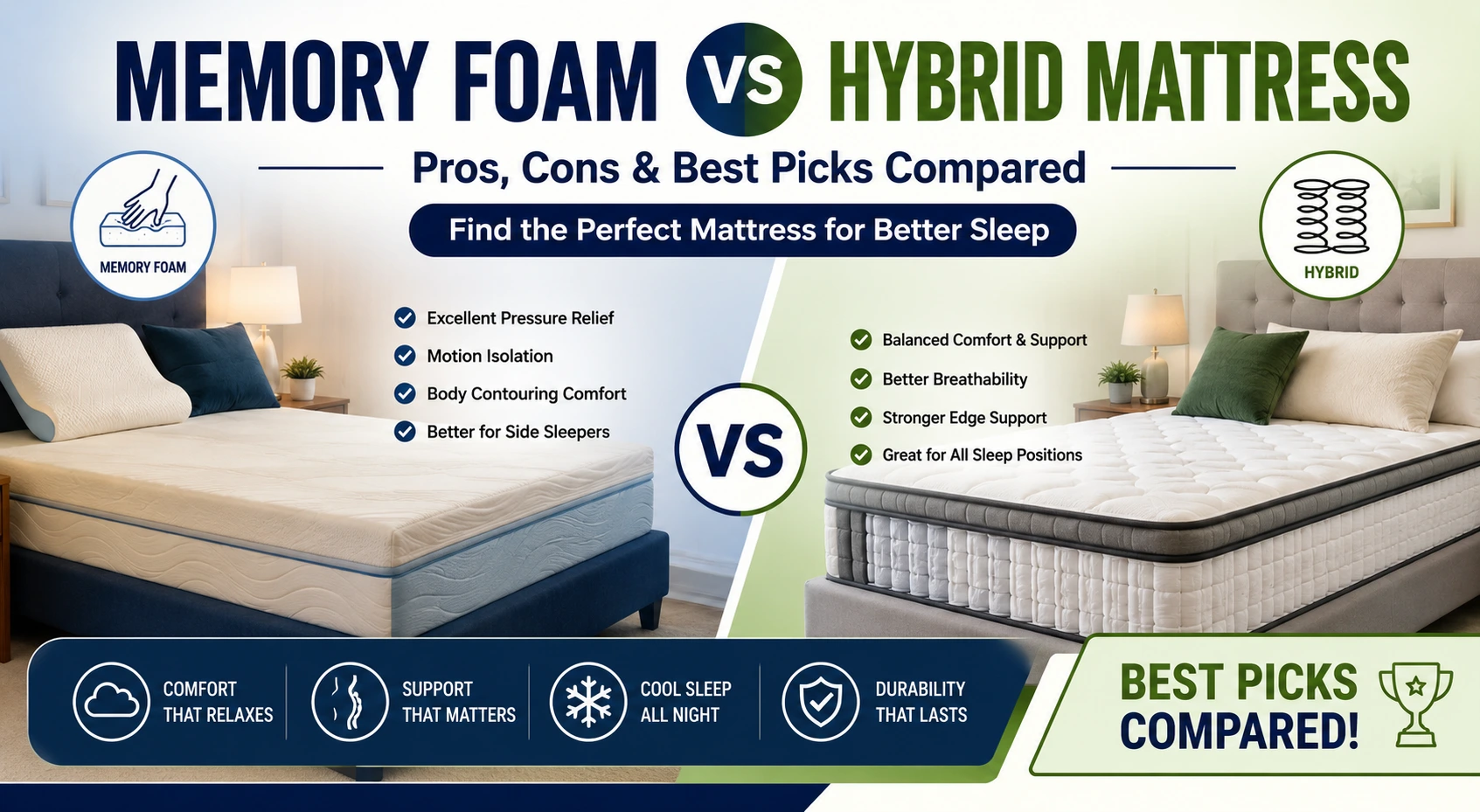
Somewhere around 2 a.m., after flipping my pillow for the fourth time, I finally admitted I needed a new mattress. What I didn’t expect was to spend three weekends reading spec sheets like they were legal documents. If you’ve landed here trying to make sense of memory foam vs hybrid mattress options, you’re probably in that same boat — tired, a little overwhelmed, and just want someone to lay it out straight. So let’s do that.
The Short Answer First
Memory foam mattresses contour closely to your body, isolate motion well, and tend to cost less — but they can sleep hot and feel a bit like sinking into wet sand if you’re a stomach or back sleeper who needs more support. Hybrid mattresses combine coil support systems with a foam comfort layer, so they sleep cooler, feel more responsive, and generally suit a wider range of sleep positions and body types — but you’ll usually pay more, and you might feel a bit more motion transfer than pure memory foam.
If you share a bed and one of you tosses around at night, memory foam usually wins. If you run hot, sleep on your stomach, or you’re heavier-set and need real edge support, hybrid tends to be the safer bet. That’s the one-paragraph version. Now here’s the chart, and then the reasoning behind it.
Memory Foam vs Hybrid Mattress: Comparison Chart
| Feature | Memory Foam | Hybrid |
|---|---|---|
| Body contouring | Excellent — deep, close hug | Moderate — some contour, more bounce |
| Motion isolation | Excellent, great for couples | Good, but coils transfer some movement |
| Temperature/cooling | Tends to sleep warm (unless gel-infused) | Sleeps cooler due to coil airflow |
| Edge support | Weak to moderate | Strong, especially with reinforced coils |
| Support for back/stomach sleepers | Fair — can feel too soft without a firm base layer | Good — coils add structural support |
| Average price range | $$ (often more affordable) | $$$ (higher due to coil + foam construction) |
| Durability | 6–8 years typically | 7–10 years typically |
| Feel | Slow-response, “sinking” sensation | Responsive, more like a traditional mattress with foam comfort |
| Best for | Side sleepers, couples, pressure point pain, colder rooms | Stomach/back sleepers, hot sleepers, heavier body types |
This isn’t a chart you’ll find identical anywhere else — it’s built from actually comparing specs across a dozen models and cross-checking what customers report after 6+ months of use, not just the marketing copy on day one.
Memory Foam: What It Actually Feels Like to Sleep On
Memory foam was originally developed by NASA in the 1960s for cushioning during flights — not marketed for sleep at all initially. It didn’t become a mainstream mattress material until the ’90s, when Tempur-Pedic popularized it. That history matters a little, because the material’s core trait — slow-recovery foam that molds to pressure and heat — is exactly why it feels so different from a regular spring mattress.
Lie down on a good memory foam mattress, and you’ll notice your hips and shoulders sink in slightly while the surrounding foam supports the rest of your body. For side sleepers, that’s often a genuine relief — less pressure on the shoulder joint, less tossing to find a comfortable angle. I’ve heard this from more than one friend with chronic shoulder pain: switching to memory foam was the first time in years they didn’t wake up with a dead arm.
The downside? That same slow-response foam traps heat. Standard memory foam doesn’t have much airflow, so if you already run warm at night, you might notice it. Most brands now offer gel-infused or “cooling” memory foam to offset this, and it does help — though it rarely performs as well as a hybrid with actual coil airflow underneath.
Hybrid Mattresses: The Middle Ground, Sort Of
A hybrid mattress isn’t just memory foam with springs thrown in — it’s a genuine engineering compromise. You get a coil support core (usually pocketed coils, meaning each spring is individually wrapped so they move somewhat independently) topped with a few inches of foam, usually memory foam or latex, for comfort.
The coils do two things memory foam alone can’t: they create airflow that keeps the mattress cooler, and they add responsive bounce, which matters more than people expect until they try switching positions on a mattress that “grabs” them. If you sleep on your stomach or back, that responsiveness usually translates to better spinal alignment, since pure memory foam can let your hips sink too deep without enough pushback.
Edge support is where hybrids really pull ahead. If you or your partner tend to sit on the edge of the bed to put on shoes, or if you just like the full width of the mattress usable for sleeping, coil-based edge support holds up far better than foam alone, which tends to compress and roll off toward the edges over time.
The trade-off is price and, to a lesser extent, motion isolation. Coils, even individually wrapped ones, transfer a bit more movement than solid foam. If you’re a very light sleeper sharing a bed with someone who moves a lot at night, that’s worth testing before you buy.
What About Innerspring? A Quick Note
If you’re comparing memory foam vs hybrid mattress options, you’ll probably also see plain innerspring mattresses mentioned. Worth clarifying: innerspring is basically a hybrid’s older cousin — coils with a thin comfort layer, usually cotton or basic foam, and not much pressure relief. Most people who’d have bought innerspring a decade ago are now choosing hybrids instead, since the extra foam layer solves the “springs poking through” complaint without losing the coil support and cooling.
How to Actually Decide (Not Just What Sounds Nice)
Here’s a rough framework, based on what actually predicts satisfaction after a few months, not just the first night:
- Side sleepers with shoulder/hip pain → memory foam, ideally medium-firm, not ultra-soft
- Stomach or back sleepers → hybrid, medium-firm to firm
- Couples with different sleep styles → hybrid with individually wrapped coils, or a memory foam with a firm support core
- Hot sleepers → hybrid, or gel-infused memory foam as a second choice
- Budget-conscious buyers → memory foam generally costs less at comparable quality tiers
- Heavier body types (over roughly 230 lbs) → hybrid, since coil support resists long-term sagging better than foam alone
None of these are absolute rules. I’ve met plenty of stomach sleepers who love memory foam because they simply prefer the hug. Preferences are real, and no chart replaces actually lying on a mattress for 10-15 minutes in a store, or using a sleep trial period at home, which most major brands now offer (usually 90-120 nights).
A Fair Warning About “Sleep Trials”
Almost every online mattress brand advertises a 100-night trial or similar. What they don’t advertise as loudly: return shipping and restocking can still cost you $50-150 in some cases, and mattresses often need 2-4 weeks of “break-in” adjustment before you can judge them fairly. Don’t return a mattress after night three just because it feels unfamiliar — that’s often just your body adjusting, not a sign the mattress is wrong for you. Give it real time before deciding.
The Bottom Line
There’s no universal winner in the memory foam vs hybrid mattress debate — it genuinely comes down to how you sleep, your body type, your room temperature, and your budget. If I had to sum it up in one line: memory foam is the better hug, hybrid is the better all-around performer. Neither is a bad choice; they’re just built for different priorities.
FAQs
1. What is the main difference between memory foam and hybrid mattresses?
Memory foam is made of dense, slow-recovery foam layers throughout, while a hybrid combines a coil support core with a foam comfort layer on top, giving it more bounce and airflow.
2. Which is better for back pain — memory foam or hybrid?
It depends on the cause. Memory foam often helps with pressure-point pain (shoulders, hips), while hybrid tends to offer better spinal alignment support for back and stomach sleepers.
3. Do hybrid mattresses sleep cooler than memory foam?
Generally yes, because the coil layer allows airflow through the mattress core, while solid memory foam tends to trap body heat unless it’s specifically gel-infused or has cooling covers.
4. Are hybrid mattresses more expensive than memory foam?
Usually, yes. The combination of coil systems and foam layers costs more to manufacture, so hybrids typically sit in a higher price bracket than comparable memory foam models.
5. Which mattress type is best for couples?
Memory foam generally isolates motion better, which helps if one partner moves a lot at night. Hybrids with individually wrapped coils are a decent middle ground if you also want cooling and edge support.
6. How long do memory foam and hybrid mattresses last?
Memory foam typically lasts 6-8 years with proper care, while hybrids often last 7-10 years since the coil core resists sagging longer than foam alone.
7. Is a hybrid mattress good for stomach sleepers?
Yes, generally better than pure memory foam, since the coil support prevents the hips from sinking too deep, which helps keep the spine more neutral.
8. What firmness should I choose for memory foam vs hybrid?
Most sleep experts suggest medium-firm as a safe starting point for both types, adjusting softer for side sleepers and firmer for back/stomach sleepers or heavier body types.
9. Do memory foam mattresses have a strong smell when new?
Some do — it’s called off-gassing, caused by volatile organic compounds (VOCs) releasing as the foam expands. It usually fades within a few days to two weeks with ventilation.
10. Can I compare memory foam and hybrid mattresses in a chart before buying?
Yes — comparing side-by-side on contouring, cooling, motion isolation, edge support, and price (like the chart above) is one of the fastest ways to narrow down options before an in-store or trial-period test.
11. Is innerspring the same as hybrid?
No. Innerspring uses coils with a thin comfort layer, usually basic foam or cotton, while hybrids use thicker, more advanced foam or latex comfort layers on top of the coil system, giving noticeably better pressure relief.
12. Which is better for heavier body types?
Hybrid mattresses generally hold up better for heavier individuals since the coil core resists long-term sagging better than foam layers alone.
13. How do I know if a mattress trial period is worth it?
Look for at least 90 nights, check the return shipping/restocking cost in the fine print, and give the mattress 2-4 weeks of regular use before judging — early nights often feel “off” simply due to adjustment.
14. Do hybrid mattresses have better edge support?
Yes, generally. The coil-based perimeter in most hybrids resists compression and rolling far better than foam-only edges.
15. Should I choose memory foam or hybrid if I run hot at night?
Hybrid is usually the safer choice for hot sleepers due to coil airflow. If you prefer the foam feel, look specifically for gel-infused or open-cell memory foam designed for cooling.











Leave a Reply