


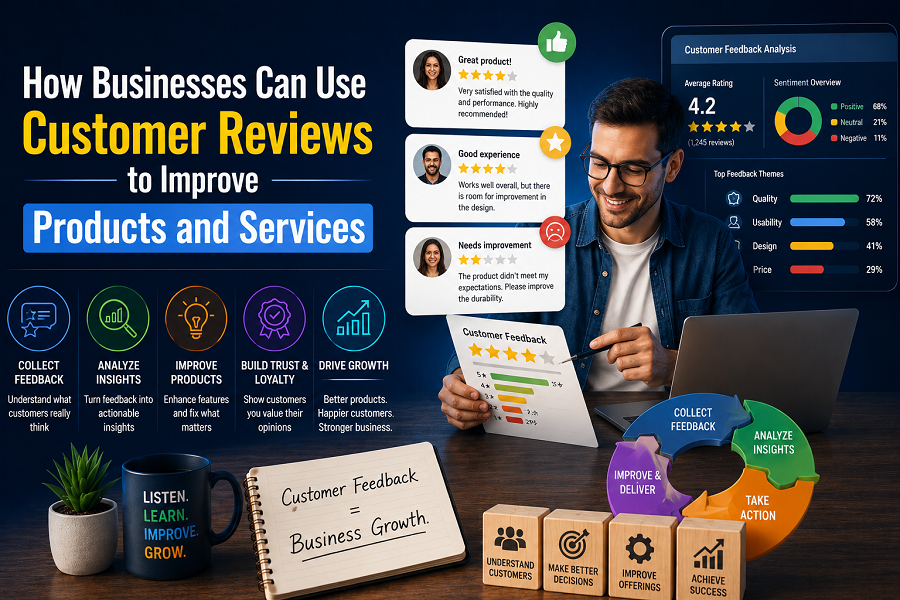
Most businesses treat customer reviews as a reputation management challenge — something to monitor, respond to, and occasionally worry about. The businesses that consistently outperform their competitors treat reviews as something fundamentally different: the most honest, unsolicited, and actionable product research available to them.
The gap between these two approaches is substantial. One posture is defensive. The other is strategic. And the organizations that have shifted from the first to the second are finding that their review ecosystem functions as a continuous improvement engine that compounds in value the longer it operates.
Reviews Contain Product Intelligence That Research Cannot Replicate
Traditional product research — surveys, focus groups, usability testing — operates under a fundamental constraint: participants know they’re being observed. The Hawthorne effect, social desirability bias, and the artificial context of structured research all introduce distortions that reduce the reliability of what participants report versus what they actually experience.
Customer reviews carry none of these distortions. A customer writing a review after a genuine purchase experience, motivated by the desire to share what they encountered, produces feedback that research environments almost never replicate. They describe real usage patterns, real friction points, real moments of delight, and real failures — in their own language, on their own timeline, without any incentive to tell the business what it wants to hear.
The product intelligence embedded in review content spans several distinct categories:
- Unmet needs — customers frequently describe workarounds they’ve developed for product limitations, revealing feature gaps the product team never identified
- Unexpected use cases — reviews regularly surface applications of a product that the business never intended or marketed, revealing adjacencies worth developing
- Terminology and language — the words customers use to describe problems the product solves are exactly the words that should appear in marketing copy, because they reflect how buyers actually think about the category
- Competitive positioning signals — reviews that reference competitor products reveal where customers perceive relative advantage and disadvantage, providing competitive intelligence without commissioning research
- Quality threshold indicators — the specific complaints that appear most frequently define the minimum quality floor below which customer satisfaction degrades reliably
None of this intelligence requires extraction from a research exercise. It exists in reviews already written, waiting for a systematic process to surface it.
Building a Review Intelligence System That Actually Works
The challenge most businesses face with review intelligence isn’t access — it’s process. Reviews arrive continuously, across multiple platforms, in unstructured text that doesn’t map neatly onto internal product categories or service metrics. Without a system, the intelligence diffuses into noise. With one, it becomes a decision-making asset.
Building a functional review intelligence system involves several interconnected components:
- Aggregation across platforms — reviews living exclusively on external platforms in siloed reading experiences need to be pulled into a central repository where patterns become visible across the full dataset rather than one platform at a time
- Categorization framework — a consistent taxonomy for tagging review content by product area, issue type, sentiment, and customer segment allows pattern recognition that unstructured reading cannot produce
- Volume and trend tracking — counting how frequently specific complaints or praise points appear, and tracking whether those frequencies are rising or falling over time, converts anecdote into measurable signal
- Routing to relevant teams — product feedback reaching product managers, service feedback reaching operations leaders, and logistics feedback reaching supply chain teams ensures that intelligence generates action rather than sitting in a report nobody reads
- Cycle closure measurement — tracking whether product or service changes made in response to review intelligence actually reduce the frequency of the complaints that drove them closes the loop between feedback and outcome
Organizations that build this infrastructure find that their product roadmaps begin to align more closely with what customers actually need — because customer voice has a direct, structured path into prioritization decisions rather than filtering through layers of interpretation.
Negative Reviews Are the Most Valuable Data in the Ecosystem
Counter-intuitively, negative reviews are where the most actionable intelligence concentrates. Positive reviews confirm what’s working — useful for reinforcement but rarely surprising. Negative reviews reveal what’s failing — uncomfortable but precisely the information that drives meaningful improvement.
The specific types of negative review content that generate the highest product and service improvement value include:
Repeated complaints about the same specific issue — when three, five, or ten unconnected customers independently describe the same problem, the probability that it represents a systematic issue rather than an isolated incident approaches certainty. Each repeated complaint is a vote for prioritization.
Complaints about the gap between expectation and reality — when customers describe expecting one thing and receiving another, the issue may be product quality, or it may be a marketing or description problem. Both are actionable, but they require different interventions.
Complaints that include specific context about when the failure occurs — “the battery dies after two hours of continuous use” is more actionable than “the battery is bad.” Specific failure context gives engineering and product teams the parameters they need to reproduce and address the issue.
Complaints paired with competitor comparisons — when customers explicitly state that a competitor handles a specific function better, the review doubles as competitive intelligence. These comparisons, aggregated across multiple reviews, produce a reliable map of competitive vulnerability.
The organizations that consistently extract the most value from negative reviews are those that have culturally normalized treating criticism as useful rather than threatening — where product teams read negative reviews with curiosity rather than defensiveness.
Closing the Feedback Loop Converts Intelligence Into Trust
Extracting intelligence from reviews and acting on it is valuable. Communicating that the action was taken in response to customer feedback amplifies the value significantly — both by deepening the trust of existing customers who feel heard and by signaling to prospective customers that the business is genuinely responsive.
The feedback loop closure takes several practical forms depending on the nature of the change:
- Public responses to reviews that describe how the feedback influenced a specific change demonstrate responsiveness to the reviewer and everyone who reads the exchange afterward
- Product update communications that explicitly credit customer feedback as the driver of specific improvements — “you told us the onboarding was confusing, so we rebuilt it” — convert product changes into trust-building signals rather than routine updates
- Direct follow-up with reviewers who described specific problems, informing them that their feedback led to a change, converts a dissatisfied customer into a potential advocate who now has a personal stake in the improved experience
- Review response patterns that acknowledge recurring issues and describe the steps being taken to address them signal organizational seriousness to readers evaluating the business
The commercial impact of visible feedback loop closure extends beyond existing customer relationships. Prospective customers evaluating a business read how it responds to criticism as a leading indicator of how it will respond to their problems if they become customers. A business that demonstrably acts on feedback is a business that demonstrates it values the customer relationship beyond the transaction.
Segmenting Review Intelligence by Customer Type Produces Sharper Insights
Aggregate review analysis produces useful signal. Segmented review analysis produces actionable intelligence with enough specificity to drive targeted product decisions.
Not all customers are the same, and their review content reflects different use cases, expectations, and value priorities. A product serving both casual consumers and professional users will receive review content reflecting fundamentally different relationships with the same product — and blending those signals produces a muddled picture that serves neither segment well.
Effective segmentation approaches for review intelligence include:
- Purchase channel segmentation — reviews from customers who bought through different channels often reflect meaningfully different demographics, use cases, and expectations
- Product variant segmentation — reviews for different configurations, sizes, or tiers of the same product family reveal where quality and value perception differ across the range
- Geographic segmentation — reviews from different markets sometimes reveal service quality variations, logistics differences, or cultural expectation gaps that aggregate analysis masks
- Recency segmentation — separating recent reviews from historical ones tracks whether product or service changes are producing the improvements they were designed to deliver, or whether new problems are emerging that offset gains elsewhere
The granularity available through segmented review analysis gives product and service teams the specificity needed to make targeted improvements rather than broad changes that help one customer type at the expense of another.
Conclusion
Customer reviews are the most democratized form of product research available — generated continuously, at no cost to the business, by real customers describing real experiences without the distortions that formal research introduces. The businesses treating this resource strategically are building product intelligence systems that compound in value over time, developing cultural norms that treat criticism as useful data, closing feedback loops that convert dissatisfied customers into advocates, and segmenting insights to drive targeted improvements.
The reviews are already being written. The only question is whether the intelligence in them reaches the people who can act on it — or disappears into a notification queue that nobody reads twice.
FAQs
1. How should businesses prioritize which review feedback to act on first?
Prioritize by frequency and impact simultaneously. A complaint appearing in one review may represent an isolated incident. The same complaint appearing independently across ten reviews describes a systematic issue worth addressing urgently. Within high-frequency complaints, prioritize those that affect the core use case of the product rather than edge cases — failures at the center of the customer experience drive more churn than failures at the periphery.
2. What tools help businesses analyze review content at scale?
Sentiment analysis platforms, customer feedback aggregation tools, and AI-powered text analysis systems can process large review volumes and extract categorized insights that manual reading cannot produce efficiently. The specific tool matters less than the categorization framework applied — technology amplifies a good analytical process and amplifies a poor one equally.
3. How can small businesses build a review intelligence system without dedicated resources?
Start with a simple manual process: read all reviews weekly, tag each with a primary topic and sentiment, and maintain a running count of how often each topic appears. Even a basic spreadsheet tracking complaint frequency reveals patterns that inform prioritization decisions. The sophistication of the system should scale with the volume of reviews — manual processes work well at low volume and become impractical as volume grows.
4. Should businesses respond to every review, including those with useful product feedback?
Yes — responding to reviews that contain genuine product feedback serves two purposes simultaneously. It acknowledges the customer’s contribution and signals to other readers that the business engages seriously with feedback. When a response can truthfully indicate that the feedback influenced a specific change, the response becomes a trust-building signal that benefits the business beyond the individual exchange.
5. How do businesses prevent review intelligence from getting lost in organizational silos?
Establish clear routing protocols that send specific review categories to specific internal owners — product complaints to product managers, service complaints to operations, logistics complaints to supply chain. Require that routed feedback generate a documented response: either a prioritized action item or an explicit decision not to act with reasoning. The routing and response requirement together prevent feedback from diffusing into reports that generate no action.







Leave a Reply