


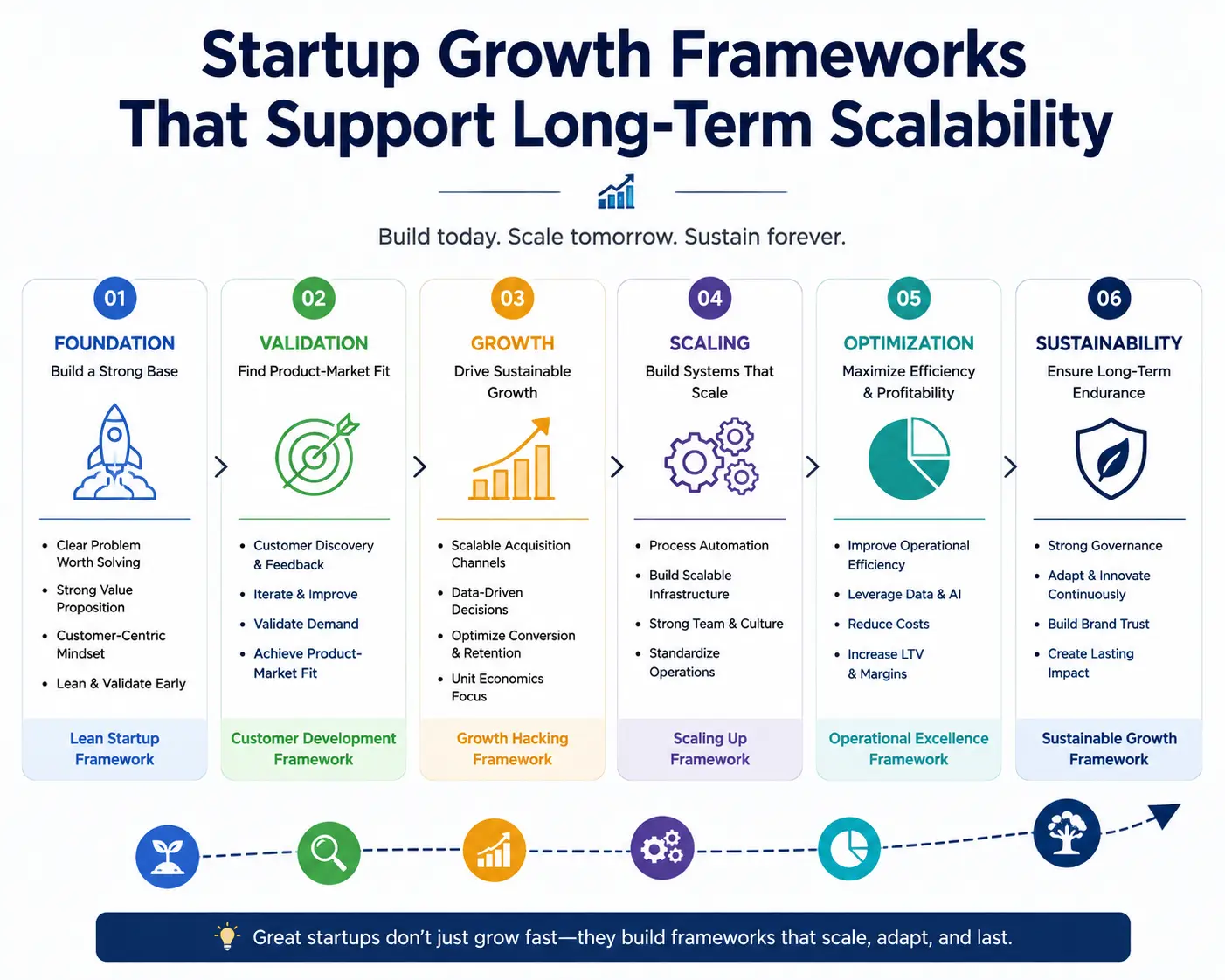
Securing early market traction is an exciting milestone for any startup, but transitioning from a fragile early-stage venture to a resilient, scalable enterprise requires structural discipline. Many businesses fail during expansion because they attempt to accelerate sales using chaotic, unrepeatable processes. Without an underlying framework designed to handle increased operational pressure, rapid customer acquisition can quickly break down internal infrastructure.
Achieving sustainable longevity demands a shift from ad-hoc growth tactics to predictable, scalable frameworks. By embedding scalability into your product design, marketing metrics, and internal engineering, you can expand your market footprint smoothly without compromising service quality.
The North Star Metric and Growth Accounting Framework
A scalable expansion strategy requires absolute clarity across all departments. The North Star Metric framework aligns engineering, marketing, and customer success teams around a single high-leverage measurement that reflects genuine, long-term user value. When configured alongside a strict growth accounting formula, this model keeps teams focused on sustainable retention rather than vanity acquisition numbers.
-
Identifying the Core Value Indicator: Choosing a single metric—such as daily active interactions or successful workflow completions—that directly correlates with customer satisfaction and retention.
-
Deconstructing the Growth Formula: Breaking down revenue acceleration into specific variables: net new acquisition, existing user expansion, and churn reduction.
-
Cross-Departmental Synergy: Eliminating localized department goals that conflict with each other, ensuring all resource allocations optimize the primary target metric.
-
Predictive Performance Benchmarking: Establishing weekly data review intervals to catch operational anomalies before they impact the broader financial pipeline.
Implementing the Pirate Metrics Loop for Capital Efficiency
To ensure your growth framework remains highly efficient, operations must be continuously optimized across the entire user journey. The classic AARRR blueprint ensures that customer acquisition costs remain balanced against the long-term value generated by your user base.
-
Acquisition via High-Intent Intent: Channeling marketing assets toward organic search, educational hubs, and specific programmatic funnels that attract highly qualified prospects automatically.
-
Activation with Decreased Time-to-Value: Engineering a frictionless initial user onboarding experience that guides a customer to their first successful outcome within minutes of sign-up.
-
Retention Through Behavioral Loops: Developing localized notification triggers, tailored educational content, and core feature habits that keep users returning to the application consistently.
-
Referral Optimization via Native Loops: Embedding viral mechanics and sharing incentives directly inside the product interface, turning happy active users into primary acquisition channels.
-
Revenue Expansion Frameworks: Introducing tier-based pricing models and usage-driven upgrades that automatically increase user account values as their businesses expand.
Building a Decoupled Agile Operational Architecture
The final operational pillar of long-term scalability lies within your internal team structures and technical design. A decoupled architecture divides large, slow-moving departments into autonomous, cross-functional growth pods.
Each pod contains a dedicated product manager, designer, and data analyst focused entirely on optimizing a specific subsection of the user lifecycle. By decoupling dependencies between teams, you eliminate the typical corporate approvals that halt innovation. This structural flexibility allows the broader organization to deploy software patches, launch marketing variants, and pivot target demographics simultaneously without causing internal friction or system outages.
Securing Future Market Dominance
Scaling a startup is a deliberate engineering challenge rather than a product of luck. By anchoring your teams around a single North Star Metric, systematically optimizing each phase of the user funnel, and maintaining a decoupled operational structure, you build a company designed to expand organically. Prioritize repeatable systems over short-term hacks to guarantee long-term market longevity.
Frequently Asked Questions
What makes a business framework truly scalable?
A framework is scalable when it allows a company to increase its output and revenue exponentially while only experiencing a linear, predictable increase in operational overhead costs.
Why are vanity metrics dangerous for expanding startups?
Vanity metrics, like total registered users or social media impressions, show superficial traction without proving financial sustainability, user engagement, or long-term retention.
How does a growth pod operate within a business?
A growth pod is a small, autonomous team containing mixed skill sets. They focus entirely on a single objective, such as user activation, and move rapidly without needing corporate sign-off.
When should a company update its North Star Metric?
A company should update its primary metric only when its underlying business model undergoes a fundamental shift, or when the current metric no longer tracks true user value.
What is time-to-value, and why does it matter?
Time-to-value is the duration between when a user signs up and when they realize the product’s actual benefit. Minimizing this gap is crucial to preventing immediate user abandonment.





Leave a Reply