


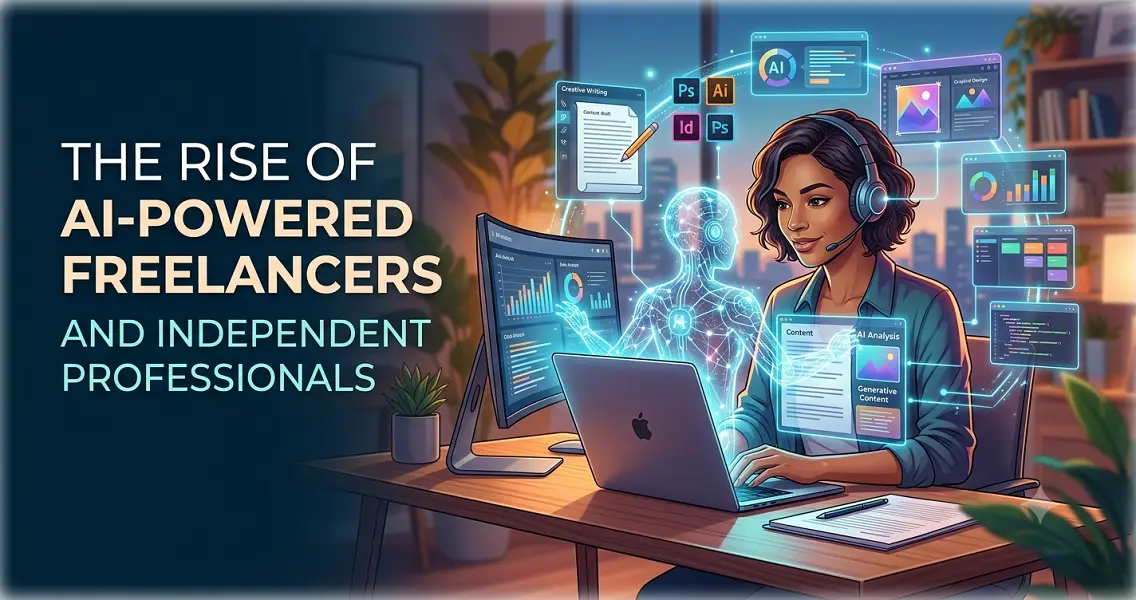
The gig economy is undergoing a massive transformation as independent contractors blend human ingenuity with advanced automation. This evolution has birthed a new class of solopreneurs who utilize artificial intelligence to manage multi-disciplinary workloads that once required full-scale agencies. By shifting focus from manual execution to strategic direction, these modern professionals are significantly expanding their earning potential and project capacities.
Redefining Productivity and Service Delivery Architecture
The core advantage of an automated tech stack lies in the compression of production cycles. Independent operators no longer balance administrative bottlenecks against billable client work. Instead, they embed intelligent systems directly into their delivery frameworks to optimize output quality and speed.
-
Predictive Asset Creation: Designers and developers build responsive, base-level code wireframes and visual concepts instantly, allowing more time for custom refining.
-
Contextual Data Synthesis: Consultants run client source documentation through localized models to extract hidden trends and actionable business intelligence within minutes.
-
Asynchronous Client Management: Smart communication agents filter client updates, draft precise milestone responses, and schedule meetings based on real-time project progress.
-
Dynamic Research Mapping: Writers and marketers bypass static search queries to map out semantic keyword intent and complex content architectures dynamically.
Essential Skills for the Modern Solo Operator
Surviving the shift toward automated workflows requires an entirely new set of professional competencies. Technical mastery of software is no longer a luxury; it is the baseline for marketplace relevance.
-
Iterative Prompt Architecture: Crafting highly specific, multi-layered instructions to extract flawless technical or creative deliverables from foundational models.
-
Output Validation and Fact-Checking: Serving as a human filter to verify accuracy, eliminate hallucinated data, and ensure absolute compliance with intellectual property standards.
-
Cross-Platform API Orchestration: Connecting distinct machine learning applications to form unified, self-executing software chains that handle complex business operations.
-
Hyper-Niche Personal Branding: Establishing undeniable subject-matter authority that highlights the irreplaceable value of unique human perspective and lived industry experience.
Navigating the Ethical and Legal Contractual Frontier
As the integration of machine learning becomes standard practice, clients are introducing strict legal guardrails regarding data privacy and copyright ownership. Independent professionals must proactively address these shifting expectations to protect their business relationships.
Contracts are increasingly requiring explicit clauses regarding where client data is stored and whether it is used to train public models. Savvy freelancers secure enterprise-grade software licenses that guarantee complete data isolation. Furthermore, because purely machine-generated work cannot be copyrighted, professionals must clearly document their substantial human additions, edits, and structural changes. Providing clients with a transparent overview of your production pipeline ensures safety, builds trust, and justifies premium service rates.
Conclusion
The emergence of the tech-enabled freelancer marks the beginning of an era centered on creative leverage. Rather than rendering human talent obsolete, automation is eliminating administrative drudgery and technical bottlenecks. The independent professionals who command the highest market premiums are those who view software as a collaborative partner to scale their unique intellectual property.
FAQs
What defines an AI-powered freelancer?
An AI-powered freelancer is an independent professional who integrates advanced machine learning and automation tools into their workflow to enhance productivity, strategy, and service delivery.
How do automated tools impact freelance pricing strategies?
Because execution time is drastically reduced, successful freelancers are abandoning hourly rates in favor of value-based or flat-rate project pricing to maintain profitability.
Can clients reject work created with the help of automation software?
Yes, if the contract prohibits it. Freelancers should always discuss tool usage upfront and ensure their contracts explicitly define what level of automation is acceptable.
How do independent professionals handle copyright issues with automated outputs?
Freelancers ensure copyright viability by heavily editing, restructuring, and injecting original human analysis or proprietary data into the foundational software outputs.
Which freelance sectors are adapting to these technological changes the fastest?
Software development, digital marketing strategy, technical content creation, and data analytics are currently leading the transition toward automated workflows.






Leave a Reply