


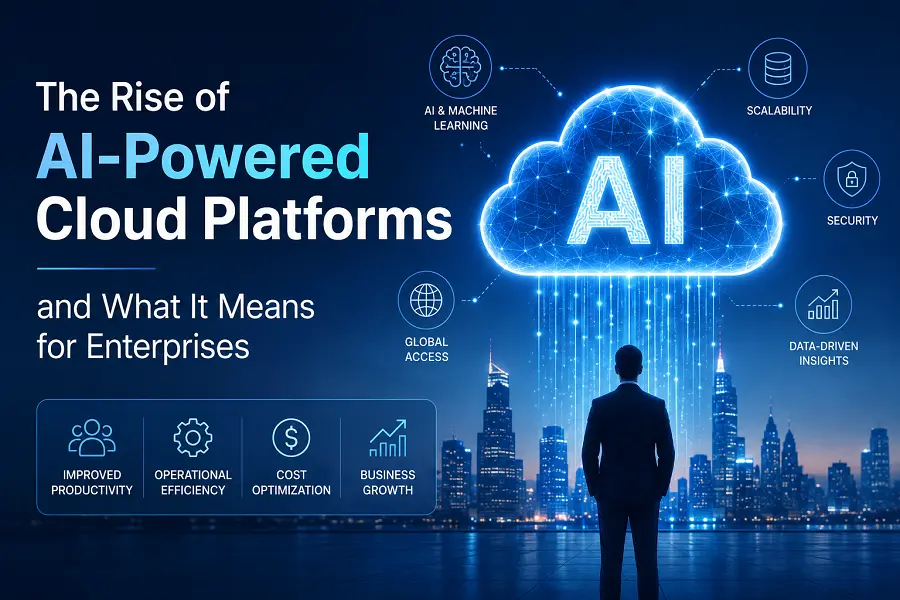
Cloud computing is undergoing its most significant shift since the migration away from on-premises servers. Modern cloud infrastructure is no longer just a passive warehouse for storing data and running applications. It has evolved into an active, self-optimizing ecosystem driven by integrated artificial intelligence. For enterprises, this shift fundamentally changes how software is deployed, resources are managed, and digital products are scaled.
The Shift from Static Infrastructure to Intelligent Systems
Traditional cloud environments required continuous manual oversight to adjust bandwidth, allocate storage, and patch security vulnerabilities. AI-powered cloud platforms eliminate these operational bottlenecks by embedding machine learning algorithms directly into the hypervisor and network layers. This allows the infrastructure to analyze telemetry data in real time and predict system demands before they cause latency.
-
Predictive Autoscaling: Systems analyze historical traffic patterns to provision virtual machines ahead of demand spikes, eliminating the lag associated with traditional reactive scaling.
-
Automated FinOps: Intelligent cost-management engines identify underutilized resources, recommend optimal instance types, and automatically terminate orphaned storage volumes.
-
Proactive Cyber Defense: Machine learning models establish a baseline of normal network behavior, allowing them to detect and isolate anomalous traffic anomalies instantly.
Overcoming Legacy Integration and Multi-Cloud Complexity
As enterprises adopt hybrid and multi-cloud strategies, managing fragmented environments becomes a major operational challenge. AI orchestration layers act as a unifying fabric across disparate public and private clouds. They abstract the underlying complexity, allowing engineers to manage workloads based on performance requirements and compliance rules rather than specific provider architecture.
-
Workload Portability: Intelligent orchestrators automatically format and migrate containerized applications between different cloud providers to leverage lower spot-pricing or better regional latency.
-
Continuous Compliance Auditing: AI engines scan cloud configurations against global data protection frameworks, automatically remediating drift without human intervention.
-
Unified Data Pipelines: Distributed databases use AI to optimize query pathways across multi-cloud environments, reducing data egress fees and processing times.
Practical Blueprint for Enterprise Adaptation
Transitioning to an intelligent cloud requires a deliberate shift in corporate strategy, skills development, and data architecture. Businesses cannot simply overlay AI tools onto disorganized data structures and expect meaningful optimization.
Enterprise leadership must first prioritize data hygiene. Machine learning models within the cloud require clean, well-cataloged data to make accurate operational decisions. Simultaneously, traditional IT departments must transition into platform engineering teams, focusing on designing policies that guide autonomous systems rather than performing manual configurations. Finally, organizations should implement strict algorithmic guardrails to monitor AI decision-making, ensuring automated resource allocation aligns with quarterly budgetary constraints.
Conclusion
The integration of artificial intelligence into cloud platforms marks the end of reactive IT management. Enterprises that embrace these self-optimizing ecosystems gain unprecedented agility, robust security, and precise cost control. Success in this new paradigm belongs to organizations that treat cloud infrastructure not as a utility, but as an active operational partner.
FAQs
What is an AI-powered cloud platform?
It is a cloud infrastructure that integrates machine learning algorithms directly into its core systems to autonomously manage, optimize, and secure computing resources without constant human intervention.
How does intelligent cloud infrastructure reduce enterprise costs?
It constantly monitors resource utilization, automatically shrinking or expanding infrastructure to match exact workloads, which prevents over-provisioning and eliminates wasted spend on idle servers.
Can autonomous cloud platforms completely replace IT operations teams?
No. Instead of replacing teams, it shifts their focus. IT professionals move away from repetitive manual tasks like patching and provisioning, allowing them to focus on high-level architecture and strategic initiatives.
How do these platforms handle data privacy and regulatory compliance?
They use continuous scanning algorithms to monitor data storage configurations and access logs, automatically correcting any security drift that violates frameworks like GDPR or HIPAA.
What is the first step for a business migrating to an intelligent cloud?
Organizations must audit their existing data architecture to ensure information is properly classified, clean, and accessible, as the underlying AI engines rely entirely on high-quality data to function effectively.






Leave a Reply