


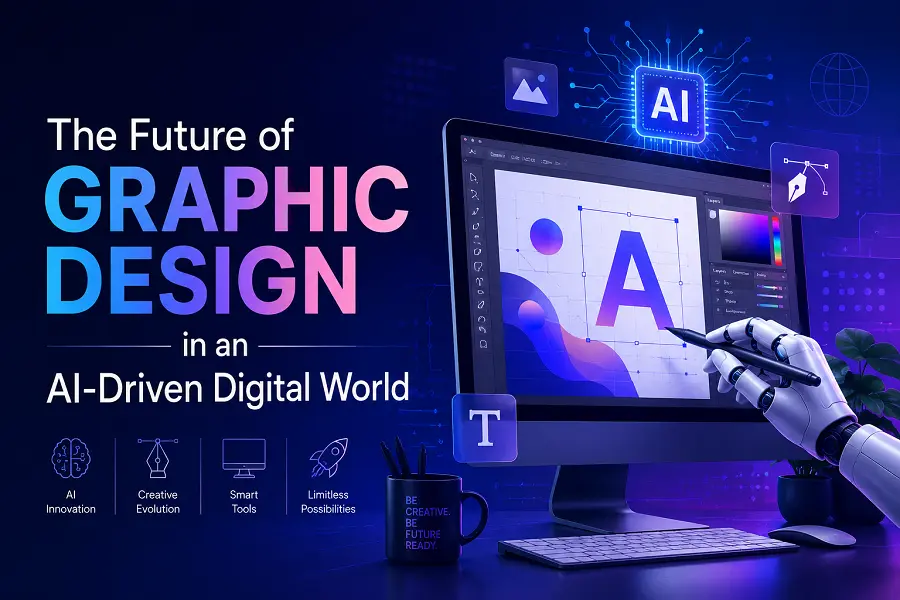
Artificial intelligence is rapidly shifting the creative landscape, transforming how visual assets are conceived, produced, and deployed. Rather than replacing human creativity, machine learning algorithms are rewriting the designer’s job description. The modern creative professional is transitioning from a manual pixel-pusher to a high-level creative director who guides automated workflows. Understanding this evolution is essential for staying competitive in a fast-changing media ecosystem.
How Machine Learning is Transforming Creative Workflows
Generative software eliminates the time-consuming bottlenecks that historically slowed down project lifecycles. Tasks that once required hours of meticulous execution can now be initiated in seconds through text-to-image prompts and neural filters. This shift allows creators to focus on conceptual strategy and emotional resonance rather than mechanical execution.
The day-to-day work of a digital artist now integrates automated systems in several practical ways:
-
Rapid Prototyping: Generating dozens of mood boards and conceptual layouts instantly to pitch diverse directions to clients.
-
Asset Scaling: Batch-processing localized social media graphics, resizing banners automatically, and generating endless color variations for global campaigns.
-
Intelligent Photo Editing: Utilizing content-aware fill, automatic subject isolation, and generative expansion to fix image composition flaws instantly.
-
Dynamic Layout Adjustment: Employing responsive typography and asset placement rules that adapt autonomously to different screen dimensions.
Essential Skills for the Next Generation of Designers
As technical barriers to asset creation drop, the value of unique human perspective increases. True originality, cultural awareness, and deep strategic empathy cannot be replicated by mathematical probability models. To thrive, creators must develop a hybrid skill set that balances classic artistic principles with advanced technical literacy.
Survival in this updated industry requires mastering several core competencies:
-
Prompt Engineering and AI Orchestration: Learning to communicate effectively with diffusion models using precise terminology, style references, and lighting parameters.
-
Advanced Vector Styling and Typographic Mastery: Focusing heavily on custom lettering and vector geometry, which algorithms still struggle to generate with absolute precision.
-
Creative Direction and Curation: Developing a keen editorial eye to filter through vast volumes of machine-generated output and select the piece that fits a brand’s identity.
-
Behavioral Psychology and User Intent: Analyzing how human audiences interact emotionally with visuals to design conversion-focused user interfaces.
Ethical Challenges and Intellectual Property Boundaries
The intersection of algorithmic synthesis and commercial art brings massive legal and systemic complications. Data scraping practices used to train foundational neural networks have sparked intense debates over artistic consent and compensation. Brand managers must navigate these muddy waters carefully to avoid copyright infringement and protect their brand reputation.
Furthermore, the threat of visual homogenization is real. Because software learns from existing internet data, it risks creating a loop of repetitive, formulaic aesthetics. Human intervention remains the only way to introduce genuine novelty, break stylistic rules intentionally, and invent entirely new visual movements.
Conclusion
The future of graphic design belongs to the collaborative creator. Systems driven by artificial intelligence handle the heavy lifting of execution, while humans provide the soul, strategy, and cultural context. Embracing automation as an advanced paintbrush enables professionals to produce highly customized, scalable visual experiences that were completely impossible just a few years ago.
FAQs
Will AI completely replace human graphic designers?
No, it changes their role. Automated tools cannot replicate original human experiences, strategic brand empathy, or cultural intuition, shifting the designer’s focus from execution to creative direction.
What is prompt engineering in graphic design?
Prompt engineering is the practice of structuring text inputs with specific design terms, angles, textures, and lighting styles to guide generative software into producing accurate visual results.
How can traditional artists adapt to algorithmic design tools?
Traditional artists can treat automated systems as brainstorming partners, using them to generate instant references, test color palettes, or handle repetitive tasks like background removal.
What design elements do neural networks struggle with most?
Text generation, symmetrical vector layouts, precise finger rendering, and complex spatial overlapping often cause errors in machine-generated imagery, requiring manual human correction.
Is machine-generated artwork safe for commercial branding?
Commercial use carries legal risks if the underlying model was trained on copyrighted material without consent, making custom human curation and vectorization vital for trademark protection.





Leave a Reply