


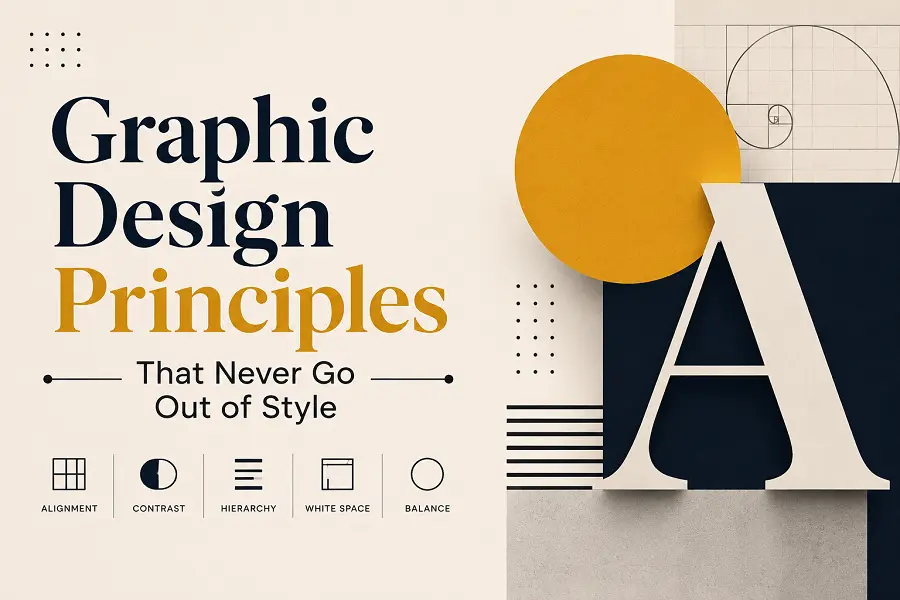
Trends come and go, but the core fundamentals of visual communication remain unchanged. Whether you are designing a printed brochure or a modern mobile application, certain rules govern how the human eye processes information. Mastering these enduring graphic design principles ensures your work stays impactful, readable, and professional across any medium.
1. Structuring Visual Content and Balance
Achieving stability in a composition prevents your layout from looking chaotic or unfinished. Visual weight determines what a viewer notices first, and distributing this weight evenly keeps the audience engaged.
-
Symmetrical Balance: Arranging elements equally on either side of a central vertical or horizontal axis creates formal, structured, and traditional aesthetics.
-
Asymmetrical Balance: Using contrasting weights, such as pairing a large bold graphic with a small block of text, generates dynamic energy while maintaining equilibrium.
-
Proximity: Grouping related items together signals an inherent relationship, reducing clutter and improving overall readability.
-
Repetition: Consistently using specific design assets—like shape patterns or custom iconography—ties a multi-page layout or brand identity together.
2. Guiding the Viewer Eye with Emphasis and Hierarchy
A layout without direction forces the audience to work too hard to find meaning. By strategically manipulating size, color, and depth, you establish an intuitive reading path that highlights the most critical message first.
-
Visual Hierarchy: Establish a clear order of importance by using scaled font sizes. Headlines require the most prominent scale, followed by subheadings, and then body text.
-
Contrast Manipulation: Place light elements against dark backgrounds or sharp geometric lines next to organic curves. High contrast instantly draws attention to critical focal points.
-
Intentional Alignment: Aligning every element to a common grid system eliminates randomness, allowing the eye to glide smoothly from one content block to the next.
3. The Power of Negative Space and Minimalism
Empty space is not wasted space; it is a functional tool. Giving design elements breathing room prevents cognitive overload and naturally elevates the perceived value of your content.
Negative space isolates key components, making them appear more deliberate and powerful. By removing unnecessary embellishments and focusing strictly on layout fundamentals, your final product gains a sophisticated, premium quality that resists getting dated.
Conclusion
Timeless design relies on clarity, structure, and purpose rather than fleeting visual fads. By consistently implementing balanced layouts, definitive visual hierarchy, and clean negative space, you create assets that remain engaging for years to come.
FAQs
What is the difference between symmetrical and asymmetrical balance?
Symmetrical balance mirrors elements precisely across a central line, offering formality. Asymmetrical balance balances different visual weights unevenly, offering a more modern and energetic feel.
How does negative space improve a graphic layout?
Negative space reduces visual noise, prevents reader fatigue, and ensures that the core message or product remains the focal point of the composition.
Why is visual hierarchy important for digital interfaces?
It directs users to take specific actions, such as clicking a button or reading a headline first, by organizing information based on visual importance.
Can a design have too much contrast?
Yes, excessive contrast across too many elements creates visual confusion, making it difficult for the viewer to identify what is truly important.
How does repetition contribute to brand identity?
Repetition strengthens brand recognition by ensuring that colors, fonts, and layouts remain uniform across different media platforms.





Leave a Reply