


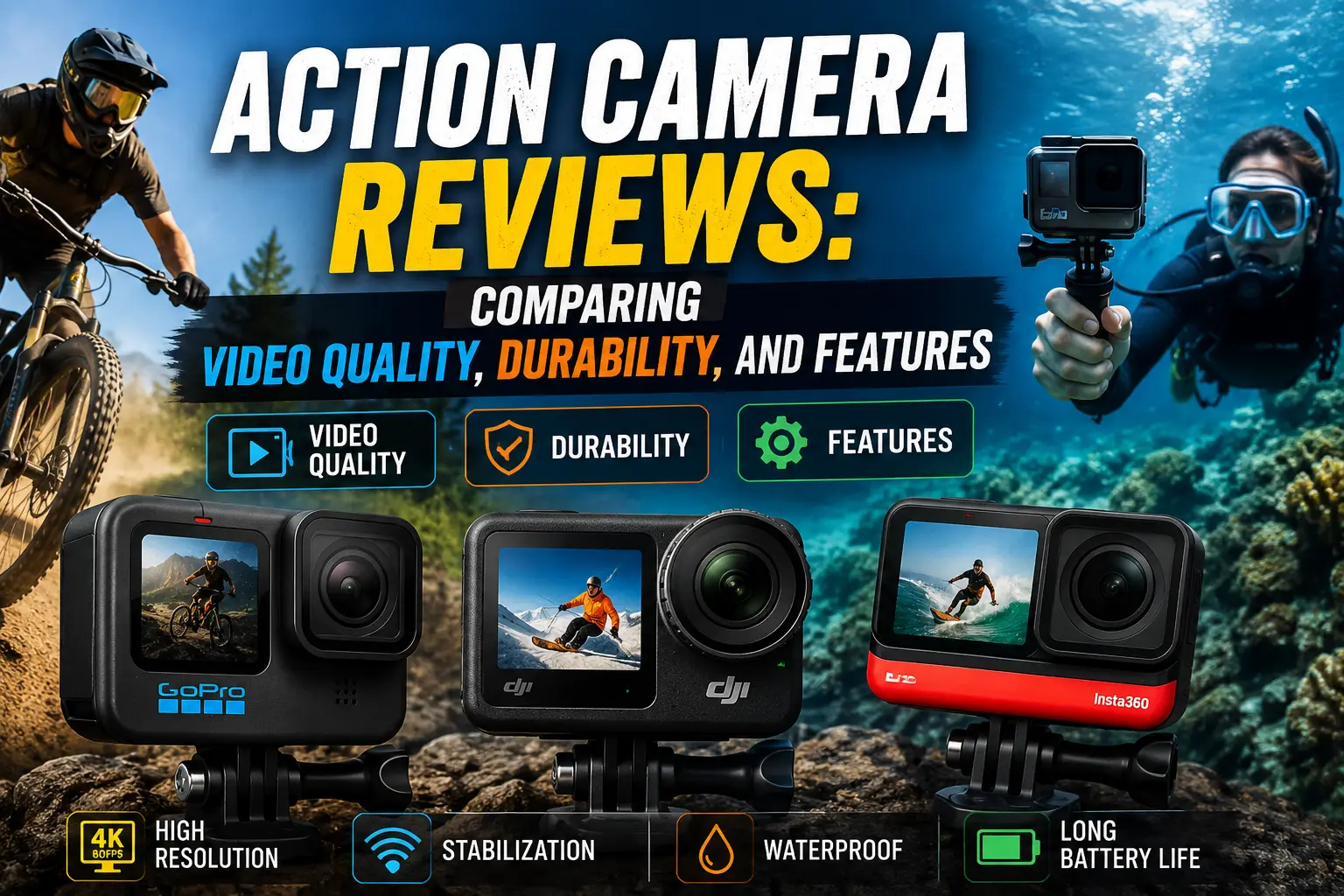
Action Camera Reviews: Comparing Video Quality, Durability, and Features
Capturing high-intensity adventures requires a camera that balances crisp imaging with a rugged, drop-resistant build. Modern action cameras have evolved far beyond basic wide-angle lenses, integrating professional-grade stabilization, smart color spaces, and heavy-duty waterproofing. Finding the right balance between sensory performance and field durability ensures your footage looks cinematic without risking equipment failure.
Video Quality and Sensor Performance
An action camera lives and dies by its ability to resolve detail under rapidly changing lighting conditions. Sensor size is the foundational factor here, dictating how much light the camera can absorb during high-speed movement or low-light scenarios.
-
Resolution and Frame Rates: Top-tier devices offer resolutions ranging from 4K up to 8K. High frame rates, such as 4K at 120 frames per second, allow for smooth, crisp slow-motion playback that preserves fast action without motion blur.
-
Sensor Dimensions: A Type 1/1.3-inch sensor offers a significant advantage over smaller, legacy sensors by pulling in more ambient light. This expanded surface area reduces digital noise during sunset or dawn sessions.
-
Color Profiles and Dynamic Range: Capturing in 10-bit color or log profiles provides millions of additional color shades. This high dynamic range ensures bright skies are not completely blown out while keeping shadow details visible in deep woods.
-
Bitrate and Clarity: High bitrate recording preserves fine textures like splashing water, loose dirt, or gravel, preventing the blocky compression artifacts common in lower-end models.
Field Durability and Environmental Protection
An adventure camera must survive punishing conditions, from freezing alpine descents to deep ocean dives, all without requiring a bulky external housing.
-
Native Waterproofing Depths: Modern engineering allows flagship units to submerge to depths between 49 and 65 feet straight out of the box, utilizing reinforced rubber seals and pressurized acoustic ports.
-
Thermal Dissipation: Continuous recording at high resolutions generates immense heat. Advanced models use structural heat sinks and power-efficient processing chips to prevent thermal shutdown during hot summer days.
-
Lens Defense Systems: Impact-resistant, hydro-phobic glass elements protect the core optical stack. User-replaceable lens covers are crucial, allowing you to quickly swap out scratched glass in the middle of a trip.
-
Shock Resistance: Internal component shielding ensures the camera can withstand sudden, repeated impacts when mounted directly to vibrating surfaces like mountain bike handlebars or surfboards.
Intelligent Features and Usability Enhancements
Hardware ruggedness is only half the battle; real-world usability depends heavily on software stabilization and intuitive control interfaces.
Electronic image stabilization relies on smart algorithms to crop and smooth out violent shakes in real time. Combined with a 360-degree horizon lock, the camera maintains a level, stable viewpoint even if the physical body flips completely upside down during an aerial maneuver.
Dual touchscreens allow for easy framing from both the front and back of the camera, streamlining vlog-style setups. Modern magnetic mounting plates allow users to snap the camera off a helmet mount and clip it onto a chest harness in seconds, completely removing the hassle of traditional thumbscrews.
Conclusion
Selecting the ideal action camera comes down to identifying your primary shooting environment. If your work involves low-light transitions and deep water, prioritize oversized sensors and high native depth ratings. For fast-paced sports where smooth framing is paramount, look toward advanced stabilization engines and robust mounting ecosystems to capture seamless, immersive footage.
Frequently Asked Questions
What is the advantage of 10-bit color in an action camera?
10-bit color records over one billion distinct colors, compared to just 16.7 million in standard 8-bit files. This prevents color banding in gradients like open skies or clear water, allowing for flexible color grading during editing.
How does image stabilization affect the field of view?
Electronic stabilization slightly crops into the image sensor to create a digital buffer zone. The camera uses this extra space to shift the frame and counteract physical shaking, resulting in a slightly narrower but perfectly stable view.
Why do action cameras struggle in low-light environments?
Because action cameras feature very small bodies, their physical lenses and sensors cannot gather as much light as large mirrorless systems. This requires higher digital amplification, which often introduces grain or noise in dark settings.
Do I need a separate waterproof case for modern action cameras?
Most flagship action cameras are entirely waterproof without a case down to specified depths, typically around 50 feet. An external dive housing is only necessary if you plan on deep scuba exploration exceeding those limits.
Can action cameras be used reliably as standard webcams?
Yes, most current models offer a plug-and-play USB mode that outputs high-definition video directly to computers, making them dual-purpose tools for streaming or remote meetings.








Leave a Reply