

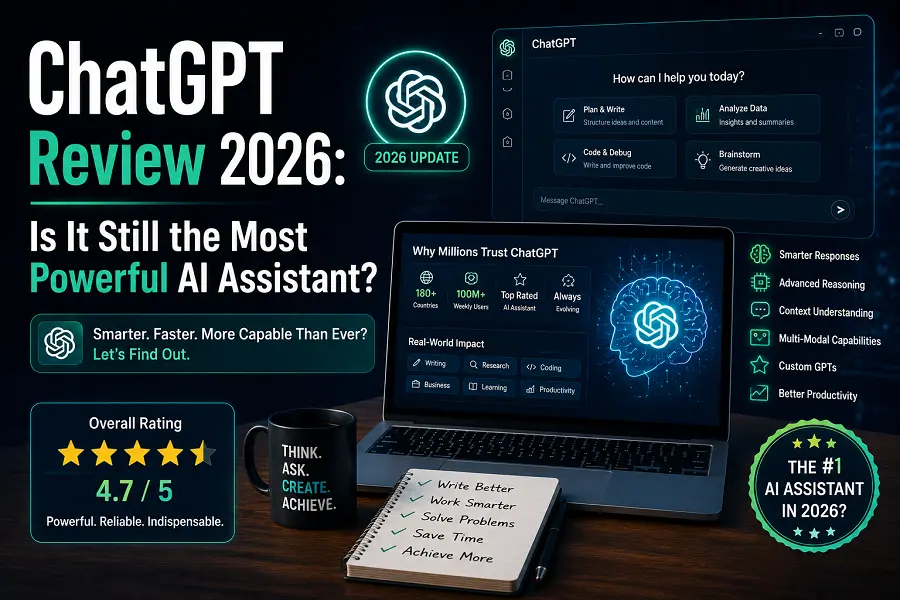
When ChatGPT launched in late 2022, it did something no consumer technology product had done in years — it created a genuinely new category of everyday tool almost overnight. Within months, it had more active users than products that took competitors years to build. Within a year, it had spawned an entire industry of competing systems, derivative applications, and enterprise deployments built on its underlying models.
Three years later, the question isn’t whether ChatGPT matters — it clearly does. The question is whether it still leads the category it created, or whether the competition it inspired has caught and surpassed it in ways that matter to real users.
What ChatGPT Does Well in 2026
ChatGPT’s core strength has always been conversational fluency combined with broad knowledge — the ability to engage with almost any topic, follow complex multi-turn conversations, and produce output that reads like it was written by a thoughtful human rather than assembled by a machine.
That strength hasn’t diminished. In 2026, ChatGPT handles extended, context-rich conversations with impressive coherence. It maintains the thread of a complex discussion across many exchanges, remembers what was established earlier in a session, and produces prose that adapts naturally to tone, register, and complexity requirements.
The areas where ChatGPT consistently performs at or near the top of the field include:
- Long-form content generation — articles, reports, essays, and structured documents produced with coherent argumentation and readable style
- Code generation and debugging — across most major programming languages, ChatGPT produces functional code and explains logic clearly enough for developers at multiple skill levels
- Summarization and synthesis — condensing large volumes of text into accurate, structured summaries without losing key information
- Brainstorming and ideation — generating creative options, alternative framings, and novel approaches to both creative and analytical problems
- Instruction following — executing complex, multi-part prompts accurately and handling follow-up corrections without losing context of the original request
The breadth of competence across these areas remains genuinely impressive. ChatGPT is still the tool that can handle almost anything a knowledge worker throws at it without requiring task-specific setup.
Where ChatGPT Shows Meaningful Limitations
Honest assessment requires engaging with where ChatGPT falls short — not to diminish what it does well, but because understanding limitations is what separates useful tool evaluation from promotional content.
Factual reliability remains a persistent challenge. ChatGPT produces confident, fluent output whether its underlying information is accurate or not. In 2026, hallucination rates have improved substantially compared to earlier versions, and web search integration helps with questions requiring current information — but the fundamental tendency to generate plausible-sounding content without reliable grounding in verified fact hasn’t been eliminated. Users who need factual accuracy for consequential decisions must still verify outputs independently.
Deep domain expertise has a ceiling. ChatGPT performs remarkably across a wide range of topics at a generalist level. In highly specialized domains — advanced mathematics, cutting-edge research, domain-specific professional judgment — specialist models trained deeply on domain-specific data consistently outperform it. Breadth and depth remain in tension, and ChatGPT has chosen breadth.
Complex multi-step reasoning with many interdependencies occasionally breaks down in ways that aren’t immediately obvious. The output looks coherent and confident even when a logical step has gone wrong — which is more dangerous than an obvious error because it requires careful verification rather than being self-evidently wrong.
Consistency across sessions depends on how memory features are configured. Without explicit memory enabled, each conversation starts fresh — which frustrates users who want an assistant that builds genuine context about their work and preferences over time.
The Competitive Landscape Has Genuinely Narrowed the Gap
The most significant change in the AI assistant market since ChatGPT’s launch isn’t what happened to ChatGPT — it’s what happened around it. The competitive landscape in 2026 includes capable alternatives that have closed the gap in meaningful ways across specific use cases.
Several dynamics characterize the current competitive environment:
- Specialized models outperform ChatGPT in their domains — coding-focused assistants, legal AI tools, medical AI systems, and research-specific models regularly outperform ChatGPT on domain-specific benchmarks by margins that matter in professional contexts
- Multimodal capabilities are table stakes, not differentiators — the ability to process images, generate content across formats, and handle non-text inputs has become standard across leading AI assistants rather than a ChatGPT-specific advantage
- Enterprise competitors have stronger integration stories — for business deployments, competitors with deeper workflow integrations, stronger data security guarantees, and more configurable deployment options have captured significant enterprise market share
- Open-source alternatives have reached viability — for technically sophisticated users and organizations that require on-premise deployment, open-source models have reached quality levels that make them credible alternatives for many use cases
- Pricing competition has intensified — the premium pricing that once came with ChatGPT’s first-mover advantage has been compressed by competitors offering comparable capability at lower price points
None of these developments makes ChatGPT irrelevant — but they collectively mean that the answer to “which AI assistant should I use” is no longer as obviously ChatGPT as it was in 2023.
ChatGPT Plus and Pro Tiers: Is the Premium Worth It
The free tier of ChatGPT provides access to capable models with usage limits. The Plus and Pro subscription tiers offer higher usage limits, access to more powerful models, priority access during high-demand periods, and expanded feature sets including advanced data analysis, image generation integration, and more extensive memory capabilities.
For casual users who interact with AI assistants occasionally, the free tier handles most needs without requiring subscription investment. The value proposition of paid tiers concentrates among users who:
- Use ChatGPT as a daily productivity tool where usage limits would create workflow friction
- Need access to the most capable available models for complex or consequential tasks
- Rely on advanced features like extended data analysis, custom instructions, or memory across sessions
- Work in professional contexts where the productivity gain from premium access justifies the subscription cost
The honest assessment of premium tier value depends entirely on usage intensity and task complexity. Occasional users are likely overpaying for capabilities they’ll rarely access. Daily professional users are likely getting measurable productivity returns that exceed the subscription cost.
Who ChatGPT Is Best Suited For in 2026
After evaluating performance, limitations, and the competitive context, a clear picture emerges of who gets the most value from ChatGPT specifically:
Generalist knowledge workers who need a capable tool across many different task types without switching between specialized tools benefit most from ChatGPT’s breadth. Writers, marketers, analysts, and educators who need competent assistance across varied daily tasks find ChatGPT’s versatility more valuable than any specialist alternative’s depth.
Developers using ChatGPT for coding assistance remain well-served, though dedicated coding assistants with deeper IDE integration offer workflow advantages for professional development contexts.
First-time AI assistant users still benefit from ChatGPT’s intuitive interface, conversational interaction model, and the breadth of available tutorials and community resources built around the platform.
Organizations already embedded in the OpenAI ecosystem through API integrations, existing deployments, or established workflows have switching costs that make continued ChatGPT use rational regardless of marginal performance differences with competitors.
Conclusion
ChatGPT in 2026 remains one of the most capable and versatile AI assistants available — but the unqualified “most powerful” designation it could claim in 2023 no longer applies cleanly. The category it created has matured. Competitors have closed gaps in capability, expanded multimodal features, and built stronger cases for specific use cases and enterprise deployments.
What ChatGPT retains is something competitors are still working to match: the combination of conversational fluency, breadth of competence, established ecosystem, and user familiarity that makes it the default choice for general-purpose AI assistance. For most users with varied needs, it remains the most practical starting point. For users with specialized, high-stakes requirements in specific domains, the competitive landscape now offers alternatives worth serious evaluation.
The honest answer to whether ChatGPT is still the most powerful AI assistant is: it depends on what you’re measuring, and for the first time since its launch, that answer requires genuine consideration rather than a reflexive yes.
FAQs
1. Is ChatGPT still the best AI assistant in 2026?
ChatGPT remains one of the top AI assistants for general-purpose use, but “best” now depends significantly on use case. For broad, varied tasks across knowledge work, it remains a leading choice. For specialized domains — advanced coding, legal analysis, medical applications, or research — dedicated specialist models have closed or surpassed the gap in ways that matter for professional use.
2. What are ChatGPT’s biggest weaknesses in 2026?
Factual reliability remains the most consequential limitation — ChatGPT produces confident output regardless of underlying accuracy, requiring independent verification for consequential decisions. Deep domain expertise has a ceiling that specialist models exceed. Complex multi-step reasoning occasionally fails in non-obvious ways, and session-to-session memory requires explicit configuration rather than functioning automatically.
3. Is ChatGPT Plus worth paying for in 2026?
For daily professional users who rely on AI assistance as a core productivity tool, the premium tiers deliver measurable value through higher usage limits, more capable models, and advanced features. For casual users who interact with AI assistants occasionally, the free tier handles most needs without requiring subscription investment.
4. How does ChatGPT compare to its main competitors in 2026?
The competitive gap has narrowed significantly across all major dimensions. Multimodal capabilities are now standard rather than differentiating. Specialized competitors outperform ChatGPT in their specific domains. Enterprise alternatives offer stronger integration and security stories. Open-source options have reached viability for technically sophisticated users. ChatGPT’s primary advantage remains breadth of competence and ecosystem maturity.
5. What types of users get the most value from ChatGPT in 2026?
Generalist knowledge workers who need capable assistance across varied task types benefit most from ChatGPT’s breadth. Writers, marketers, educators, and analysts find its versatility more valuable than specialist depth. Developers remain well-served for coding assistance. First-time AI assistant users benefit from the intuitive interface and extensive community resources built around the platform.





Leave a Reply