


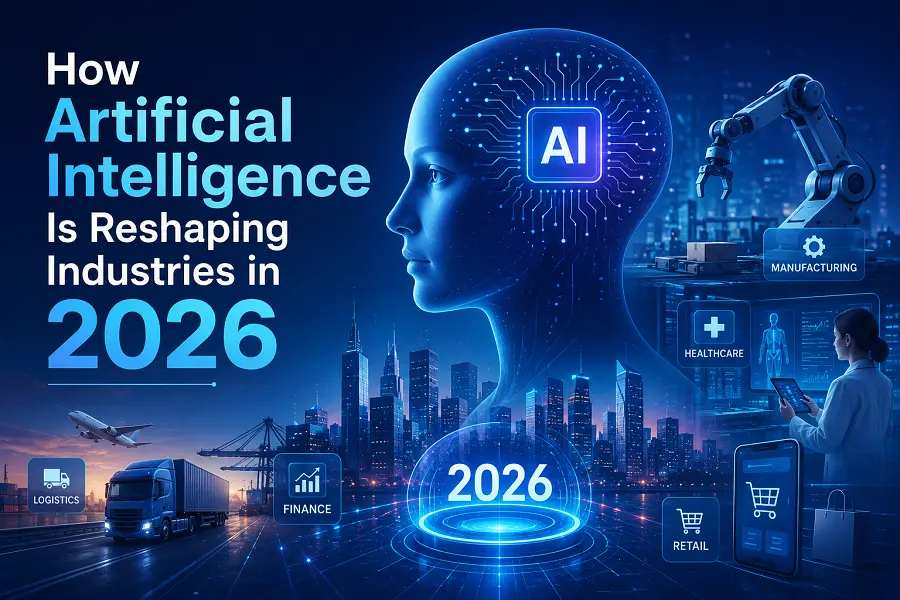
Industries don’t transform gradually and then suddenly — they transform gradually until they do. Artificial intelligence spent years as a background technology, improving incrementally across narrow applications. In 2026, the accumulation of those increments has crossed a threshold. AI is no longer enhancing how industries operate. In several sectors, it’s redefining what operation looks like entirely.
The changes are uneven across sectors — some industries are deeper into transformation than others — but the direction is consistent everywhere.
Healthcare Is Shifting From Reactive Treatment to Predictive Care
The traditional healthcare model waits for illness to present before responding. AI is systematically dismantling that model by enabling intervention before symptoms become diagnoses and diagnoses become crises.
Diagnostic imaging is the most mature application. AI systems analyzing radiology scans, pathology slides, and retinal images are detecting abnormalities at sensitivities that match or exceed specialist review — and doing so at a fraction of the time. A radiologist reviewing hundreds of scans daily operates under cognitive load that inevitably affects accuracy. An AI system reviewing the same scans doesn’t fatigue, doesn’t lose concentration, and flags every anomaly that meets its detection threshold.
Beyond imaging, the shift toward predictive care is visible across several healthcare functions:
- Hospital readmission prediction — models analyzing discharge data, social determinants, and prior history identify patients at high readmission risk before they leave, enabling targeted follow-up intervention
- Sepsis early warning — continuous monitoring of vital signs and lab values detects sepsis indicators hours before clinical presentation, giving care teams intervention time that previously didn’t exist
- Drug interaction screening — AI pharmacy systems cross-reference prescriptions against patient history, current medications, and genomic data simultaneously — catching combinations that manual review misses
- Mental health monitoring — passive signals from device usage patterns are being studied as early indicators of mood disorder episodes, enabling outreach before crisis
The ethical complexity of predictive healthcare is real — questions of consent, data use, and algorithmic bias in clinical settings demand rigorous governance. But the clinical potential is substantial enough that every major health system is actively deploying or piloting AI across multiple care pathways.
Financial Services Are Running on AI Infrastructure
Finance was among the first industries to deploy machine learning at scale, and in 2026 the depth of that integration has reached a point where AI isn’t a tool financial institutions use — it’s the infrastructure they run on.
Fraud detection operates in real time across billions of transactions daily. No human review system could evaluate each transaction at the speed and volume modern payment networks require. AI models trained on behavioral patterns detect anomalies in milliseconds, blocking fraudulent transactions before they complete while minimizing the false positives that frustrate legitimate customers.
Credit underwriting has been transformed by models that evaluate creditworthiness across a far wider range of signals than traditional scoring systems considered. Alternative data — utility payment history, rental records, employment stability patterns — is enabling credit access for individuals who would have been declined under conventional models, while more accurately pricing risk across the entire applicant pool.
Algorithmic trading has evolved from rule-based execution into AI systems that model market microstructure, sentiment signals from news and social data, and cross-asset correlations simultaneously. The speed and complexity of modern market AI has changed what human traders do — shifting their role from execution toward strategy, risk management, and oversight of the systems doing the actual trading.
Regulatory compliance — historically a significant operational cost center — is being automated through AI systems that monitor transactions, flag suspicious patterns, generate regulatory reports, and maintain audit trails without the manual overhead that compliance previously required.
Manufacturing Is Becoming Predictive, Flexible, and Increasingly Autonomous
Factory floors have always generated enormous amounts of data. For most of manufacturing history, that data was either ignored or reviewed retrospectively after problems occurred. AI has changed the relationship between production data and production decisions — turning the factory floor into a continuously monitored, continuously optimizing system.
Predictive maintenance is the highest-value near-term application. Sensors monitoring vibration, temperature, power consumption, and acoustic signatures feed AI models that detect equipment degradation before failure occurs. Unplanned downtime in manufacturing is extraordinarily expensive — not just in repair costs but in production losses, delivery delays, and supply chain disruptions. Predicting and preventing failures before they happen converts that cost into planned maintenance windows that minimize disruption.
Quality control is undergoing a similar transformation. Computer vision systems inspecting products on production lines detect defects at resolutions and speeds no human inspector can match — catching problems earlier in the production process before defective components become defective assemblies.
The longer-term manufacturing shift involves flexible production. Traditional manufacturing optimized for volume by minimizing variation. AI-enabled manufacturing can optimize across multiple dimensions simultaneously — adjusting production sequences, material flows, and quality thresholds dynamically in response to order changes, supply disruptions, and demand signals. This flexibility is making shorter production runs economically viable for the first time in many sectors.
Retail Is Personalizing at a Scale That Wasn’t Previously Possible
Retail personalization used to mean segmentation — grouping customers into broad categories and serving each category a slightly different experience. AI has replaced segmentation with genuine individualization — treating each customer as a distinct entity with distinct preferences, price sensitivity, browsing patterns, and purchase history.
The implications run through every customer-facing function:
- Product recommendations trained on individual behavior rather than category averages drive conversion rates that broad merchandising strategies can’t approach
- Dynamic pricing responds to inventory levels, demand signals, and competitive pricing in real time rather than waiting for weekly category reviews
- Search and discovery understands intent behind ambiguous queries rather than returning literal keyword matches — surfacing what a customer actually wants rather than what they technically typed
- Inventory allocation across distribution networks uses demand forecasting models to position stock closer to where it will be needed before demand materializes
The competitive pressure this creates is significant. Retailers who have built AI personalization infrastructure are widening the experience gap over those still operating on legacy merchandising approaches — and the gap compounds with every transaction that feeds the model more signal.
Conclusion
The industries furthest into AI transformation share a common characteristic: they operate at volumes and speeds that exceed what human attention can monitor comprehensively. Healthcare generates more diagnostic data than clinicians can review. Finance processes more transactions than human fraud analysts can evaluate. Manufacturing produces more sensor data than engineers can interpret. Retail generates more behavioral signals than merchandisers can act on.
AI doesn’t replace the human judgment these industries require at their most consequential moments. It processes everything else — creating the conditions where human expertise is applied where it actually matters, rather than spread thin across everything that happens to need attention.
That redistribution of human attention, more than any individual AI capability, is what’s reshaping industries in 2026.
FAQs
1. Which industry is being most transformed by AI in 2026?
Healthcare and financial services show the deepest structural transformation. Healthcare because AI is fundamentally shifting the model from reactive treatment to predictive intervention. Financial services because AI has become the operational infrastructure — not an enhancement layer — for fraud detection, credit underwriting, trading, and compliance simultaneously.
2. How is AI changing manufacturing beyond simple automation?
AI is making manufacturing predictive and flexible in ways traditional automation couldn’t achieve. Predictive maintenance prevents unplanned downtime. Computer vision quality control detects defects earlier in production. Dynamic optimization adjusts production sequences in real time — making shorter, more varied production runs economically viable for the first time in many sectors.
3. Is AI in healthcare replacing doctors and clinicians?
No — AI in healthcare is augmenting clinical capability, not replacing clinical judgment. Diagnostic AI flags anomalies for clinician review. Predictive models surface risk profiles for care team action. The human remains responsible for diagnosis, treatment decisions, and patient relationships. AI extends what a clinician can monitor and evaluate, not what they ultimately decide.
4. How is AI personalization in retail different from traditional customer segmentation?
Traditional segmentation groups customers into broad categories and serves each category a standardized experience. AI personalization builds individual models for each customer — adapting recommendations, pricing, search results, and inventory positioning to individual behavior patterns rather than category averages. The difference in conversion and retention outcomes is measurable and significant.
5. What should businesses in traditional industries do to prepare for AI-driven transformation?
Start by identifying where your organization generates data that currently goes unused or is reviewed retrospectively. Those are the highest-value AI opportunity areas. Invest in data infrastructure before AI tooling — models are only as good as the data pipelines feeding them. And treat AI deployment as an organizational change challenge, not just a technology procurement decision.







Leave a Reply