


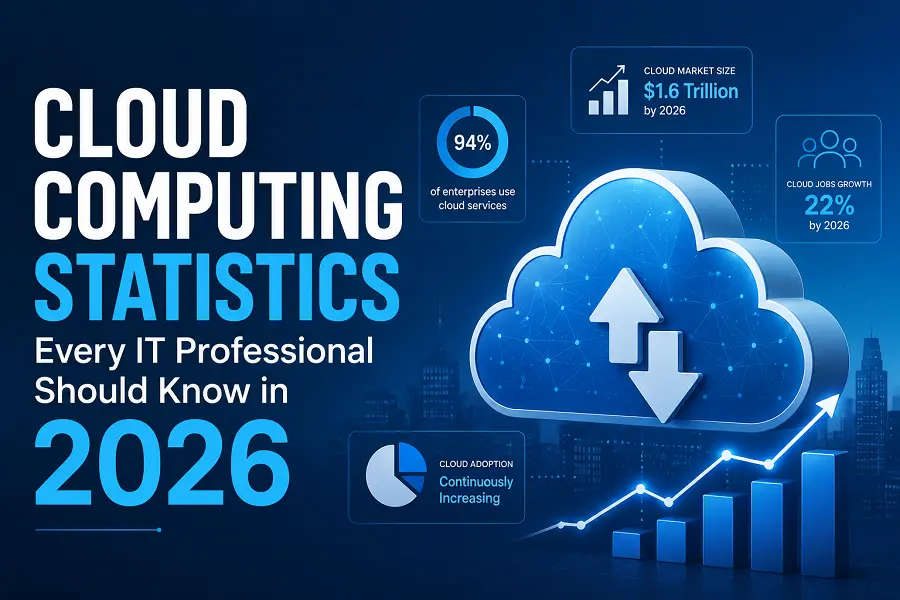
The global cloud ecosystem is undergoing a massive structural shift, moving far beyond standard data hosting. Modern digital infrastructure demands that technology leaders stay ahead of infrastructure scaling, budget allocation, and architectural planning. Understanding current industry metrics is essential for maintaining a competitive edge and optimizing enterprise performance.
Market Expansion and the Rise of AI-Driven Workloads
The scale of global infrastructure deployment reveals that cloud architecture is the primary engine of modern business infrastructure. Public cloud end-user spending is projected to reach $1,135 billion globally this year, highlighting a steady migration away from legacy, on-premises datacenters. This expansion is heavily accelerated by structural updates required for advanced analytics and next-generation software development.
Platform-as-a-Service (PaaS) has become the fastest-growing sector within the market, experiencing an annual growth rate exceeding 37%. This rapid expansion reflects a broader industry priority: organizations are actively upgrading their software infrastructure to support machine learning pipelines, complex data modeling, and automated application hosting. Furthermore, roughly 58% of enterprises now actively use generative artificial intelligence services provided directly through public infrastructure, altering traditional compute resource requirements.
Deployment Frameworks and Infrastructure Reality
Enterprise deployment choices show that single-vendor setups are no longer standard practice. Navigating infrastructure requires managing highly distributed environments to ensure operational flexibility, balance processing speeds, and maintain regulatory compliance.
-
Multi-Cloud Normalization: Roughly 89% of large organizations now utilize services from multiple distinct public providers to avoid single-vendor dependencies and leverage best-of-breed software features.
-
The Hybrid Backbone: Approximately 73% of enterprises operate combined hybrid environments, linking internal private datacenters with public resources to balance data sensitivity against scalable resource availability.
-
Analytics Relocation: Approximately 75% of all enterprise data and analytics workloads are processed within cloud-managed environments to optimize processing speeds and business intelligence workflows.
-
Workload Redistribution: More than two-thirds of total enterprise operational workloads have migrated away from localized hardware to external environments over the past three years.
Financial Optimization and Governance Obstacles
While infrastructure capacity continues to scale, controlling operational spending remains a significant hurdle for engineering teams and financial departments alike. The dynamic nature of modern resource consumption has elevated cloud financial operations (FinOps) to a core architectural discipline.
-
Slower Efficiency Rates: Rapid deployment of heavy computational models has caused average infrastructure efficiency rates to drop from 80% down to 65%, resulting from unoptimized resource provisioning.
-
Budget Realignment: Approximately 45% of traditional corporate information technology budgets have officially transitioned from capital expenditures on hardware to variable cloud spending models.
-
Wasted Expenditure Management: Organizations implementing structured governance and continuous cost management frameworks report reducing their infrastructure spending by 10% to 30%.
-
Operational Savings: Businesses that successfully complete structured infrastructure migrations achieve average long-term reductions of 20% to 40% in total infrastructure maintenance costs compared to localized setups.
-
Governance Ownership: To handle these dynamic environments, 47% of large enterprises have established dedicated oversight teams focused strictly on cloud governance, resource boundaries, and budget predictability.
Conclusion
The operational data clarifies that modern engineering requires an intentional, multi-layered strategy blending hybrid configurations, financial optimization, and advanced analytics readiness. Success no longer depends solely on migrating workloads, but on managing distributed complexity efficiently. Organizations that prioritize strict governance, automated optimization, and architecture-specific placement will achieve superior operational resilience and financial returns.
Frequently Asked Questions
What factor is currently driving the rapid growth of PaaS deployments?
The acceleration of Platform-as-a-Service is primarily driven by organizations modernizing their technology frameworks to support artificial intelligence model training, data inference, and advanced analytics pipelines without managing raw virtual machine layers.
Why are companies moving toward hybrid multi-cloud models instead of single public platforms?
Enterprises adopt hybrid multi-cloud models to combine the strict security and compliance control of private hardware with the elastic scalability of public systems, while simultaneously avoiding vendor lock-in and minimizing single-point-of-failure risks.
What is causing the observed drop in infrastructure efficiency rates?
The decline in cloud efficiency is largely caused by the rapid, unoptimized deployment of high-performance compute resources and graphic processing clusters, which frequently lead to over-provisioning and idle capacity.
How does proper cloud governance impact corporate technology budgets?
Implementing clear governance structures and automated financial operations allows engineering teams to identify misconfigured resources and eliminate wasted capacity, lowering overall platform expenditures by up to 30%.
What percentage of corporate data workloads now run in cloud-managed environments?
Estimates show that 75% of data analytics and active production workloads are processed within cloud-managed systems, highlighting a major historical shift away from localized corporate servers.






Leave a Reply