


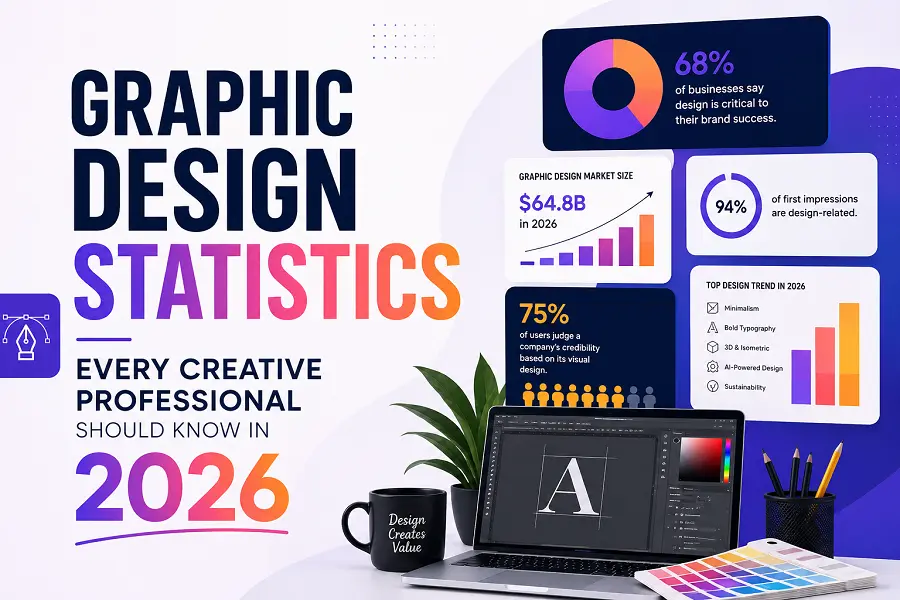
Visual landscapes are shifting rapidly as commercial demands and technological capabilities converge. Staying competitive requires a firm understanding of structural industry movements, software preferences, and economic realities. The following data-driven insights outline the current state of visual communication, helping agency leaders, freelancers, and corporate creators align their skills with market demand.
Market Valuation and Business Investment Shifts
The commercial footprint of visual assets expands as corporate entities view creative execution as an operational necessity rather than a variable expense.
-
Global Valuation Growth: The global graphic design sector is projected to reach $57.8 billion this year, driven by a compound annual growth rate that emphasizes digital platforms and interactive assets.
-
Budget Expansion: Approximately 47% of businesses report increasing their dedicated design budgets over the past twelve months, while 32% have maintained stable funding. Only 12% note financial pullbacks.
-
Operational Integration: Nine out of ten enterprises actively utilize professional graphic design workflows to support marketing campaigns, brand identity governance, and growth initiatives.
-
Financial Allocations: Over half of all purchasing entities commit between $1,000 and $15,000 annually to outsourced visual production, with 5% exceeding a $50,000 yearly investment.
-
Platform Dominance: Online collaborative systems hold a commanding 63.60% share of the digital production tool market, accommodating fast turnaround workflows for expanding teams.
Workflow Integration of Automated Systems
Algorithmic automation is fundamentally changing daily timelines, acting as an assistive mechanic rather than an outright replacement for human creative oversight.
-
System Adoption Rates: Nearly 88% of businesses use automated or predictive layout tools in some capacity, yet only 18% state that these integrations have minimized their long-term reliance on professional human staff.
-
Task Delegation Breakdown: Routine production tasks are shifting to automated programs. Forty-five percent of teams use automation for background removal or file editing, 36% utilize it for social media layouts, and 35% generate automated advertising variations.
-
Hiring Priorities: Creative execution and conceptual strategy remain the core criteria for talent acquisition, with 51% of hiring managers prioritizing creative innovation over speed or baseline affordability.
-
Skill Integration Shifts: Job listings demanding familiarity with automated production systems have surged to 32%, representing a significant upward movement from single-digit requirements in previous hiring cycles.
-
Efficiency Gains: Design professionals utilizing integrated software suites report saving an average of eight hours per complex project by using automated features to clear baseline administrative and layout tasks.
High-Income Verticals and Freelance Market Movements
Independent contract models and highly specialized design niches continue to command premium compensation rates across global industries.
The independent creator ecosystem now accounts for roughly 49% of the global design workforce. Flexibility and localized income control drive this preference, with 83% of independent contractors reporting higher satisfaction than their traditionally employed peers. Corporate entities are adapting to this structural change; 42% of businesses choose to outsource specialized creative projects rather than onboarding full-time personnel.
Specialization remains the most reliable path to financial mobility. UI/UX design tracks continue to command the highest industry returns, yielding average annual salaries ranging from $85,000 to $110,000 due to complex systemic demands. Senior design roles are also shifting toward interactive requirements, with 45% of advanced listings specifically mandating proficiency in motion graphics and kinetic typography. Meanwhile, traditional logo development and core brand identity systems remain an foundational anchor, commanding 31.35% of overall market revenue as organizations refresh asset kits to prevent audience fatigue.
Conclusion
The creative economy is experiencing a structural evolution defined by expanding operational budgets and specialized technical requirements. While automated tools handle low-tier production tasks, the demand for human ingenuity, strategic visual systems, and complex execution has never been more pronounced. Success requires balancing artistic talent with data fluency and modern software mastery.
Frequently Asked Questions
Which graphic design software programs hold the largest share of the current market?
Professional application ecosystems are led by traditional vector and raster platforms, holding a combined market share near 36%. Collaborative interface design software dominates digital product workflows with a 67% adoption rate, while browser-based platforms serve a rapidly growing user base looking for rapid templating.
How significantly do professional visual assets affect digital advertising metrics?
Visual execution is a primary driver of marketing success. Thirty-one percent of commercial entities state that graphic choices have the single largest impact on paid advertising performance, while 30% link design choices directly to social media engagement metrics.
What are the main visual style trends driving audience engagement this year?
The industry is experiencing a counter-movement against clinical, hyper-polished imagery. Current visual directions favor tactile 3D elements, highly expressive experimental typography, organic shapes, and intentional asymmetry that mimics analog print layout styles.
Is global employer demand for print design services growing or shrinking?
The marketplace continues to prioritize digital experiences over physical layouts. Traditional print production sectors face a projected multi-year decline of 1.5% annually, as spending redirects toward interactive mobile interfaces, digital ad sets, and augmented reality assets.
Why do organizations choose to outsource creative work over building in-house teams?
Outsourcing allows businesses to remain agile and reduce long-term structural overhead. Relying on freelance networks or specialized agencies lets companies access highly technical skills—such as complex 3D rendering or motion design—on an as-needed basis without paying full-time executive salaries.





Leave a Reply