

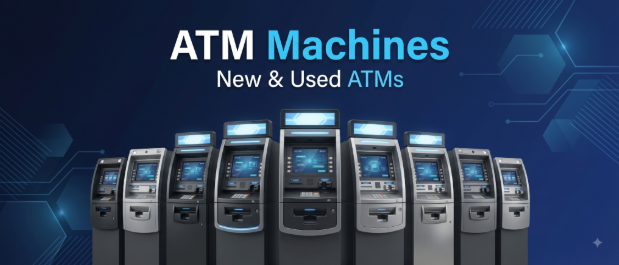
Access to cash remains important for customers who prefer physical currency for everyday purchases. Although digital payments have become increasingly common, automated teller machines (ATMs) continue to serve an important purpose in retail establishments, hospitality venues and other commercial environments. Installing an ATM can provide customers with convenient cash access while creating an additional service within a business. However, purchasing the right equipment requires careful consideration of location, functionality, security and ongoing operating costs. Businesses planning to buy ATM machine equipment should understand these factors before selecting a model.
Understanding the Different Types of ATM Machines
Standard Retail ATMs
Retail ATMs are commonly installed in convenience stores, restaurants, petrol stations and other customer-facing establishments.
These machines primarily provide cash withdrawals and may offer additional functions depending on their configuration and processing arrangements.
Through-the-Wall ATMs
These machines are designed for installation through an exterior wall, allowing customers to access the terminal without entering the building.
Their suitability depends on the building structure, installation requirements, security arrangements and available space.
Advanced Financial Institution ATMs
Banks and larger financial institutions may require machines with additional capabilities, higher transaction capacities or more complex configurations.
Five Important Factors to Evaluate Before Purchasing
1. Location and Customer Traffic
The installation location can influence how frequently an ATM is used.
Businesses should consider:
- Daily customer foot traffic.
- Availability of parking and convenient access.
- Visibility and lighting.
- Proximity to other cash access points.
- Security of the proposed installation area.
A machine positioned in a convenient, visible location may receive more customer use than one placed in an inaccessible area.
2. Hardware and Functional Requirements
Different ATM models offer different capabilities. Important specifications include screen design, card reader configuration, receipt printing, cash dispenser capacity and connectivity options.
For example, businesses comparing machines from Genmega and Hyosung should examine individual model specifications rather than assuming that every machine from the same manufacturer offers identical functionality.
The supplied product catalogue includes retail models such as the Genmega G2500, Genmega Onyx and Hyosung Halo 2, alongside higher-priced models such as the Hyosung MX5400 Hero and Genmega GT5000. It also lists certain pre-owned configurations.
3. Connectivity and Transaction Processing
An ATM requires a reliable connection to its processing network to communicate transaction information and receive authorisation.
Depending on the equipment and processor, connectivity may use a wired internet connection or an approved cellular modem.
Before purchasing, confirm that the machine is compatible with the intended processor and supported communication methods.
4. Security and Compliance
Security is one of the most important considerations in ATM ownership.
Relevant features and safeguards may include:
- EMV-compatible card reading.
- Secure PIN entry.
- Electronic locks and controlled physical access.
- Anti-skimming protection.
- Transaction monitoring.
- Appropriate software and security updates.
Payment industry requirements and processor rules should also be considered. Visa’s ATM risk guidance highlights transaction monitoring, due diligence and controls designed to identify suspicious activity.
5. Maintenance and Technical Support
ATM ownership involves ongoing maintenance. Components such as receipt printers, card readers, cash dispensers and communication equipment may require inspection or servicing.
Before purchasing, establish:
- Warranty coverage.
- Availability of replacement components.
- Technical support arrangements.
- Software update procedures.
Understanding the Total Cost of Ownership
The initial equipment price represents only one part of the overall investment.
Other expenses may include installation, processing services, communication charges, cash replenishment, insurance, maintenance and applicable transaction-related fees.
Businesses should also consider cash management requirements. The amount of money held in an ATM depends on its cassette configuration and expected withdrawal demand.
New Versus Used ATM Equipment
New machines may offer updated hardware, current manufacturer support and warranty coverage. However, they can involve a higher initial investment.
Used equipment may provide a lower-cost alternative, particularly for businesses testing demand or operating within a limited budget.
Before selecting pre-owned equipment, verify its condition, maintenance history, software compatibility and remaining support availability.
Conclusion
Purchasing an ATM is an operational decision that should reflect customer demand, available space, transaction requirements, and long-term maintenance considerations. Those researching where to buy ATM equipment can use the information and product categories provided by Best Products Sales & Service as a reference point when comparing available configurations. Businesses should compare hardware specifications, evaluate security features and understand processing arrangements before committing to a particular model.





Leave a Reply