


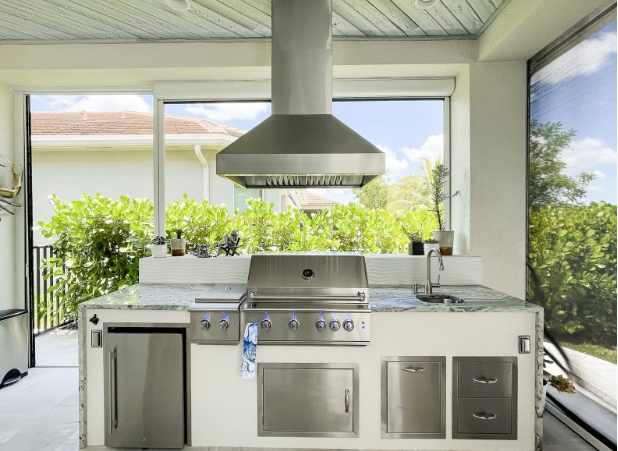
Kitchen islands often serve as central cooking and preparation areas, particularly in open-plan homes where the cooking surface is positioned away from surrounding walls. This arrangement creates a different ventilation challenge because smoke, steam, and cooking odors can spread in multiple directions. A properly selected 36-inch island range hoods capture these emissions before they travel throughout the room. Understanding dimensions, airflow requirements, installation height, and maintenance needs is important when planning ventilation above an island cooktop.
Understanding the Purpose of Island Ventilation
Unlike wall-mounted appliances, island ventilation systems are suspended from the ceiling above a freestanding cooking surface. Their position allows them to capture airborne emissions rising directly from the cooktop.
However, the absence of nearby walls means smoke can escape from the sides more easily. This makes canopy dimensions and airflow capacity particularly important.
36-inch island range hoods are generally intended for cooking surfaces of similar width. Their dimensions provide a capture area over the burners while maintaining a balanced appearance within the kitchen layout.
The correct size should be determined by measuring the actual cooking appliance rather than estimating based on the island countertop alone.
Why Hood Width and Capture Area Matter
The capture area refers to the space beneath the canopy where smoke and grease are collected before entering the ventilation system.
An adequately sized canopy helps contain rising cooking emissions. If the ventilation unit is narrower than the cooktop, smoke produced by burners near the edges may escape before reaching the filters.
For this reason, 36-inch island range hoods are commonly considered for cooktops measuring approximately 36 inches across.
Kitchen ceiling height and the distance between the cooktop and canopy also influence capture effectiveness. A unit installed too high may allow smoke to disperse, while incorrect positioning can interfere with safe cooking clearances.
Choosing the Right CFM Capacity
Airflow capacity is measured in cubic feet per minute, or CFM. It indicates the volume of air a ventilation system can move in one minute.
The required capacity depends on cooking intensity, appliance output, and the ventilation layout.
The referenced collection includes models with capacities ranging from approximately 550–600 CFM for moderate cooking to higher-output options reaching 900–1,800 CFM.
Moderate Cooking Requirements
Homeowners who primarily prepare meals using standard burners may not require the highest available airflow capacity. A moderate-output model can be suitable when cooking produces limited smoke and heat.
High-Heat Cooking
Frequent frying, searing, wok cooking, and high-output gas burners generate more airborne emissions. Higher CFM capacity may be necessary to capture these emissions effectively.
The collection also identifies a 36-inch model with a 1,200 CFM configuration and 304 stainless steel construction.
Nevertheless, airflow should not be selected based on CFM alone. Duct resistance, duct diameter, installation quality, and the surrounding kitchen’s air supply influence actual performance.
Understanding Ducted Ventilation
Ducted systems carry contaminated air outside through a connected ventilation route. This method removes smoke, moisture, grease particles, and odors from the building rather than returning filtered air to the kitchen.
For island installations, ductwork generally passes through the ceiling and connects to an exterior exhaust point.
The design should minimize unnecessary bends and restrictions because these can reduce effective airflow. Duct dimensions must also follow the appliance manufacturer’s specifications.
Before installing 36-inch island range hoods, homeowners should confirm whether the ceiling structure can accommodate the required ductwork and mounting support.
Ductless configurations may be available on certain ventilation models, but compatibility must be verified individually. These systems use filters to remove some airborne particles before returning air to the room. They do not provide the same moisture and heat removal as an effective ducted exhaust.
Material Selection and Construction
Stainless steel is frequently used in kitchen ventilation because it offers durability and a surface that is relatively straightforward to clean.
Grade 304 stainless steel is particularly valued for its corrosion resistance. It is suitable for many residential kitchen environments where the appliance is regularly exposed to moisture and cooking residues.
The referenced collection includes stainless steel models with different airflow configurations and finishes. Buyers should examine the specifications of the exact model rather than assuming every unit has identical construction.
Filters, Lighting, and Controls
Filters are responsible for capturing grease before it enters the internal blower and ductwork. Metal baffle filters and other washable filter designs can simplify routine maintenance.
Lighting is another practical consideration because an island ventilation system can also illuminate the cooking surface. LED lighting provides focused visibility while generally consuming less electricity than traditional lighting technologies.
Variable-speed controls allow users to adjust ventilation according to cooking activity. Lower settings may be suitable for simmering, while higher settings can support smoke-heavy cooking.
Installation and Maintenance Requirements
Ceiling-mounted ventilation systems require secure structural support. The mounting arrangement must account for the appliance’s weight and the loads associated with normal operation.
Professional installation is recommended when ceiling reinforcement, electrical work, or complex duct routing is involved. Installation height should follow the manufacturer’s guidelines.
Filters should be cleaned regularly to prevent grease accumulation. External surfaces, lighting components, and controls should also be inspected during routine maintenance.
Conclusion
Island ventilation requires careful coordination between appliance dimensions, airflow capacity, duct design, and mounting arrangements. Evaluating these factors helps homeowners select equipment that suits their cooking habits and kitchen layout. Comparing available range hoods by their construction, filtration, and ventilation specifications provides a useful starting point for understanding different configurations.











Leave a Reply