


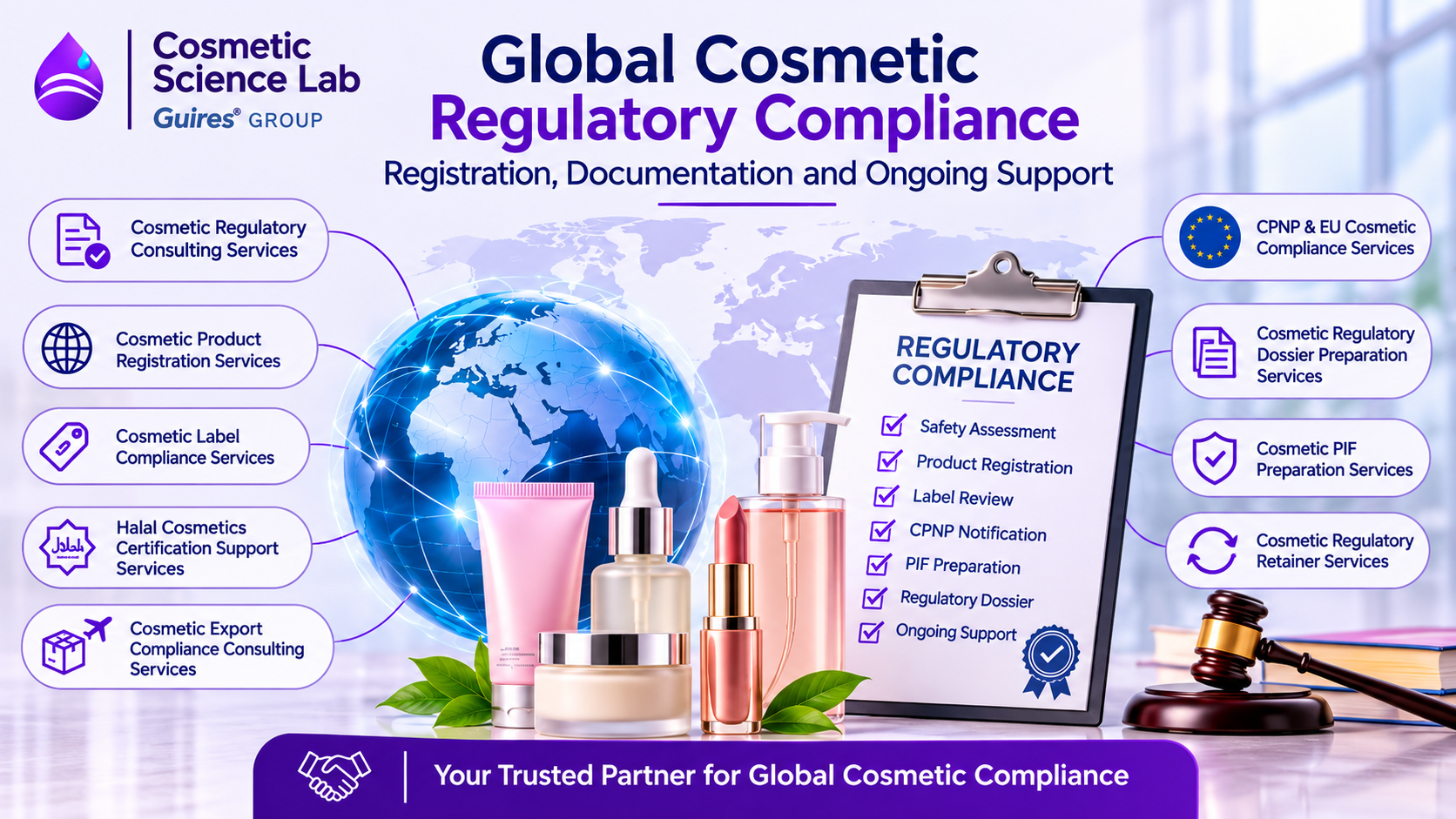
The global cosmetics industry is growing rapidly, creating opportunities for skincare, haircare, personal care and beauty brands to enter international markets. However, launching cosmetic products across different countries requires more than product formulation and manufacturing. Businesses must meet market-specific regulatory requirements, complete safety documentation, verify product claims and ensure accurate product labelling.
Working with experienced cosmetic regulatory consulting services helps manufacturers, brand owners and distributors understand these requirements before launching their products. From ingredient assessments and product registration to safety documentation and export compliance, regulatory support helps businesses reduce delays and manage compliance throughout the product lifecycle.
Guires Cosmetic Science Lab (CSL) provides global regulatory support for cosmetic brands targeting markets including the European Union, United Kingdom, United States, India, Canada, GCC, ASEAN and Australia. Its regulatory specialists support product documentation, safety assessments, market notifications, label reviews and ongoing compliance management.
Why Do Cosmetic Brands Need Regulatory Consulting Services?
Every country has its own cosmetic regulations, ingredient restrictions, labelling requirements and product notification procedures. A formulation that meets the requirements in one country may require additional documentation or modifications before entering another market.
Professional cosmetic regulatory consulting services help businesses identify regulatory gaps before commercial launch.
Common regulatory challenges include:
- Understanding ingredient restrictions and permitted concentrations.
- Preparing product safety assessments and technical documentation.
- Completing cosmetic product registration and notification.
- Reviewing INCI ingredient lists and product labels.
- Substantiating cosmetic claims with appropriate evidence.
- Preparing export documentation and market-specific regulatory files.
- Managing regulatory updates and product formulation changes.
A structured regulatory strategy allows brands to plan international launches while maintaining product safety and regulatory compliance.
- Cosmetic Regulatory Consultant India: Understanding Indian Requirements
India has a defined regulatory framework for cosmetic manufacturing and imports under the Drugs and Cosmetics Act, 1940 and Cosmetics Rules, 2020.
Working with a cosmetic regulatory consultant india helps cosmetic manufacturers and international brands understand the requirements for importing, manufacturing and distributing cosmetic products in India.
The Central Drugs Standard Control Organization (CDSCO) regulates cosmetic imports, while manufacturing licensing is managed by the respective State Licensing Authorities.
Typical regulatory support includes:
- Reviewing cosmetic product formulations and ingredient documentation.
- Supporting import registration applications.
- Coordinating required product and manufacturing-site information.
- Reviewing packaging and labelling requirements.
- Supporting manufacturing licence documentation.
- Responding to regulatory queries and documentation gaps.
For imported cosmetic products, registration requirements must be assessed before products enter the Indian market.
Explore CSL’s Cosmetic Regulatory Services in India for market-specific regulatory support.
- Cosmetic Product Registration Services for International Markets
Entering international markets requires businesses to understand the regulatory pathway applicable to each destination.
Professional cosmetic product registration services help manufacturers prepare the necessary technical documents, product details, safety information and notification submissions.
Different countries follow different regulatory procedures.
| Market | Regulatory framework / requirement |
| European Union | Regulation (EC) No 1223/2009 and CPNP notification |
| United Kingdom | UK Cosmetics Regulation and SCPN notification |
| United States | MoCRA facility registration and cosmetic product listing, where applicable |
| India | CDSCO cosmetic import registration and manufacturing licensing |
| Canada | Cosmetic Notification Form and ingredient compliance |
| GCC | Applicable GSO requirements and country-specific registration |
| ASEAN | ASEAN Cosmetic Directive and country notification requirements |
| Australia | AICIS requirements for applicable industrial chemicals |
Registration and notification are not identical processes. Requirements depend on the product category, ingredients, intended claims and destination market.
- Cosmetic Label Compliance Services for Product Launches
Cosmetic labels communicate essential information about a product, including its ingredients, purpose, directions for use, warnings and responsible business details.
Incorrect or incomplete labelling can lead to regulatory concerns, product relabelling and delays in market entry.
Cosmetic label compliance services help brands review packaging artwork and product information against applicable market requirements.
Important label elements include:
- Product name and intended function.
- INCI ingredient declaration.
- Net contents and batch identification.
- Manufacturer, importer or Responsible Person details, where required.
- Product warnings and directions for use.
- Shelf-life or period-after-opening information, where applicable.
- Required local-language information.
- Fragrance allergen declarations, where applicable.
- Cosmetic claims and supporting evidence.
For example, EU cosmetic labels must meet the applicable requirements of Regulation (EC) No 1223/2009, while US cosmetic labels must comply with the relevant FDA labelling requirements.
A market-specific label review before printing can help prevent costly packaging corrections.
- Halal Cosmetics Certification Support Services
Halal cosmetics are becoming an important product category for brands targeting Muslim consumers and markets where halal requirements are relevant.
However, halal compliance involves more than avoiding certain ingredients. Brands may need to assess raw materials, ingredient sources, manufacturing processes, storage, handling and contamination controls.
Halal cosmetics certification support services help manufacturers prepare for the certification process by reviewing product and manufacturing documentation.
Typical support includes:
- Reviewing ingredient origins and raw-material specifications.
- Identifying ingredients that require additional verification.
- Assessing processing aids and manufacturing inputs.
- Reviewing supplier declarations and supporting documents.
- Evaluating manufacturing and handling procedures.
- Coordinating documentation for the relevant certification body.
Halal certification requirements vary by market and certification authority. Brands should identify the appropriate certification scheme before making halal claims on product packaging.
CSL supports halal certification requirements as part of its wider GCC and international regulatory support.
- Cosmetic Export Compliance Consulting Services
Exporting cosmetic products involves more than preparing commercial invoices and shipping documents. Businesses must also understand the destination country’s regulatory requirements.
Cosmetic export compliance consulting services help manufacturers prepare product documentation, regulatory files, registration information and market-specific labelling before shipment.
Export preparation may involve:
- Checking ingredient restrictions in the destination market.
- Reviewing product classification and cosmetic claims.
- Preparing Free Sale Certificates where required.
- Organising product safety and technical documentation.
- Checking country-specific registration requirements.
- Reviewing packaging and local-language declarations.
- Coordinating with importers and local regulatory representatives.
A well-prepared export compliance strategy helps brands avoid documentation gaps and unexpected market-entry delays.
- CPNP & EU Cosmetic Compliance Services
The European Union has a harmonised regulatory framework for cosmetic products under Regulation (EC) No 1223/2009.
Before a cosmetic product is placed on the EU market, businesses must meet the applicable safety, documentation, labelling and notification requirements.
Professional CPNP & EU cosmetic compliance services help brands prepare for these obligations.
Key requirements include:
EU Responsible Person: Every cosmetic product placed on the EU market must have a Responsible Person established within the EU.
Cosmetic Product Safety Report (CPSR): The product requires a safety assessment consisting of Part A and Part B.
Product Information File (PIF): The Responsible Person must maintain the required product documentation and make it available to competent authorities.
CPNP Notification: Product information must be submitted through the Cosmetic Products Notification Portal before the product is placed on the market.
Label and Claims Review: Product labels, ingredient declarations, warnings and cosmetic claims must comply with applicable requirements.
It is important to understand that CPNP is a notification portal, not an EU product approval or certification programme.
CSL supports EU Responsible Person arrangements, safety reports, PIF documentation, CPNP notifications and post-launch regulatory requirements.
Explore CSL’s EU Cosmetic Regulatory Services.
- Cosmetic Regulatory Dossier Preparation Services
Regulatory dossiers provide the technical and safety information needed to demonstrate that cosmetic products meet applicable market requirements.
Cosmetic regulatory dossier preparation services help brands organise the information required for regulatory submissions, market notifications and compliance assessments.
A regulatory dossier may include:
- Product composition and formulation details.
- Raw-material specifications.
- Ingredient safety information.
- Product manufacturing information.
- Stability and microbiological test reports.
- Product safety assessments.
- Packaging specifications.
- Product labels and claims evidence.
- Manufacturing quality documentation.
The required documents differ between markets. Therefore, regulatory documentation should be prepared according to the destination country’s requirements rather than using one identical file for every market.
- Cosmetic PIF Preparation Services
The Product Information File (PIF) is an important regulatory document for cosmetic products marketed in the European Union.
Reliable cosmetic PIF preparation services help brands compile and maintain the technical information required under EU cosmetic legislation.
The EU PIF generally includes:
- A description of the cosmetic product.
- The Cosmetic Product Safety Report (CPSR).
- A description of the manufacturing method and a statement of compliance with Good Manufacturing Practice.
- Evidence supporting the claimed effects of the cosmetic product, where justified.
- Data on animal testing where required under the Regulation.
The PIF must be readily accessible to the relevant competent authorities at the Responsible Person’s address and retained for the prescribed period.
CSL supports PIF compilation, safety documentation, regulatory review and file maintenance for cosmetic brands entering the EU market.
- Cosmetic Regulatory Retainer Services for Ongoing Compliance
Regulatory compliance does not end when a cosmetic product enters the market. Ingredient restrictions, labelling requirements, safety documentation and market regulations may change over time.
Cosmetic regulatory retainer services provide ongoing support to help brands manage their regulatory responsibilities across multiple products and markets.
A regulatory retainer can include:
- Regulatory monitoring: Updates on ingredient restrictions and relevant regulatory changes.
- Label reviews: Compliance checks for new products, shades and packaging variations before printing.
- PIF maintenance: Updating product safety files when formulations or suppliers change.
- Export documentation: Supporting Free Sale Certificates and other required export documents.
- Regulatory assistance: Access to a designated specialist for ongoing compliance questions.
- Post-market support: Assistance with authority requests, safety concerns and relevant product updates.
An ongoing regulatory relationship helps businesses manage their product portfolio without treating every compliance update as a completely new project.
- Choosing a Global Cosmetic Compliance Consulting Company
Cosmetic brands entering multiple international markets need a regulatory partner that understands differences between regional requirements.
A reliable global cosmetic compliance consulting company should provide more than individual registration assistance. It should help connect formulation information, product testing, safety assessments, technical documentation and regulatory requirements.
Before selecting a regulatory partner, consider:
- Experience with multiple international cosmetic markets.
- Knowledge of ingredient restrictions and safety requirements.
- Expertise in PIF, CPSR and regulatory dossier preparation.
- Support for CPNP, SCPN and relevant market notifications.
- Cosmetic labelling and claims review capabilities.
- Access to relevant testing and technical expertise.
- Ongoing compliance monitoring and retainer support.
Guires Cosmetic Science Lab brings formulation, testing and regulatory expertise together to support cosmetic brands throughout product development and international market entry.
Global Regulatory Support from Guires Cosmetic Science Lab
Managing cosmetic compliance across multiple countries can become challenging when documentation, ingredient requirements, product labels and registration processes differ between markets.
Guires Cosmetic Science Lab provides integrated regulatory support to cosmetic manufacturers, private-label brands, distributors and international businesses.
Its regulatory services cover:
- EU Responsible Person services, CPSR, PIF and CPNP notifications.
- UK Responsible Person, safety documentation and SCPN notifications.
- US MoCRA facility registration and product listing support.
- Indian cosmetic import registration and manufacturing licence support.
- GCC and UAE cosmetic registration and export documentation.
- ASEAN cosmetic notifications and Product Information Files.
- Halal certification coordination and documentation support.
- Cosmetic label reviews and ongoing regulatory monitoring.
For markets beyond its core regions, CSL works with in-country regulatory partners to support market-specific documentation and compliance requirements.
Its regulatory work is supported by a documented ISO 9001 quality management system, with technical reports and supporting evidence maintained through the project process.
How Can Cosmetic Brands Get Started?
A structured regulatory process helps businesses understand what is required before launching a product internationally.
Step 1: Share your product details.
Provide the formulation, ingredient list, product category, packaging details and intended claims.
Step 2: Identify your target markets.
Specify the countries where you intend to manufacture, register, distribute or export your cosmetic products.
Step 3: Complete a regulatory gap assessment.
Review the applicable ingredient, safety, testing, labelling and documentation requirements.
Step 4: Prepare the required documents.
Coordinate product registration or notification, safety reports, PIF, regulatory dossiers and label reviews.
Step 5: Maintain ongoing compliance.
Monitor regulatory changes and update the relevant files when formulations, suppliers, packaging or market requirements change.
Conclusion
Global cosmetic market entry requires careful planning, accurate product documentation and compliance with country-specific regulations. From Indian cosmetic import registration to EU CPNP notifications and international export documentation, each market requires a different regulatory approach.
Choosing professional cosmetic regulatory support helps brands manage documentation, safety assessments, product labels and ongoing compliance more effectively.
Guires Cosmetic Science Lab supports cosmetic manufacturers and beauty brands with regulatory expertise across multiple international markets. With integrated formulation, testing and regulatory capabilities, CSL helps businesses prepare their products for compliant global expansion.
Ready to expand your cosmetic brand into international markets?
Explore Global Regulatory & Retainers at Guires Cosmetic Science Lab and discuss your product, target markets and regulatory requirements with the team.
Frequently Asked Questions
- What are cosmetic regulatory consulting services?
Cosmetic regulatory consulting services help manufacturers and beauty brands understand market regulations, prepare safety documentation, complete product registration or notification, review labels and maintain ongoing compliance.
- Why do cosmetic brands need a regulatory consultant in India?
A cosmetic regulatory consultant in India helps brands understand CDSCO import registration, applicable manufacturing licence requirements, ingredient standards and product labelling obligations.
- What documents are required for cosmetic product registration?
Documents may include formulation details, ingredient specifications, manufacturing information, safety reports, product labels, certificates and other market-specific technical information.
- What is a Cosmetic Product Information File (PIF)?
A PIF is a technical document maintained for cosmetic products marketed in the EU. It contains product information, safety assessment documentation, manufacturing information and supporting claims evidence.
- Is CPNP notification the same as EU cosmetic approval?
No. CPNP is the Cosmetic Products Notification Portal used to submit product information before placing cosmetics on the EU market. Notification does not represent product approval or certification.
- Do cosmetic products require halal certification for export?
Halal certification requirements depend on the destination market, applicable rules and certification scheme. Brands should verify the relevant requirements before making halal claims.
- What are cosmetic regulatory retainer services?
Regulatory retainer services provide ongoing support such as regulatory updates, label reviews, PIF maintenance, export documentation and access to a regulatory specialist.
- Can one regulatory dossier be used for every country?
Not always. Some technical information can be reused, but individual countries may require different application formats, safety documents, labels and registrations.
- What is the difference between cosmetic registration and notification?
Registration generally involves submitting an application to the relevant regulatory authority under a specified process. Notification involves providing required product information to the designated authority or portal. The legal effect differs by country.
- How does Guires Cosmetic Science Lab support global cosmetic compliance?
Guires Cosmetic Science Lab supports market-specific regulatory assessments, safety documentation, PIF preparation, product registration, notifications, label reviews, export documentation and ongoing compliance management.










Leave a Reply