


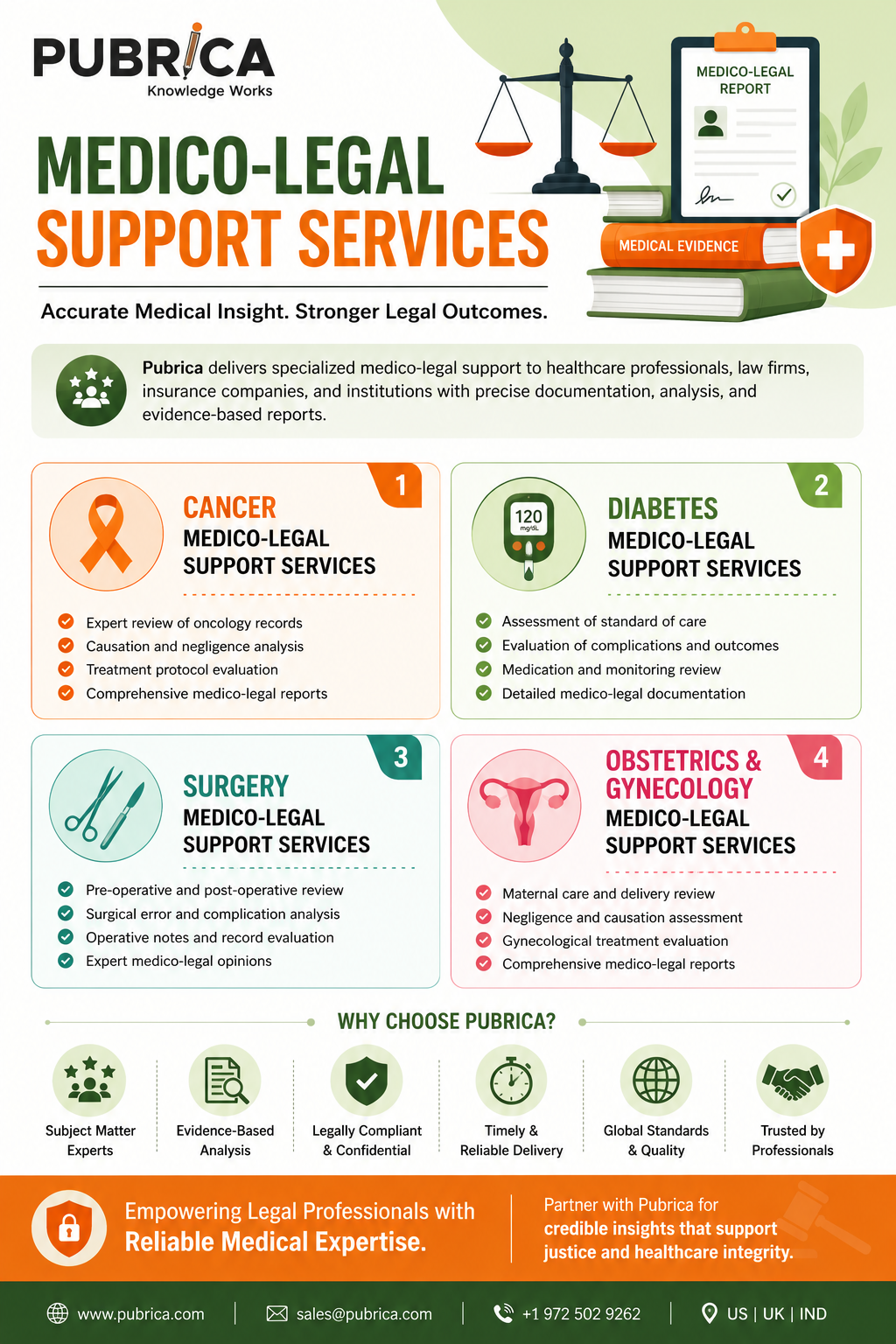
Pubrica offers trusted medico-legal consulting and expert review services, helping healthcare professionals with accurate medical assessments, clinical documentation, and evidence-based reports. Our specialized Medico-Legal Support Services help researchers, healthcare professionals, legal teams, and institutions address complex medical and legal requirements.
Pubrica Academy
Written by the medical writing and biostatistics teams
Table of Contents
- Medico-Legal Medicine
- Types of Medico-Legal Cases
- Role and Responsibilities of the Medico-Legal Expert
- Documentation and Report Writing in Medico-Legal Cases
- Forensic Procedures and Evidence Collection
- Legal and Ethical Considerations in Medico-Legal Work
- Specialized Medico-Legal Support Services
- Conclusion
1. Medico-Legal Medicine
Medico-legal medicine combines medical knowledge with legal principles to support criminal investigations, legal proceedings, injury assessments, medical negligence evaluations, and insurance claims. It requires accuracy, impartiality, confidentiality, and professional ethics because medical reports and expert opinions can serve as important evidence in legal proceedings.
Medico-legal professionals interpret clinical findings, review medical records, assess treatment outcomes, and prepare reports that meet relevant legal requirements. Their expertise helps healthcare professionals and legal authorities understand complex medical information.
Key principles of medico-legal medicine include:
- Medical Expertise: Applying clinical knowledge to evaluate medical conditions and treatment outcomes.
- Objectivity and Impartiality: Providing unbiased medical assessments based on available evidence.
- Accurate Documentation: Preparing clear and comprehensive reports for legal review.
- Professional Ethics: Maintaining confidentiality and following applicable professional standards.
2. Types of Medico-Legal Cases
Healthcare professionals encounter different cases that require specialized medico-legal expertise. These may involve medical negligence, personal injuries, surgical complications, chronic diseases, and treatment-related disputes.
Cancer-Related Medico-Legal Cases
Cancer treatment often involves complex diagnosis, chemotherapy, radiotherapy, surgery, and long-term patient management. Medical disputes may arise from delayed diagnosis, treatment complications, inadequate clinical documentation, or questions about the standard of care.
Cancer Medico-Legal Support Services help with reviewing oncology records, evaluating diagnostic procedures, assessing treatment decisions, and examining possible medical negligence. Expert medical analysis can support the preparation of accurate reports for cancer-related legal cases.
Diabetes-Related Medico-Legal Cases
Diabetes management requires continuous monitoring, medication management, lifestyle interventions, and regular clinical assessments. Complications such as diabetic neuropathy, kidney disease, and cardiovascular conditions may lead to disputes involving diagnosis, treatment, and patient care.
Diabetes Medico-Legal Support Services involve reviewing diabetes-related medical records, assessing treatment plans, examining complications, and evaluating whether appropriate clinical care was provided. These assessments help clarify medical evidence in disputes involving diabetes management.
Surgery-Related Medico-Legal Cases
Surgical procedures require appropriate preoperative assessment, informed consent, surgical planning, and postoperative monitoring. Medico-legal disputes may arise from surgical errors, complications, delayed intervention, or concerns regarding postoperative care.
Surgery Medico-Legal Support Services focus on reviewing operative notes, evaluating surgical procedures, examining postoperative complications, and assessing whether the treatment provided followed accepted clinical standards. These reviews help organize relevant medical evidence for legal evaluation.
Obstetrics and Gynecology-Related Medico-Legal Cases
Obstetrics and gynecology cases may involve pregnancy complications, childbirth injuries, maternal care, fertility treatments, and gynecological procedures. Medical disputes can arise from delayed intervention, inadequate monitoring, complications during delivery, or concerns about clinical decision-making.
Obstetrics and Gynecology Medico-Legal Support Services help review maternal and gynecological medical records, assess pregnancy and delivery management, evaluate complications, and examine clinical documentation. These services support objective medical assessments in complex women’s healthcare-related legal matters.
Other common medico-legal case categories include:
| Case Type | Examples | Key Considerations |
|---|---|---|
| Criminal | Assault, homicide, sexual assault | Injury assessment and forensic evidence |
| Civil | Medical negligence and personal injury | Causation and compensation assessment |
| Occupational | Workplace accidents and exposure-related diseases | Fitness for duty and exposure documentation |
| Mental Health | Competency and criminal responsibility | Psychiatric evaluation and risk assessment |
| Insurance | Disability and compensation claims | Functional assessment and medical evidence |
3. Role and Responsibilities of the Medico-Legal Expert
Medico-legal experts play an important role in legal proceedings involving healthcare and medical matters. They apply their clinical knowledge to interpret medical evidence and provide objective professional opinions.
Their responsibilities include:
- Conducting physical examinations and psychiatric evaluations.
- Reviewing medical records and clinical documentation.
- Collecting and preserving biological and physical evidence.
- Preparing comprehensive medico-legal reports.
- Providing expert opinions for legal proceedings.
- Supporting law enforcement agencies, legal authorities, and insurance organizations.
Medical record review is particularly important because it helps identify relevant clinical information, treatment timelines, diagnostic findings, and possible gaps in documentation.
4. Documentation and Report Writing in Medico-Legal Cases
Accurate documentation is essential for effective medico-legal case evaluation. Reports should be clear, factual, chronological, and supported by available medical evidence.
Important components of a medico-legal report include:
- Patient Information: Relevant demographic and clinical details.
- Case Summary: Date, location, and description of the incident.
- Clinical Findings: Detailed examination findings and injury descriptions.
- Investigation Results: Laboratory tests, imaging, and other diagnostic findings.
- Medical Opinion: Evidence-based assessment of causation, prognosis, and severity.
- Signature and Date: Appropriate professional authentication.
Well-organized documentation helps legal professionals understand medical findings and evaluate the evidence presented.
5. Forensic Procedures and Evidence Collection
Forensic procedures support medico-legal investigations by ensuring that relevant evidence is collected, preserved, and documented appropriately.
Common types of forensic evidence include:
- Biological Evidence: Blood, hair, and saliva.
- Physical Evidence: Clothing, weapons, and personal belongings.
- Chemical Evidence: Toxic substances and drugs.
- Post-Mortem Evidence: Findings used to assess the cause and manner of death.
Maintaining the chain of custody is essential to protect evidence integrity throughout collection, transportation, storage, and analysis.
6. Legal and Ethical Considerations in Medico-Legal Work
Medico-legal professionals must follow appropriate legal and ethical standards when reviewing medical evidence and preparing reports.
Important considerations include:
- Maintaining patient confidentiality unless disclosure is legally required.
- Providing objective and evidence-based medical opinions.
- Avoiding conclusions beyond professional qualifications and expertise.
- Following relevant laws, forensic guidelines, and professional standards.
- Ensuring accuracy and transparency in medical documentation.
In medical negligence and malpractice cases, these principles help maintain the credibility and reliability of expert assessments.
7. Specialized Medico-Legal Support Services
Different medical specialties require specific clinical knowledge and documentation expertise. Specialized medico-legal support helps evaluate complex medical cases by considering relevant treatment procedures, clinical findings, and patient outcomes.
Pubrica provides specialized support across several medical areas, including:
Cancer Medico-Legal Support Services: Support for oncology record reviews, cancer diagnosis assessments, treatment evaluations, and medical negligence analysis.
Diabetes Medico-Legal Support Services: Support for diabetes treatment reviews, medication assessments, complication evaluations, and clinical documentation analysis.
Surgery Medico-Legal Support Services: Support for surgical record reviews, operative procedure assessments, postoperative complication analysis, and medical evidence evaluation.
Obstetrics and Gynecology Medico-Legal Support Services: Support for maternal care reviews, pregnancy-related complications, delivery assessments, and gynecological treatment documentation.
Explore Pubrica’s Medico-Legal Support Services for specialized medical review, clinical documentation, and expert medico-legal assistance.
8. Conclusion
Medico-legal expertise brings together clinical knowledge, forensic procedures, and legal principles to support accurate medical assessments and reliable documentation. From cancer and diabetes-related disputes to surgical complications and obstetrics and gynecology cases, specialized medical knowledge plays an important role in understanding complex healthcare-related legal matters.
Accurate record reviews, objective medical opinions, evidence preservation, and ethical reporting help strengthen the quality of medico-legal evaluations. Organizations and healthcare professionals can benefit from expert support when handling complex medical documentation and legal case assessments.
Need Expert Support for Medico-Legal Case Evaluation?
Pubrica provides specialized medical analysis, clinical documentation review, and expert guidance for complex medico-legal matters.
Explore Medico-Legal Support Services
References
- Simpson K. (1974). A Practical Medico-Legal Guide for the Physician. Proceedings of the Royal Society of Medicine, 67(7), 693.
- Naveen, S., & Kumar, M. V. (2013). Preparing medico legal report in clinical practice. The Indian Journal of Surgery, 75(1), 47–49.
- Madadin, M., et al. (2021). Characteristics of Medico-Legal Cases and Errors in Medico-Legal Reports at a Teaching Hospital in Saudi Arabia. Open Access Emergency Medicine, 13, 521–526.
- Tobin-Tyler, E., & Teitelbaum, J. B. (2019). Medical-Legal Partnership: A Powerful Tool for Public Health and Health Justice. Public Health Reports, 134(2), 201–205.
- Tenny S, Varacallo MA. Evidence-Based Medicine. StatPearls, 2025.
- Higley, L., et al. (2025). Make forensic case reports required legal and scientific documents. Proceedings of the National Academy of Sciences, 122(26).
- Yip, C., Han, N. R., & Sng, B. L. (2016). Legal and ethical issues in research. Indian Journal of Anaesthesia, 60(9), 684–688.











Leave a Reply