


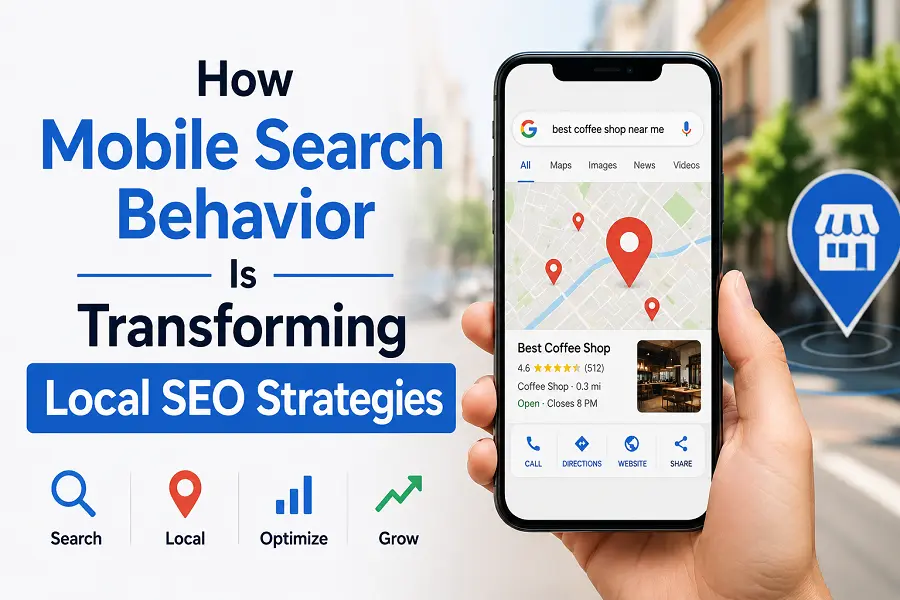
The intersection of physical location and digital discovery has reached a critical turning point. Neighborhood commerce no longer depends on consumers researching businesses from a desktop computer before leaving the house. Instead, the modern purchasing journey unfolds on smartphone screens while individuals are actively on the move, walking down high streets, or sitting in traffic.
This shift toward real-time, on-the-go exploration fundamentally alters how search engines evaluate regional relevance. Algorithms now prioritize hyper-local proximity and real-world behavioral signals over traditional on-page text optimization. To sustain visibility, local businesses must transition from static directory management to an agile framework designed specifically for immediate, mobile-first micro-moments.
The Shift from Explicit Typed Phrases to Implicit Spatial Intent
Mobile users have abandoned rigid, formal search language. The widespread adoption of location tracking services means that consumers expect search engines to automatically understand their geographical context without being explicitly told.
-
The Decline of City-Specific Modifiers: Searchers rarely append exact zip codes or city names to their mobile queries anymore. Phrases like “plumber near me” or simply “emergency plumbing” rely entirely on the device’s live coordinates to populate the results.
-
Hyper-Localized Proximity Radiuses: Mobile algorithms have shrunk the visible geographic boundaries for service recommendations. A listing that easily commanded attention city-wide may now find its organic reach focused strictly on a two-mile micro-market or specific neighborhood district.
-
The Immediacy of “Open Now” Filters: Smartphone users frequently filter results by real-time operational availability. If a physical profile lacks explicitly updated seasonal hours or holiday schedules, it is instantly hidden from consumers seeking immediate service.
-
Visual Street-Level Inquiries: Through advanced camera-based tools like Google Lens, pedestrians can point their smartphone cameras at a storefront to pull up ratings, busy times, and menus without typing a single character.
Actionable Operational Workflows for Mobile SEO Dominance
Succeeding in a mobile-dominated search ecosystem requires moving past standard website optimization. Local brands must engineer an effortless digital interface that quickly converts smartphone views into physical store visits or concrete service inquiries.
-
Prioritize Mobile Navigation and Layout Speeds: Ensure your primary landing pages feature rapid loading times and large, easily clickable buttons. Complex navigation menus, intrusive pop-up windows, and slow-loading graphics cause immediate user abandonment on mobile connections.
-
Optimize for Direct Map Pack Actions: Since a vast majority of mobile local searches result in zero-click answers, your Google Business Profile must be built for immediate interaction. Focus on driving actions like direction requests and real-time messaging directly from the map interface.
-
Build Granular Micro-Location Landing Pages: If your business operates across multiple neighborhoods, create unique, dedicated pages for each zone. Avoid copy-and-paste text; instead, feature authentic local customer reviews, specific landmark references, and hyper-targeted geographic imagery.
-
Deploy Event-Driven Local Structured Schema: Embed precise local business microdata into your website’s HTML backend. This explicit coding directly informs automated search crawlers about your exact spatial coordinates, booking links, and service parameters.
Understanding Shifting Conversion Paths and AI Local Packs
The layout of mobile search result pages continues to evolve as generative answer models compress traditional real estate. AI-driven local summaries often consolidate information, presenting only one or two highly vetted business recommendations rather than the standard three-pack list.
Interestingly, mobile engagement tracking shows a steady evolution in how people take action. While direct phone calls from listings have experienced a slight decline, driving direction requests and immediate online appointment bookings have climbed significantly. Mobile consumers are skipping the introductory phone call and moving directly from discovery to immediate, physical intent. Businesses must ensure their profiles feature flawless mapping coordinates and clear, friction-free scheduling paths to capture these high-velocity conversions.
Conclusion
Mobile search behavior has successfully transformed local SEO from a game of keyword matching into a battle for real-world trust and hyper-local convenience. Winning this space requires maintaining absolute data consistency across all map networks, optimizing for lightning-fast mobile actions, and embracing visual and AI discovery methods. Senders who align their digital footprint with how people naturally navigate the physical world will continue to secure the highest volume of localized consumer leads.
FAQs
How does mobile search behavior differ fundamentally from desktop search?
Desktop searches are often exploratory, broad, and research-focused. Mobile searches, by contrast, are driven by immediate situational needs, carrying much higher transactional intent and a strict focus on nearby physical availability.
Why are driving direction requests becoming more important than phone calls?
Mobile consumers are increasingly making rapid, frictionless decisions. Instead of calling a storefront to confirm details, they check live profile attributes and immediately request navigation routes to visit the business in person.
Can a slow website damage my local map rankings?
Yes. Google utilizes mobile-first indexing and tracks user experience metrics closely. If mobile users repeatedly click away from your slow website back to the map results, it signals a poor experience, causing your listing visibility to drop.
What are AI local packs and how do they impact mobile SEO?
AI local packs are generative summaries that appear at the top of mobile search pages. They extract information from multiple local sources to recommend a narrowed selection of businesses, making profile accuracy and rich customer reviews more critical than ever.
How do I optimize my brick-and-mortar storefront for visual search?
Upload high-resolution, clear exterior photos of your building, street-facing signage, and interior layout to your business profiles. This helps visual search tools accurately recognize your business entity when users photograph your shopfront.





Leave a Reply